
Yellow and Champagne Diamonds: Warm Colour on a Budget
A yellow diamond ring or a champagne stone can cost less than a white diamond of the same size, or far more. How the colour scale works and where value is.
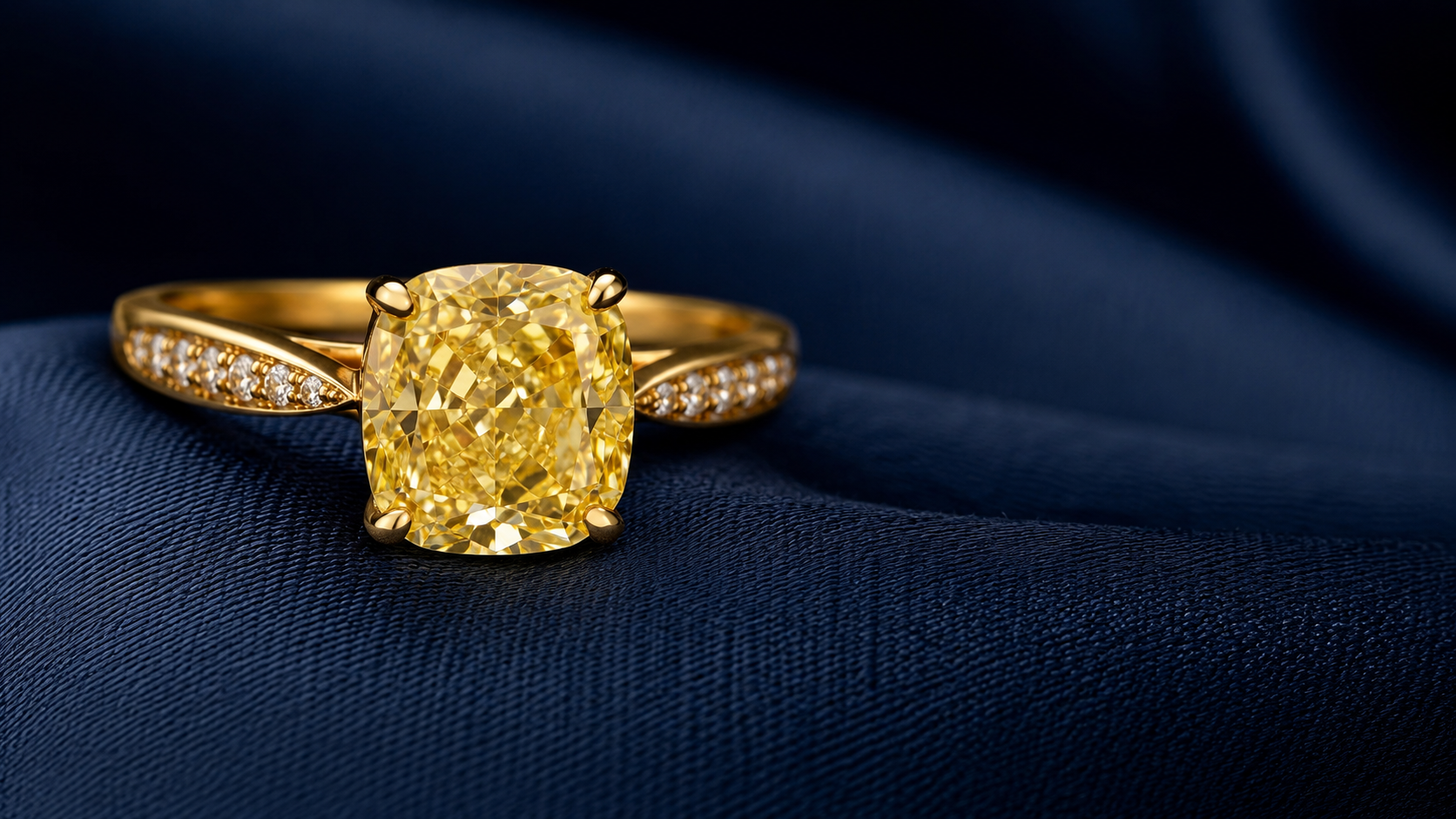
A yellow diamond ring sits in an odd corner of the market. Depending on exactly how yellow the stone is, it can be one of the cheapest ways to wear a large diamond, or one of the most expensive. Champagne and brown stones behave the same way. Understanding where the line falls is the whole game.
Two scales, one colour
The familiar D to Z scale measures the absence of colour. A D stone is colourless; a Z stone is visibly tinted. Most of that tint is yellow, caused by nitrogen atoms sitting in the carbon lattice. As you move down the scale the price falls, because the trade treats faint yellow as a flaw.
Then the scale runs out. Beyond Z, the same yellow is no longer a flaw. It is a fancy colour, graded on a separate scale that rises through Fancy Light, Fancy, Fancy Intense and Fancy Vivid. On that scale, more colour means more money.
So the same physical cause, nitrogen, produces the least valuable white diamonds and some of the most valuable coloured ones. The cheapest point is the bottom of the D to Z range, roughly the S to Z region that the trade calls cape stones.
Where a yellow diamond ring is a bargain
Cape stones. An S to Z diamond is unmistakably warm to the eye but not saturated enough to earn a fancy grade. These stones are usually well cut and structurally identical to anything higher up the scale. Set in yellow gold, they read as a soft golden diamond rather than a tinted white one.
Light fancy yellows. Fancy Light Yellow is the first rung of the fancy scale and still comparatively accessible. The colour is clear and even in daylight.
Champagne and brown. Brown colour in diamond generally comes from distortion in the crystal lattice rather than a trace element. For years these stones were sold as industrial material. Marketing them as champagne and cognac changed that, but they remain far less expensive than yellow of comparable strength. The Australian mine that produced most of them is closed, though supply on the secondary market is still broad.
Where it stops being a bargain
Fancy Intense and Fancy Vivid yellows are rare in nature and priced accordingly. A vivid yellow of a couple of carats can cost several times what a colourless stone of the same weight would. If a stone is described as canary, ask for the laboratory grade rather than the trade word; canary has no formal definition.
Watch also for modifiers. Brownish yellow and greenish yellow are graded and priced differently from pure yellow. A report will state the full colour description, and it matters.
Setting decisions
Yellow gold flatters warm stones. The metal reflects into the pavilion and deepens the apparent colour. Most fancy yellows are set in yellow gold for exactly this reason, sometimes with a yellow gold cup under the stone even when the rest of the ring is white.
White metal does the opposite. A cape stone in platinum looks paler and slightly greyer. That can be a deliberate choice, but it works against the stone rather than with it.
Cushion and radiant cuts hold colour. Their deep pavilions and many small facets bounce light around inside the stone, intensifying tint. Round brilliants return more white light and tend to wash colour out. This is why so many fancy yellows are cut as cushions.
A halo of small white diamonds makes a warm centre look more saturated by contrast.
What to ask for
A grading report from a recognised laboratory, showing the colour grade and any modifier. Confirmation that the colour is natural, since yellow can be created by treating brown stones. A viewing under daylight, not just shop lighting, which is often warm and flattering. And a cut that has been chosen for colour rather than for the highest possible brilliance.
Warm diamonds reward buyers who understand the scale. A stone chosen just below the fancy threshold, cut and set to make the most of its colour, is one of the better values in the entire diamond market.
Book a complimentary design consultation at the C'Garden atelier, The MET Corporate Towers, Kuala Lumpur: 010-766 7448 · hq@cgarden.com.my
C'Garden is an independent bespoke jeweller in Kuala Lumpur. We are not affiliated with, endorsed by, sponsored by or certified by any organisation, laboratory or brand named in this article. Third-party names are used only to refer factually to those organisations and their published standards. All text and imagery in this article is original work created by C'Garden.
Reference
Gemological Institute of America. (n.d.). Diamond colour. GIA. https://www.gia.edu/diamond-color
All journal entries