
Why Round Brilliant Diamonds Cost the Most
Round brilliant diamond price sits above every other shape at the same weight and grade. Rough yield, cut grading and demand explain the premium.
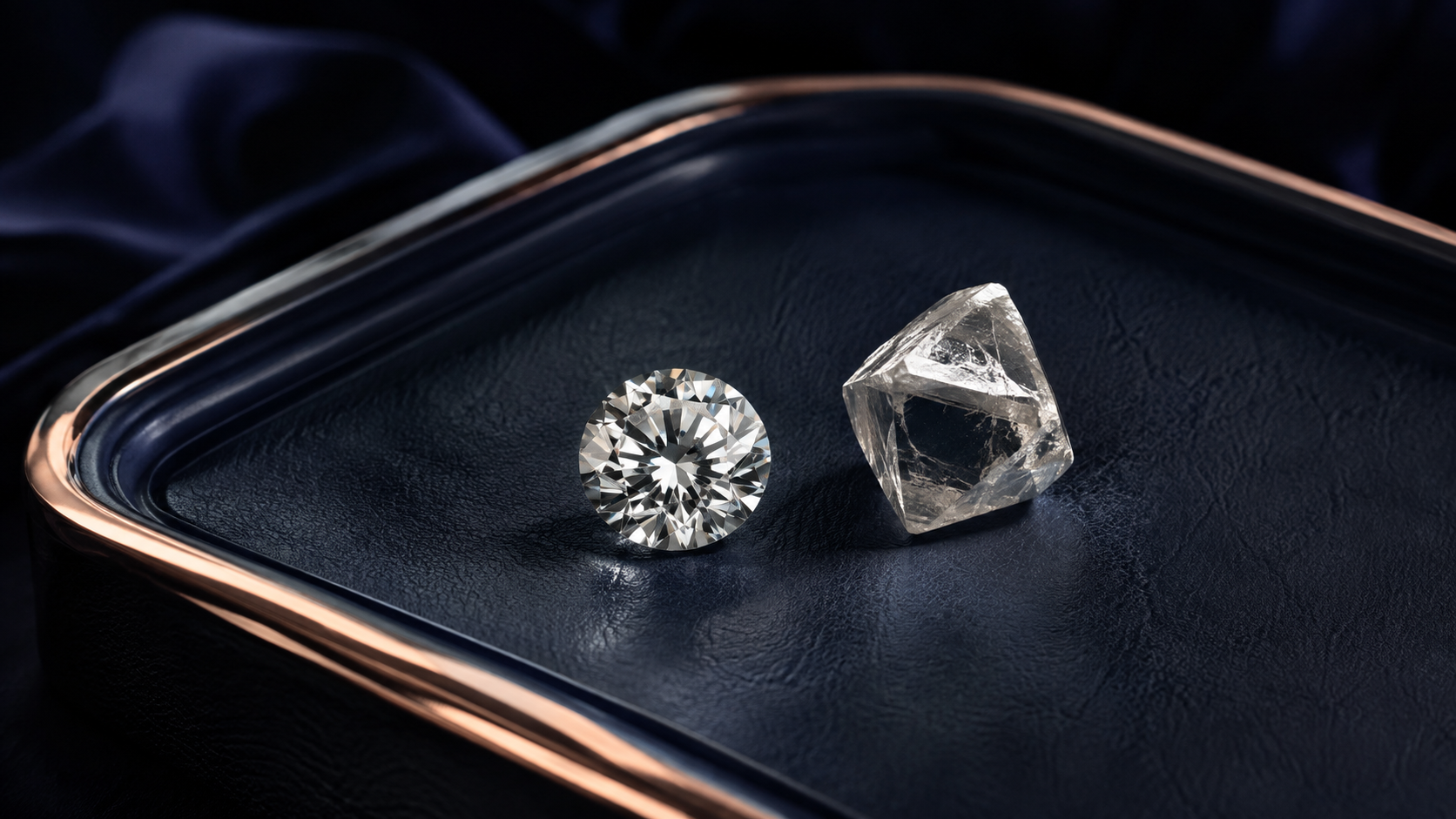
Take two diamonds of the same weight, colour and clarity, one round and one of any other shape, and the round will almost always cost more. The round brilliant diamond price premium over fancy shapes is consistent and often substantial. It is not an accident of fashion. There are three structural reasons, and understanding them tells you where the value in the market sits.
Reason one: rough yield
Diamond rough most often forms as an octahedron, two square pyramids joined at their bases. The cutter's job is to remove as little of that crystal as possible while producing a beautiful stone.
A round brilliant is a poor fit for an octahedron. Its circular outline cuts across the corners of the crystal, and its proportions demand that a large amount of material be ground away. A typical round brilliant retains well under half the weight of the rough it came from.
Fancy shapes are designed partly to solve this problem. A princess cut follows the square outline of the crystal and can retain far more of it. Elongated shapes such as ovals, pears and marquises are often cut from irregular or flattened rough that could never yield a good round. The cutter loses less material, so the finished stone costs less per carat to produce.
The buyer of a round is paying for the diamond that was ground away.
Reason two: cut grading
Laboratories assign a full cut grade to round brilliants and to almost nothing else. The round's proportions have been studied for over a century, and the relationships between crown angle, pavilion angle, table size and light return are well enough understood that a grade can be assigned with confidence.
That grade is itself valuable. A round with an excellent cut grade is a known quantity that can be traded, priced and sold without being seen. Fancy shapes lack that standard, so they carry more uncertainty, and uncertainty lowers what a buyer will pay unseen.
A well-cut round also does something no other shape quite matches. Its 57 or 58 facets, arranged symmetrically around a circle, return light more completely than any other arrangement. Brightness, fire and scintillation are all at their maximum. The premium is partly a premium for optical performance.
Reason three: demand
Rounds account for the majority of diamonds sold in engagement rings worldwide. Steady, dominant demand supports a higher price on its own, independent of yield or grading. Fancy shapes go in and out of fashion; rounds do not.
Demand also stabilises resale. A round is the easiest diamond to sell on, and that liquidity is priced in.
What this means for a buyer
The saving on a fancy shape is real. At the same weight and grade, an oval, cushion, pear or emerald cut typically costs meaningfully less than a round. The gap varies with shape and with what is fashionable, but it rarely closes.
Fancy shapes often look larger as well. Elongated shapes spread their weight across the finger, so the buyer of an oval gets a stone that costs less and reads bigger.
The round's advantage is certainty. The cut grade tells you what you are getting. With a fancy shape you have to look harder, or rely on someone who will look for you.
The round's other advantage is light. If maximum sparkle is the goal, nothing else does it quite as well.
The sensible conclusion
The round brilliant premium is not a markup for a name. It reflects lost rough, a reliable grading standard and durable demand. For a buyer who wants the brightest stone with the least risk, the premium is worth paying. For a buyer who is willing to see the stone in person and judge it, the fancy shapes are where the same money goes furthest.
Book a complimentary design consultation at the C'Garden atelier, The MET Corporate Towers, Kuala Lumpur: 010-766 7448 · hq@cgarden.com.my
C'Garden is an independent bespoke jeweller in Kuala Lumpur. We are not affiliated with, endorsed by, sponsored by or certified by any organisation, laboratory or brand named in this article. Third-party names are used only to refer factually to those organisations and their published standards. All text and imagery in this article is original work created by C'Garden.
Reference
Gemological Institute of America. (n.d.). Diamond cut. GIA. https://www.gia.edu/diamond-cut
All journal entries