
Why We Model in CAD Before Anything Is Cast
A drawing can lie about proportion. A three-dimensional model cannot. What CAD catches, what it still misses, and why you should ask to see one.
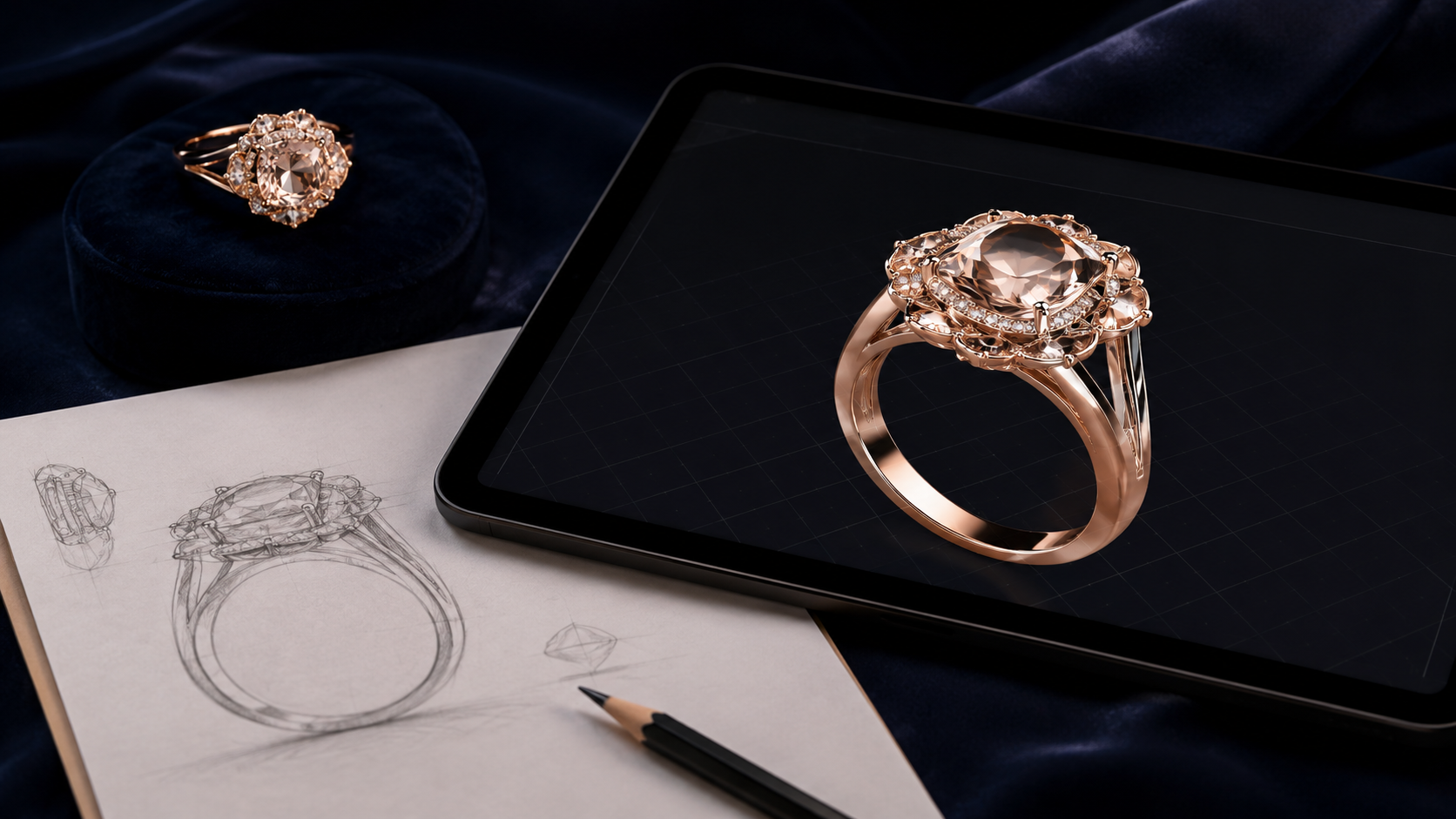
A hand drawing is the right tool for deciding what a ring is. It is a poor tool for deciding what it will look like on a hand. Those are different problems, and the second one needs three dimensions.
What a drawing flatters
Every hand-drawn ring is slightly more elegant than the real object. Not through dishonesty, through the nature of the medium.
Band thickness. On paper the shank is two lines. In metal it has a depth you can feel against the neighbouring finger. Drawings routinely under-represent this.
Stone height. A profile sketch shows the stone sitting neatly. The model shows it standing eleven millimetres off the finger, catching every jumper sleeve.
The junction. Where a slim band swells to meet the setting is the hardest area to draw and the most common place for a piece to look clumsy in metal.
What the model settles
Once the geometry exists in three dimensions, several arguments end:
- The exact finger size, as an internal diameter rather than an estimate
- Whether a future wedding band can sit flush, or whether there will be a gap
- The real weight, calculated from volume before any gold is bought
- Whether the prongs actually cover enough of the girdle to hold the stone
That last one is not cosmetic. Prongs that look generous on paper can be marginal in reality.
What CAD still cannot tell you
Be aware of the limits, because renders are persuasive.
A render is not a photograph. Polished gold is essentially a mirror, what it looks like is mostly a reflection of the room around it. Rendering software has to invent that room, so metal often reads flatter and more plastic than the finished piece. Real gold usually looks better than its render.
Scale on screen is a trap. A ring shown large on a monitor is not a ring seen at arm's length. Always ask for the actual millimetre dimensions, and hold a ruler up if you need to.
Colour is approximate. Rose gold in particular renders redder than it wears.
The practical advice
Ask to see the model from the side, not just from above. The three-quarter view is the flattering one; the profile is the honest one.
Ask for the finished weight in grams before approving. On a gold piece that is most of the cost, and it is knowable at this stage.
And ask for a printed resin pattern to try on. Everything a screen cannot tell you, mass, height, whether it snags, a five-ringgit piece of resin answers in ten seconds.
Book a complimentary design consultation at the C'Garden atelier, The MET Corporate Towers, Kuala Lumpur: 010-766 7448 · hq@cgarden.com.my
C'Garden is an independent bespoke jeweller in Kuala Lumpur. We are not affiliated with, endorsed by, sponsored by or certified by any organisation, laboratory or brand named in this article. Third-party names are used only to refer factually to those organisations and their published standards. All text and imagery in this article is original work created by C'Garden.
Reference
Jewelers of America. (n.d.). Jewelry buying guides. Jewelers of America. https://www.jewelers.org/buying-jewelry/jewelry-buying-guides
All journal entries