
Why Diamond Cut Matters More Than Carat
Carat is weight, not beauty. Why diamond cut quality decides brilliance, how light leaks from a badly cut stone, and where a fixed budget does the most work.
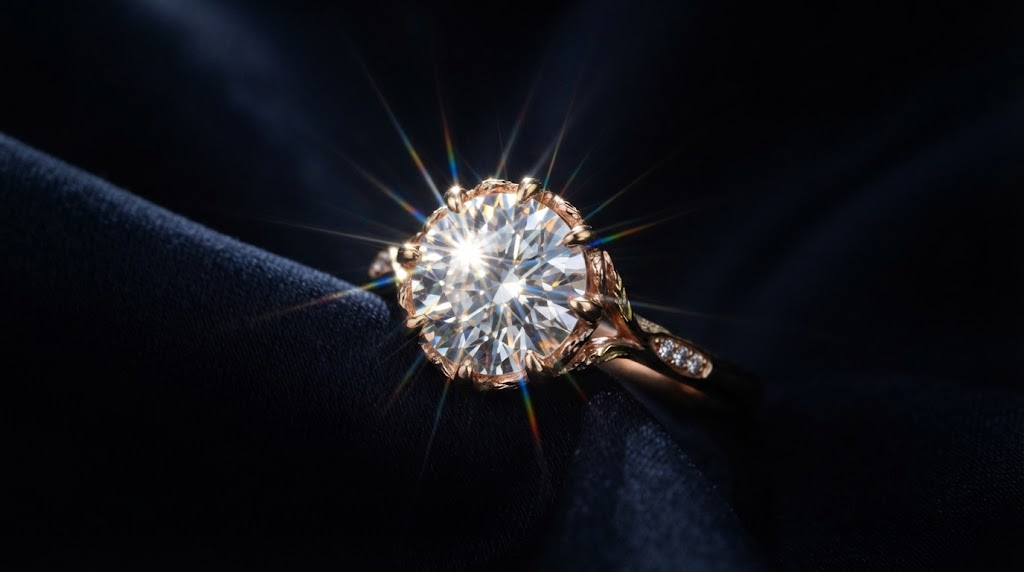
Everyone arrives with a budget. The single most consequential decision is not what the number is, it is where you let it go.
Most people put it into carat weight. We would put it into cut, almost every time, and this article explains exactly why.
What cut actually governs
A diamond is a device for handling light.
Light enters through the flat top facet, the table. It travels down into the lower portion of the stone, reflects off the internal surfaces, and returns through the top to your eye. That returned light is what you perceive as brilliance.
Cut quality determines how much of it makes the return journey.
The grading system assesses this through several components. Three describe the face-up appearance:
- Brightness, the white light reflected back
- Fire, the dispersion of light into spectral colours
- Scintillation, the pattern of sparkle and contrast as the stone moves
Four more assess design and craftsmanship: weight ratio, durability, polish and symmetry.
That last group is where the trade-offs hide. A cutter facing a rough crystal must decide between yielding a heavier stone or a better-performing one. Those goals are frequently in conflict.
What a badly cut stone does
Two failure modes, and both are visible once you know to look.
Cut too deep. Light entering the table travels down and escapes through the side of the pavilion rather than reflecting back. The stone appears dark at the centre, a phenomenon called a nailhead. It also looks smaller than its weight suggests, because the extra depth is buried in the setting.
Cut too shallow. Light passes straight through the bottom instead of reflecting. The centre looks watery and transparent, a fisheye. The stone spreads wider for its weight, which sounds like a bargain and is not.
In both cases the carat weight on the invoice is unchanged. You paid for the mass. You are simply not seeing it.
The arithmetic nobody explains
Carat weight is priced aggressively, and prices step up sharply at round numbers.
Cut quality, by comparison, is often a cheaper upgrade and a more visible one. Moving from a good cut to an excellent cut typically costs far less than moving up a meaningful amount in weight, and it changes the stone's appearance in a way anyone can see from across a room.
Consider two stones at the same price:
- Stone A: larger, average cut. More weight, less light return. Reads flat.
- Stone B: smaller, excellent cut. Less weight, far more light return. Reads bright and lively.
Almost every client shown these side by side, without being told which is which, picks Stone B. Then they check the paperwork and are surprised.
Brightness is what people notice. Millimetres are not.
Cut and shape are not the same thing
This confusion costs people money.
Shape is the outline, round, oval, pear, marquise, emerald, princess.
Cut is the quality of the making, whatever the shape.
The round brilliant is the only shape with a standardised overall cut grade, because its proportions have been studied exhaustively and the relationship between geometry and performance is well established.
Fancy shapes do not receive an overall cut grade. Their facet patterns and light behaviour vary too widely for a single scale to describe fairly. For those stones you get polish and symmetry grades, both meaningful, and then you must use your eye.
This does not mean fancy shapes are inferior. It means the responsibility shifts to you and to your jeweller.
How to judge cut with your own eyes
You do not need equipment. You need a method.
1. Look face-up at arm's length under ordinary light. Not the spotlights over a display case, which are engineered to make anything sparkle. Daylight or normal room light.
2. Check the centre. Dark and lifeless suggests too deep. Watery and see-through suggests too shallow.
3. Tilt it slowly. A well-cut stone flashes continuously through the movement. A poor one goes dull through part of the arc.
4. Look at the contrast pattern. Good stones show crisp alternation of bright and dark. Uniform grey is a bad sign.
5. Compare two stones together. Almost nobody does this, and it is the single most effective test available to a non-expert.
What this means at a consultation
When a client tells us their budget, our first instinct is not to find the largest stone that fits inside it.
It is to find the best-performing stone that fits inside it, and then see how much size is left over.
That order matters more than any other decision in the process. It is the difference between owning something impressive on paper and owning something that catches the light every time the wearer reaches for a glass.
We have never had a client come back and say the stone was too bright.
Frequently asked questions
Is excellent cut worth the premium?
In our view, yes, it is usually the best value upgrade available, because it is the one you can see.
Can a poorly cut diamond be recut?
Sometimes, but it costs weight and money. Better to buy correctly.
Do fancy shapes have cut grades?
No overall grade. They receive polish and symmetry grades, and the rest is judged by eye.
Does cut affect durability?
Yes. Very thin girdles and sharp points are more vulnerable to chipping, which is why a marquise should be set with prongs covering both tips.
What if I want size and brilliance?
Consider an elongated shape. A marquise or oval spreads its weight across the finger and presents larger than a round stone of the same carat.
The short version
Carat is what you paid for. Cut is what you see.
Spend where it shows, buy the stone that keeps catching your eye, and let the certificate confirm the decision rather than make it.
Book a complimentary design consultation at the C'Garden atelier, The MET Corporate Towers, Kuala Lumpur: 010-766 7448 · hq@cgarden.com.my
C'Garden is an independent bespoke jeweller in Kuala Lumpur. We are not affiliated with, endorsed by, sponsored by or certified by any organisation, laboratory or brand named in this article. Third-party names are used only to refer factually to those organisations and their published standards. All text and imagery in this article is original work created by C'Garden.
Reference
Gemological Institute of America. (n.d.). Diamond cut: Understanding the cut scale. GIA 4Cs. https://4cs.gia.edu/en-us/diamond-cut/
All journal entries