
Which Finger, and Why It Varies
The fourth finger of the left hand is a convention, not a rule, and plenty of the world does it differently. What the customs are and how to decide for yourself.
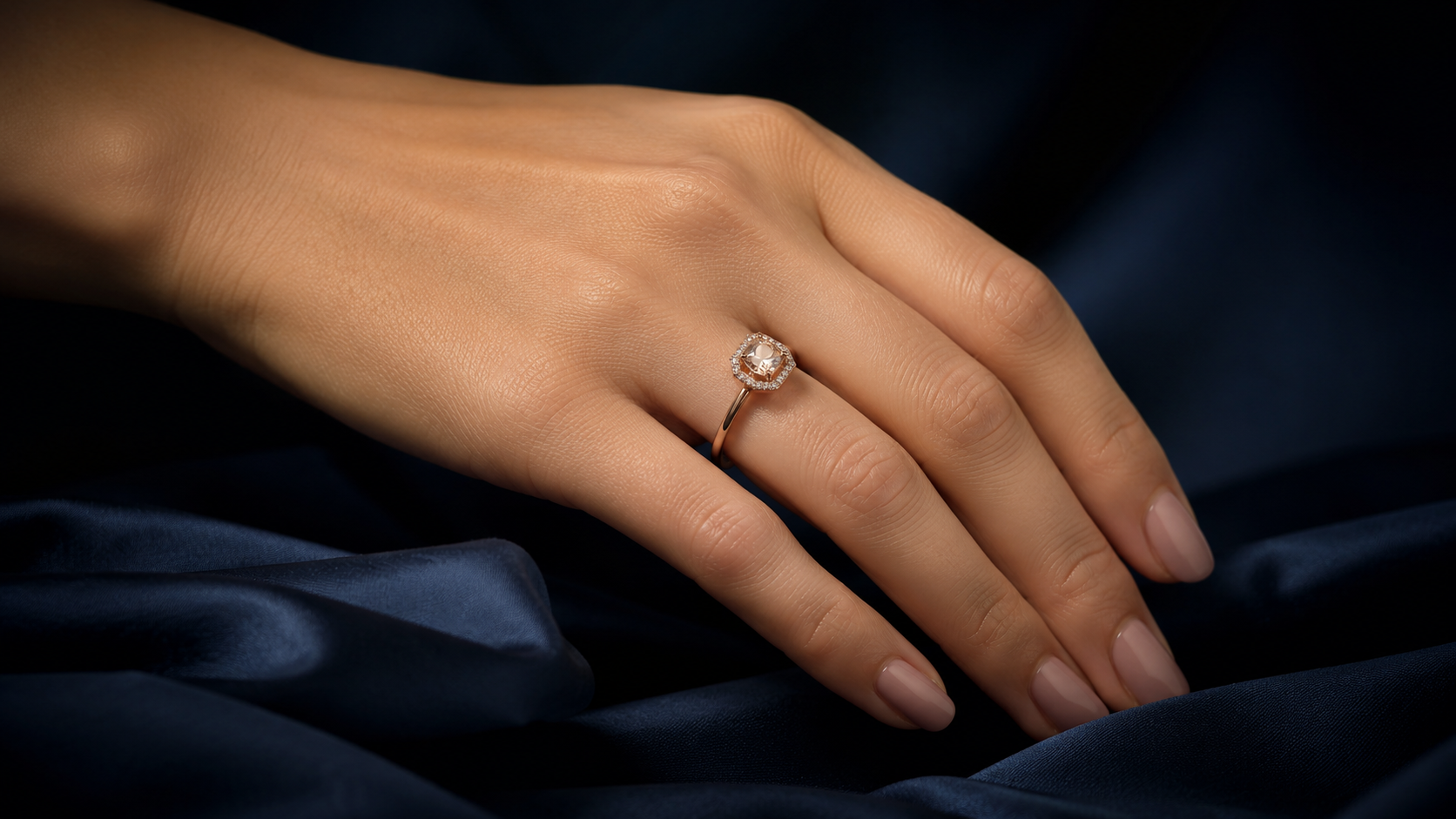
People ask this expecting one answer. There is no single correct one, and knowing the range makes the choice easier rather than harder.
The familiar convention
In much of the English-speaking world, engagement and wedding rings go on the fourth finger of the left hand.
The often-repeated explanation is the vena amoris, a vein believed to run directly from that finger to the heart. It is a lovely idea and it is not anatomically true. All fingers have comparable circulation.
The convention is genuinely old, but the romantic anatomy attached to it is a later story.
Where it differs
Right hand instead of left is standard in much of Northern and Eastern Europe, including Germany, Poland, Russia, Norway and Denmark, and in parts of Spain and India.
Both, at different stages. Some traditions move the ring from one hand to the other at marriage, engagement on one hand, wedding on the other.
Neither, particularly. In many communities the engagement ring is a recent and optional import, and the significant jewellery is elsewhere entirely: the thali worn as a necklace, or the gold given as hantaran or si dian jin.
The practical considerations
Convention aside, some things genuinely matter.
Which hand do you use most? A ring on the dominant hand takes noticeably more punishment. If a ring has delicate pavé or a high setting, the non-dominant hand will be kinder to it.
Do the two rings have to sit together? If an engagement ring and a wedding band will be worn stacked, they need to be designed for it, a straight band against a low solitaire is fine, a straight band against a curved setting leaves a gap.
Fingers are not the same size. The same ring will not fit the corresponding finger on the other hand. They differ, usually by up to half a size, and the dominant hand is often slightly larger.
Knuckle size matters more than finger size. A ring must pass the knuckle and then sit comfortably below it. For people with prominent knuckles this is the whole sizing problem, and there are design solutions, a hinged shank, or sizing beads inside the band.
On wearing it at all
Not everyone can wear a ring at work. Surgeons, mechanics, electricians, chefs and people who handle machinery often cannot, for safety as much as for wear.
The common solutions: a pendant on a chain, a plain low-profile band for work with the good ring for evenings, or a silicone band on site.
None of these mean anything about the marriage, though people occasionally act as if they do.
The short answer
Wear it where it suits your hand, your work and your family's customs. If someone tells you there is only one correct finger, they are describing their own tradition, not a universal rule.
Book a complimentary design consultation at the C'Garden atelier, The MET Corporate Towers, Kuala Lumpur: 010-766 7448 · hq@cgarden.com.my
C'Garden is an independent bespoke jeweller in Kuala Lumpur. We are not affiliated with, endorsed by, sponsored by or certified by any organisation, laboratory or brand named in this article. Third-party names are used only to refer factually to those organisations and their published standards. All text and imagery in this article is original work created by C'Garden.
Reference
Jewelers of America. (n.d.). Rings. Jewelers of America. https://www.jewelers.org/buying-jewelry/jewelry-styles/rings
All journal entries