
Gold Hallmarks in Malaysia: What the Stamp Inside Your Gold Means
What the tiny 916 stamped inside your bracelet actually means, where to find it, and the four checks to make before you pay for gold jewellery in Malaysia.
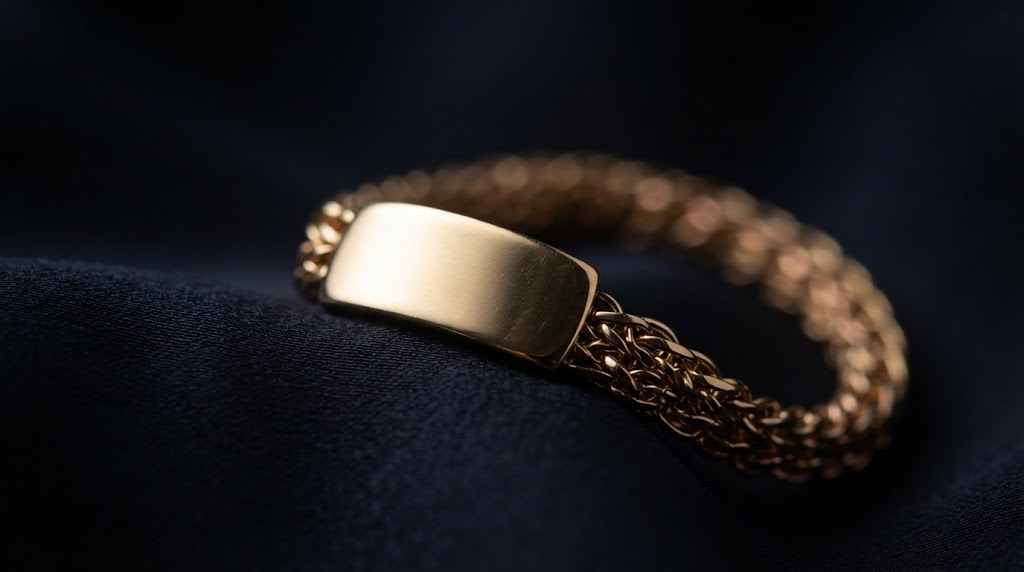
There is a number stamped somewhere on almost every piece of gold you own. Inside a band. On a clasp plate. On a small tag beside the extension chain.
Most people never look. It is worth looking, because that mark is the only part of the piece that makes a claim you can verify.
This guide explains how to read a gold hallmark in Malaysia, where to find it on different pieces, what it does and does not guarantee, and the four checks we would make before paying for any gold jewellery.
The number is a fraction, not a brand
Every purity mark expresses parts of gold per thousand.
- 999: 99.9% gold, 24K
- 916: 91.6% gold, 22K
- 835: 83.5% gold, 20K
- 750: 75% gold, 18K
- 585: 58.5% gold, 14K
- 375: 37.5% gold, 9K
You may also see the karat expressed directly: 22K, 18K, 14K. Both systems describe the same thing.
Older pieces, particularly those from Chinese goldsmiths, may carry characters instead of or alongside numerals, 足金 (zújīn, pure gold) or 千足金 (qiānzújīn, thousandth pure gold) being the most common. These are traditional purity declarations rather than modern standardised marks.
Where to find the mark
On a bracelet, look at the clasp first. Most makers stamp the clasp plate or a small tag near the extension chain, because these are flat surfaces that can take a punch without distorting the design.
On a ring, look inside the band. You may need a loupe or a phone camera at maximum zoom.
On a chain or necklace, check the small oval tag near the clasp.
On a pendant or charm, look at the bail, the loop the chain passes through, or on the reverse.
If you cannot find a mark anywhere, ask. There are legitimate reasons a piece may be unmarked, particularly if it is antique, very fine, or was made before marking was routine. But the seller should be able to tell you which reason applies.
What a hallmark does and does not guarantee
This is where honesty matters.
A stamp is a declaration of purity by whoever made or sold the piece. In Malaysia, gold jewellery purity marking is largely a matter of trade practice and the reputation of the seller rather than a compulsory independent assay on every item.
A stamp is not, by itself, proof. A mark can be applied to metal that does not match it. This is uncommon among established retailers and considerably less uncommon in informal sales, online marketplaces and holiday purchases abroad.
What the stamp genuinely gives you is accountability. It is a written claim, attached permanently to the object, that can be tested against the invoice and against the metal itself.
The four checks before you pay
1. Find the mark before you fall in love with the piece.
Ask to see it. Ask where it is. A jeweller who knows their stock will point to it immediately and hand you a loupe.
2. Check the mark matches the invoice.
The number on the metal and the number on the paper must agree. This takes four seconds and occasionally saves a great deal of money and argument.
3. Ask for the weight and the making charge separately.
Gold is sold by weight plus workmanship. A reputable seller states both figures without hesitation. A single combined number hides which part you are negotiating.
4. Ask what happens if you want it tested.
Established jewellers will test a piece for you, or tell you where to have it independently assayed. Confidence in the answer tells you more than the answer itself.
How to check gold authenticity yourself, and what not to try
There is a great deal of poor advice online about testing gold at home. Some of it will damage your jewellery.
Reasonable at home:
- Magnet test. Gold is not magnetic. If a piece is attracted to a strong magnet, something in it is not gold. Passing this test does not prove gold, several non-magnetic metals exist, but failing it is conclusive.
- Weight and feel. Gold is dense. A piece that feels suspiciously light for its size deserves questions.
- Look for wear at high points. On plated pieces, the base metal often shows through first at edges and clasps.
Do not attempt at home:
- Acid testing. It works, and it will permanently mark your piece if done carelessly. Leave it to a jeweller.
- Scratch tests. You are damaging the item to answer a question a professional can answer without damage.
- Bite tests. This tells you nothing and risks your teeth. Pure gold is soft, but so is lead.
The reliable method is XRF analysis, a non-destructive scan that reads the metal's composition in seconds. Many established jewellers and all assay offices have one.
Why we stamp where we stamp
On our own pieces, the mark sits where it can be read without a loupe and without dismantling anything.
We think a client should be able to verify what they own on a Tuesday afternoon, at home, without an appointment and without our help. That is not a small commitment, it means designing the clasp with a readable flat surface, which is a constraint on the design.
We accept the constraint, because a stamp that cannot be checked is decoration.
Frequently asked questions
Is 916 gold stamped differently in Malaysia than elsewhere?
No. 916 is an international purity expression. You will see the same number in Singapore, India and the Gulf.
My bracelet has no stamp. Is it fake?
Not necessarily, but it does mean the purity is undocumented. Have it tested before assigning it value.
What is the difference between a hallmark and a maker's mark?
A hallmark or purity mark declares metal content. A maker's mark identifies who made it. A piece may carry both.
Does the stamp affect resale?
Yes, practically. A clearly marked piece is easier and faster to value. An unmarked piece will usually be tested and may be discounted for the uncertainty.
The short version
A stamp is a small promise, and it should not be hidden.
Find it, read it, check it against the paper, and buy from someone who is comfortable being checked. That single habit removes most of the risk in buying gold jewellery in Malaysia, and it costs you nothing but four seconds and the willingness to ask.
Book a complimentary design consultation at the C'Garden atelier, The MET Corporate Towers, Kuala Lumpur: 010-766 7448 · hq@cgarden.com.my
C'Garden is an independent bespoke jeweller in Kuala Lumpur. We are not affiliated with, endorsed by, sponsored by or certified by any organisation, laboratory or brand named in this article. Third-party names are used only to refer factually to those organisations and their published standards. All text and imagery in this article is original work created by C'Garden.
Reference
World Gold Council. (n.d.). Gold jewellery hallmarks & makers marks. World Gold Council. https://www.gold.org/about-gold/about-gold-jewellery/gold-hallmarks
All journal entries