
What 'Handmade' Actually Means in Jewellery
The handmade jewellery meaning has a strict definition and a loose everyday one. What the word should cover, what it often covers, and how to settle it.
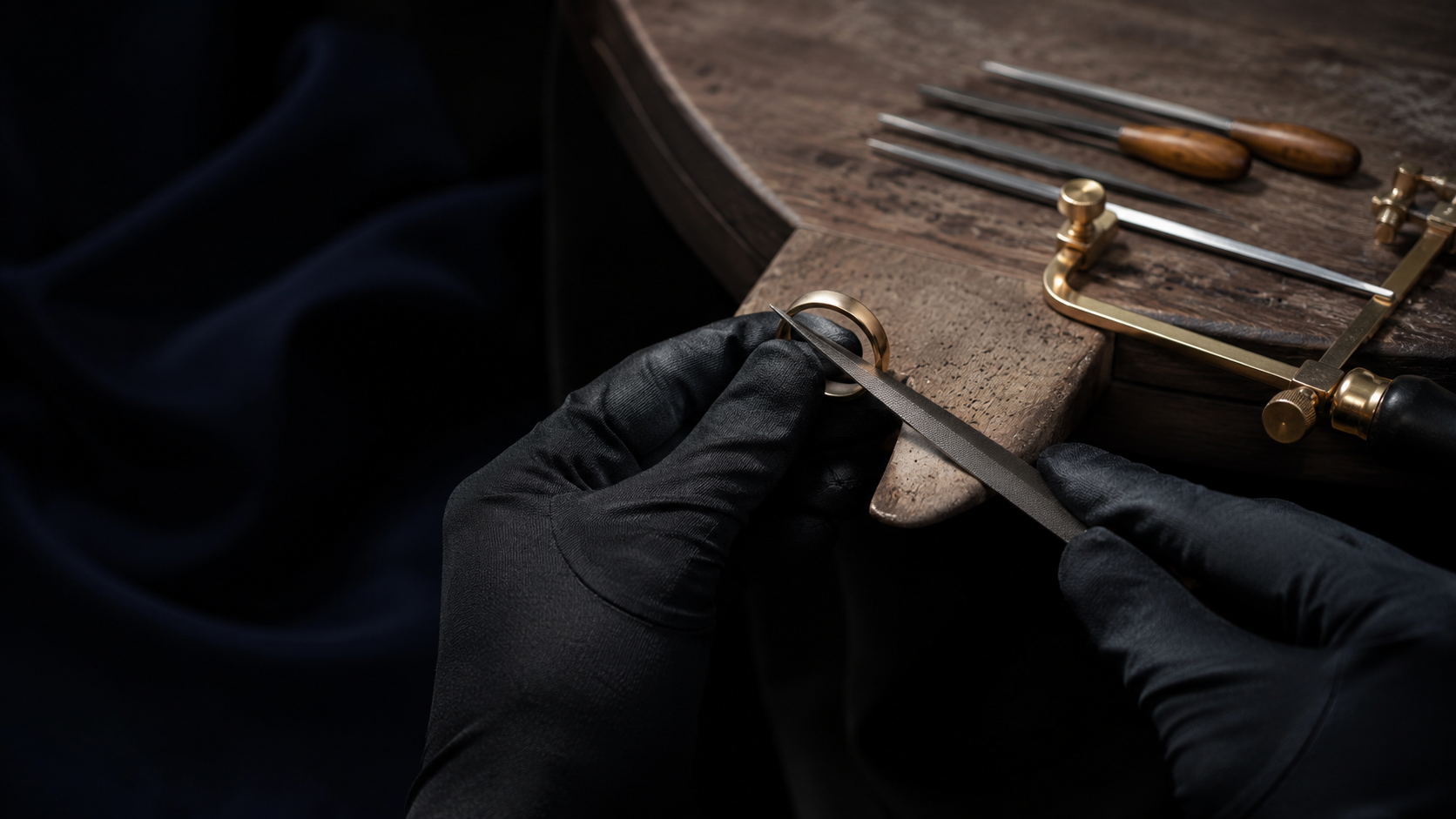
Few words in jewellery are used as freely as handmade. It appears on pieces built entirely at a bench from raw metal, and it appears on pieces cast in batches of fifty and polished by hand for four minutes. The handmade jewellery meaning that a client has in mind is usually the first. What they are sold is often the second.
The strict definition
The clearest published standard comes from the United States Federal Trade Commission's guides for the jewellery industry. Under those guides, a piece may be described as handmade or handwrought only if the entire shaping and forming of the piece from raw materials, and its finishing and decoration, was done by hand labour and hand-guided tools. Mass-producing components or forming them with machinery and then assembling by hand does not qualify.
Other markets are less explicit, but the trade generally treats the FTC wording as the honest benchmark. By that standard, a handmade ring is fabricated: the shank forged from bar, the setting built from wire or sheet, every joint soldered by a person.
What the word usually covers instead
Hand-finished. The piece was cast from a mould, possibly one of many, and then a person filed, polished and set it. Much fine jewellery is made this way and there is nothing wrong with it. It is not handmade in the strict sense.
Hand-assembled. Components made by machine or cast in volume, put together at a bench.
Hand-carved wax. The model was carved by hand, then cast. The design is the work of a hand; the metal was not shaped by one.
Designed by hand, built by CAD and casting. A designer drew it, a modeller built it on screen, a printer made the wax, a caster poured it. Many bespoke pieces are made this way, including some of ours. We call that bespoke, or made to order, and we say how it was built.
None of these is deceptive if described accurately. The problem is the single word doing the work of a sentence.
Why it matters to the buyer
Strength. A forged, fabricated piece has denser metal than a cast one. Prongs of drawn wire outlast cast prongs. If you are paying for handmade because you expect durability, you want the strict version.
Uniqueness. A piece cast from a reused mould exists in multiples. A piece fabricated at a bench does not.
Price. Strictly handmade work takes far longer. If a handmade piece is priced like a cast one, one of the two words is wrong.
Honesty. A jeweller who is precise about this is likely to be precise about metal purity, stone treatment and everything else.
Questions that settle it
"Was this cast or fabricated?" The direct question. Expect a direct answer.
"Was any part of it made from a mould or a CAD file?" Perfectly acceptable if yes, but it changes the word.
"Which parts were shaped by hand from raw metal?" A strictly handmade piece: all of them. A hand-finished piece: none.
"Can I see it being made, or see photographs of the process?" An atelier that fabricates will have plenty. One that outsources casting may not.
How we use the words
We make pieces by fabrication, by casting from CAD, and by combining the two. We describe each piece by how it was actually built. When a piece is fully fabricated at the bench, we say handmade. When the shank was cast and the collet fabricated, we say so. When a client wants a fully handmade piece and the budget or design does not suit it, we explain why and offer the alternative, rather than adjusting the label.
The word handmade is worth protecting because when it is true it means something. The way to protect it is to ask.
Book a complimentary design consultation at the C'Garden atelier, The MET Corporate Towers, Kuala Lumpur: 010-766 7448 · hq@cgarden.com.my
C'Garden is an independent bespoke jeweller in Kuala Lumpur. We are not affiliated with, endorsed by, sponsored by or certified by any organisation, laboratory or brand named in this article. Third-party names are used only to refer factually to those organisations and their published standards. All text and imagery in this article is original work created by C'Garden.
Reference
Federal Trade Commission. (2018). Guides for the jewelry, precious metals, and pewter industries. FTC. https://www.ftc.gov/legal-library/browse/rules/jewelry-guides
All journal entries