
What 0.5, 1 and 2 Carats Actually Look Like on the Hand
Diamond carat size on hand depends on diameter, shape and finger, not weight alone. What half, one and two carats measure in millimetres and how they read.
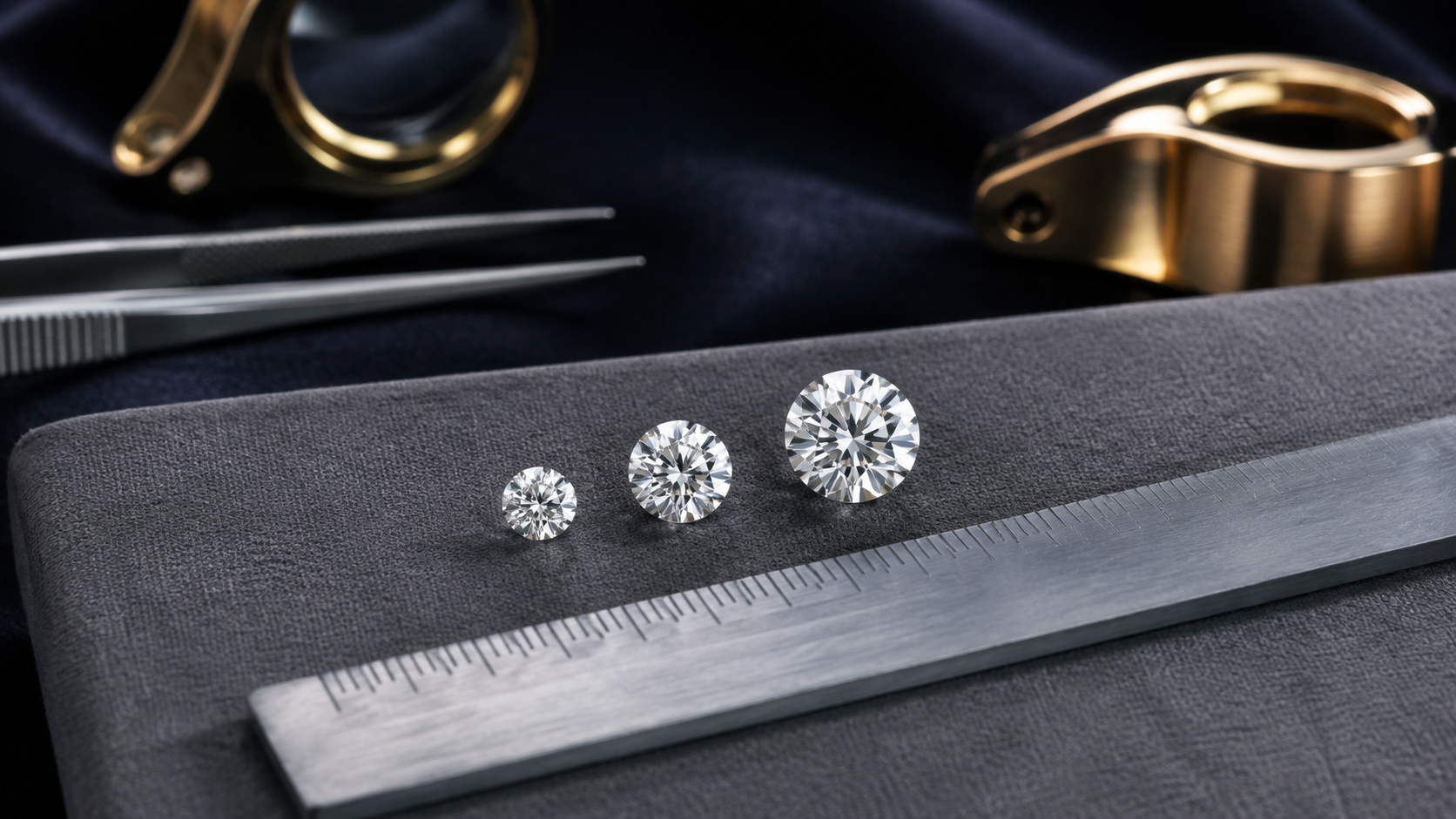
Carat is the number everyone asks about first and the one that says least about what a ring looks like. A carat is a unit of weight, one fifth of a gram. Diamond carat size on hand depends on how that weight is distributed, what shape it is cut into and what it is sitting next to. The useful number is the diameter in millimetres, and it is printed on every laboratory report.
The millimetre figures
For a well-proportioned round brilliant, the typical face-up measurements are roughly:
0.25 carat: about 4.1 mm across.
0.50 carat: about 5.1 mm.
0.75 carat: about 5.8 mm.
1.00 carat: about 6.4 to 6.5 mm.
1.50 carat: about 7.4 mm.
2.00 carat: about 8.1 to 8.2 mm.
The first thing to notice is that doubling the weight does not double the size. Weight grows with volume, and volume grows with the cube of the diameter. Going from one carat to two adds roughly 1.7 mm across, which is noticeable but far less than most people expect. Going from half a carat to one adds about 1.3 mm.
What each size reads as
Half a carat sits comfortably on most hands. On a slim finger it is a clear, deliberate stone. On a broader hand it is understated. This is the size where cut quality has the biggest effect, because a bright half carat can outshine a dull three quarter.
One carat is the size most people picture when they imagine an engagement ring. It is large enough to be seen across a table and small enough to sit low. On a UK size J to L finger it looks proportionate; on a size Q it looks moderate.
Two carats is a visibly substantial stone. It changes how a ring is designed, because the setting must be taller and the shank heavier to support it. It is the point at which practical questions about daily wear start to matter more than aesthetic ones.
The things that change the impression
Finger width. The same 6.5 mm stone occupies a larger fraction of a narrow finger. This is why ring size is the first question a good jeweller asks when someone describes the look they want.
Shape. Elongated shapes spread their weight along one axis. A one carat oval is typically around 7.5 by 5.5 mm and reads larger than a one carat round, because the eye judges length. Marquise and pear stretch further still. Cushion and Asscher, which carry more weight in their depth, often look a little smaller than a round of the same weight.
Cut depth. A stone cut too deep hides weight underneath, where it does nothing. Two one carat rounds can differ by half a millimetre in diameter depending on how they were cut. The shallower one looks bigger, but only up to the point where the proportions start leaking light.
Setting. A halo of small stones around a half carat centre produces a face-up spread close to a one carat solitaire. A bezel adds a rim of metal that increases the visual footprint. A thin band makes any stone look larger by contrast; a wide band does the reverse.
Colour and brightness. A bright, well-cut stone looks larger than a dull one of the same diameter, because the eye reads the flash, not the outline.
How to decide
Try stones on, in daylight, on the hand that will wear the ring. Look at them from arm's length, which is how everyone else will see the ring, rather than close up. Compare the millimetre measurement rather than the carat figure when choosing between two candidates.
Most people, having tried a range, settle a little below the number they walked in with and put the difference into cut. That is usually the right instinct.
Book a complimentary design consultation at the C'Garden atelier, The MET Corporate Towers, Kuala Lumpur: 010-766 7448 · hq@cgarden.com.my
C'Garden is an independent bespoke jeweller in Kuala Lumpur. We are not affiliated with, endorsed by, sponsored by or certified by any organisation, laboratory or brand named in this article. Third-party names are used only to refer factually to those organisations and their published standards. All text and imagery in this article is original work created by C'Garden.
Reference
Gemological Institute of America. (n.d.). Diamond carat weight. GIA. https://www.gia.edu/diamond-carat-weight
All journal entries