
What a Jeweller's Loupe Shows You (And How to Use One)
A jewellers loupe at 10x magnification is the standard tool for looking at stones and settings. How to hold one, what you will see, and what you will not.
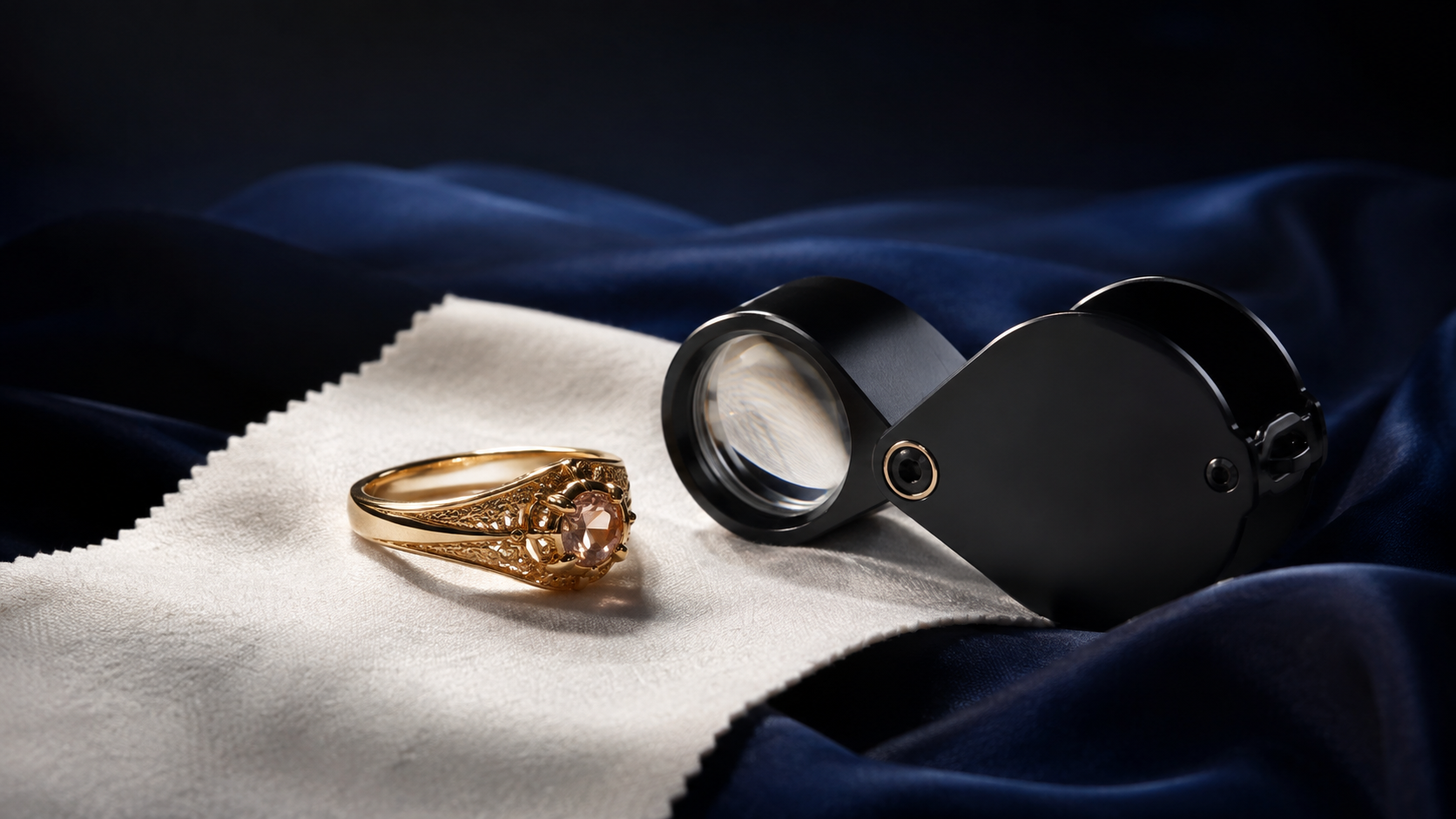
A jewellers loupe is a small folding magnifier, usually 10x, that fits in a pocket and costs less than a decent lunch. It is the single most useful tool a buyer can own, because it turns "the jeweller says it is fine" into something you can see for yourself. It is also widely misused, which is why the first thing to learn is how to hold it.
Which loupe
10x magnification is the standard. Diamond clarity grades are defined by what a trained grader can see at 10x, so it is the magnification at which the grading scale makes sense. Higher powers show more but have a shallower depth of field and a narrower view, and they make every stone look flawed.
Triplet lens. Three glass elements cemented together, corrected for colour fringing and edge distortion. A triplet shows a flat, true image. Cheap single-lens loupes bend and colour what you see.
Black housing. A black frame around the lens stops reflections of the frame appearing in the stone. Chrome loupes look nicer and work worse.
How to hold it
Most people hold the loupe near the object and squint through it from a distance. That gives a blurred, tiny image.
Bring the loupe to your eye instead, close enough that the rim almost touches your brow. Steady the hand holding the loupe against your cheek. Then bring the ring or stone up to the loupe, held in your other hand, until it snaps into focus, which will be about 25mm away. Brace both hands together so they move as one. Keep both eyes open if you can; it stops the strain.
Light matters. Daylight from a window, or a plain white LED, is best. Look at stones against a white background for inclusions and against a dark one for surface reflections.
What to look at on a diamond
The girdle. The thin edge around the widest part. Chips, nicks and small feathers live here, because this is the edge that takes knocks and the edge prongs press on. Rotate the stone all the way round.
Inclusions. Crystals, clouds, feathers and pinpoints inside the stone. At 10x you will see anything at SI grade and above quite easily, VS with effort, and VVS barely or not at all. If you see nothing, that tells you something about the grade.
The laser inscription, if the stone has a laboratory report. It sits on the girdle, tiny, and reads as a row of characters. Matching it to the report is the simplest identity check there is.
Polish and symmetry. Facet edges should meet cleanly. Scratches, burn marks and rounded facet junctions show as softness at the edges.
What to look at on a setting
Prong tips. Rounded and substantial, or flat and thin. This is the check that prevents lost stones.
Contact with the stone. Each prong should touch the stone. A gap under a prong means the stone can move.
Solder joins. Where the head meets the shank, and where any component was attached. A clean join is invisible; a poor one shows as pitting or a colour change.
Porosity. Tiny pits in cast metal, like the surface of a sponge. A few are normal; a lot is a poor casting.
Hallmarks and stamps. The fineness mark (750, 916, PT950) and any maker's mark, usually inside the band.
What a loupe will not tell you
It will not distinguish a natural diamond from a lab-grown one, or a diamond from a good simulant. It will not give you a colour grade. It will not tell you a stone's weight. Those need instruments and a laboratory. What the loupe gives you is the ability to see what is in front of you clearly, and to ask better questions about it.
Bring it with you
Using a loupe in a shop is not rude; it is expected. Any jeweller who is uncomfortable with a customer looking closely at a stone is telling you something.
Book a complimentary design consultation at the C'Garden atelier, The MET Corporate Towers, Kuala Lumpur: 010-766 7448 · hq@cgarden.com.my
C'Garden is an independent bespoke jeweller in Kuala Lumpur. We are not affiliated with, endorsed by, sponsored by or certified by any organisation, laboratory or brand named in this article. Third-party names are used only to refer factually to those organisations and their published standards. All text and imagery in this article is original work created by C'Garden.
Reference
Gemological Institute of America. (n.d.). Diamond clarity. GIA. https://www.gia.edu/diamond-clarity
Gemological Institute of America. (n.d.). Diamond quality factors. GIA. https://www.gia.edu/diamond-quality-factor
All journal entries