
Understanding Diamond Fluorescence
Fluorescence is on every report and understood by almost nobody. Occasionally it is a problem, occasionally it is a bargain, and mostly it does not matter.
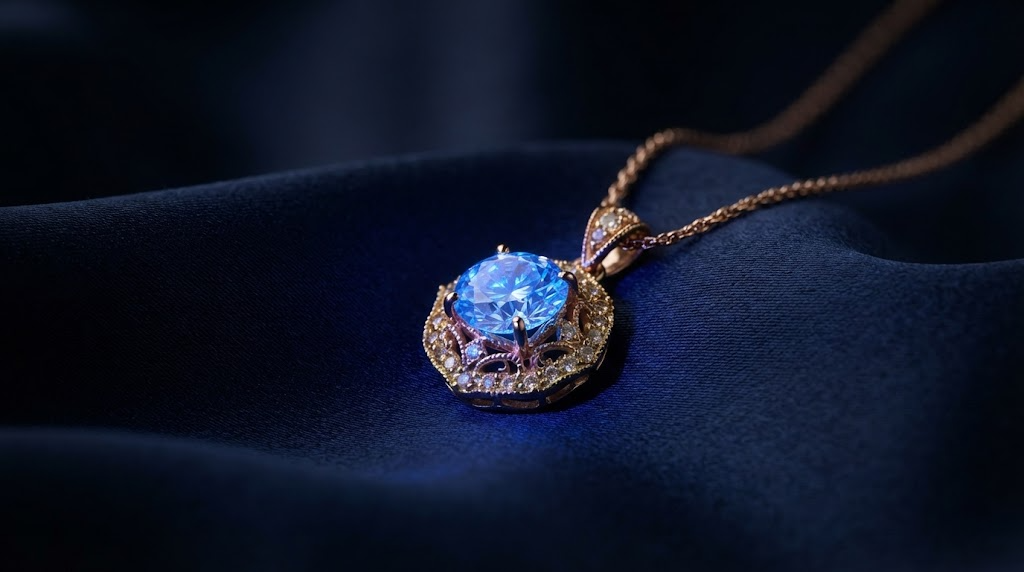
Of everything on a diamond report, fluorescence causes the most confusion and the most inconsistent advice. It is worth understanding, because it is one of the few places where a genuine discount is available.
What it is
Some diamonds glow when exposed to ultraviolet light. The glow is usually blue, occasionally yellow or white, and it comes from trace elements in the crystal.
Reports grade its strength, none, faint, medium, strong, very strong, not whether it is good or bad.
UV is present in daylight and in some artificial lighting, so a fluorescent diamond may be very faintly reacting outdoors.
When it is a problem
Strong or very strong fluorescence can, in a minority of stones, produce a hazy or milky appearance. The stone looks slightly oily or soft rather than crisp.
Two things to understand about this:
It affects a small proportion of strongly fluorescent stones, not all of them. And it is visible, you do not need equipment. If a stone looks hazy to you in normal light, that is a reason not to buy it, whatever the report says.
When it is an advantage
Blue fluorescence can counteract a faint yellow tint. In lower colour grades, roughly the I to M range, medium or strong blue can make a stone face up slightly whiter than its grade suggests.
Here the market's caution works in your favour. Fluorescent stones often trade at a discount, so a well-chosen fluorescent stone in a lower colour grade can be genuinely better value.
When it does not matter
In the great majority of stones, faint or medium fluorescence, higher colour grades, it has no visible effect at all in normal conditions.
How to actually decide
Look at the stone. This is the whole of the advice. Fluorescence is a visible property, so trust your eyes over the grading line.
See it in more than one light. Daylight near a window, indoor lighting, and shaded outdoor light. If it looks crisp in all three, the fluorescence is not hurting it.
Compare directly. Ask to see a fluorescent stone beside a non-fluorescent one of similar specification. Differences that sound significant on paper frequently vanish side by side.
Do not pay a premium to avoid it. Faint and medium fluorescence should not cost you anything.
Do consider it for value. If you are buying in the lower colour grades, a strongly fluorescent stone that faces up white is one of the few remaining bargains in diamond buying.
The one caution
If you are buying partly with resale in mind, be aware that strong fluorescence narrows the pool of future buyers, fairly or not. For a piece being bought to wear and keep, that is irrelevant.
Book a complimentary design consultation at the C'Garden atelier, The MET Corporate Towers, Kuala Lumpur: 010-766 7448 · hq@cgarden.com.my
C'Garden is an independent bespoke jeweller in Kuala Lumpur. We are not affiliated with, endorsed by, sponsored by or certified by any organisation, laboratory or brand named in this article. Third-party names are used only to refer factually to those organisations and their published standards. All text and imagery in this article is original work created by C'Garden.
Reference
Gemological Institute of America. (n.d.). Grading the diamond 4Cs. GIA. https://4cs.gia.edu/en-us/grading-diamond-4cs/
All journal entries