
Turning Old Earrings and Brooches Into Pendants
To convert brooch to pendant, or give a single earring new life, a jeweller adds a bail and reworks the back. What is involved, the risks, what to keep.
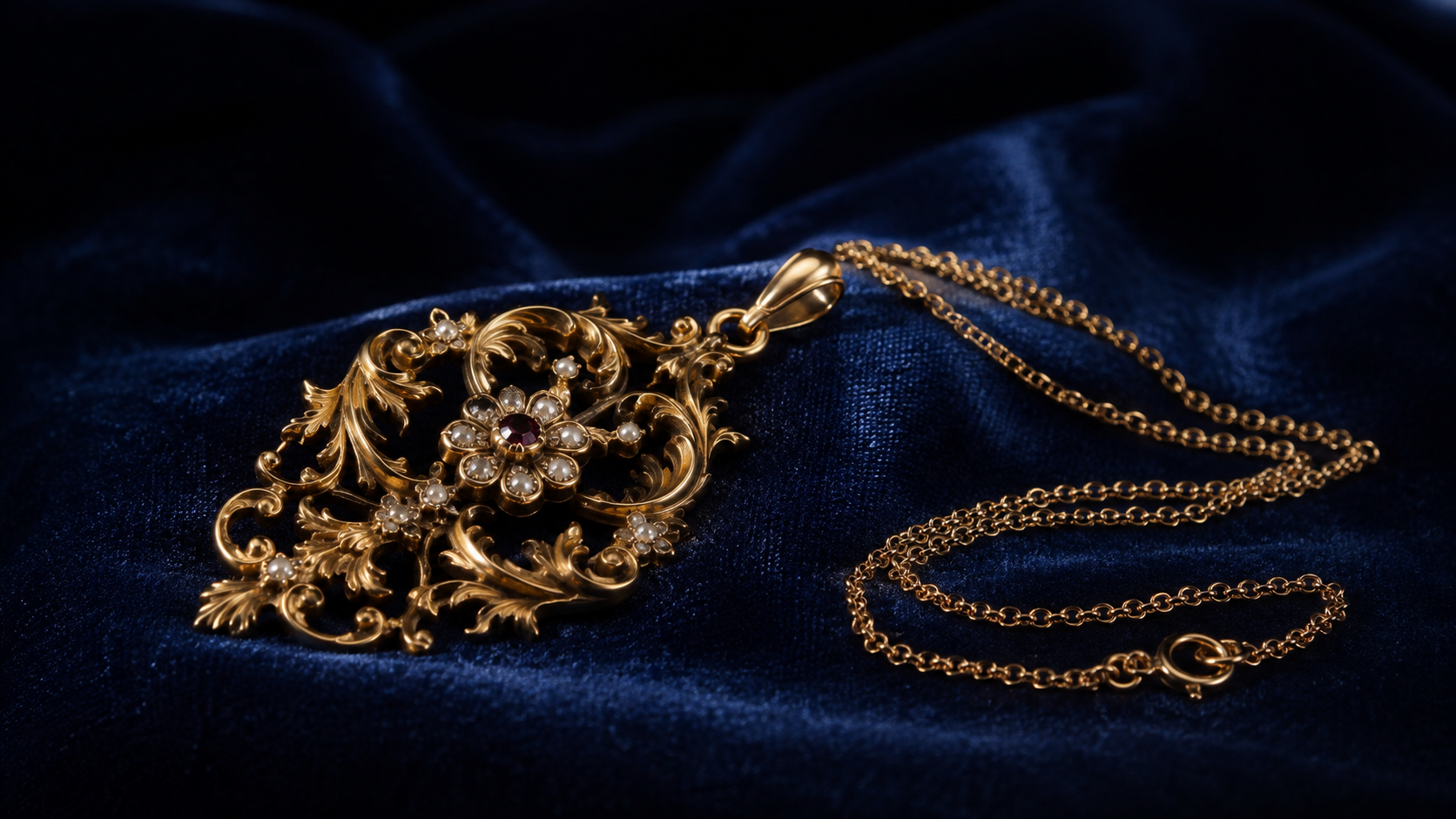
Brooches are rarely worn now, and a lot of very good jewellery sits in drawers because of it. The same is true of clip earrings, of earrings whose partner is lost, and of pieces whose fittings no longer suit the owner. The most common request we get for inherited jewellery is to convert brooch to pendant, and it is usually the right instinct: the piece keeps its identity and gets worn.
Here is what the conversion actually involves, and how to decide what to do with a given piece.
Brooches
A brooch has a pin and a catch on the back, and its design was made to sit on fabric, oriented in a particular direction. Converting it means adding a way to hang it and dealing with the pin.
The bail. A loop of metal, soldered to the top of the brooch, through which a chain passes. It is the only essential addition. The bail should be made in the same alloy and colour as the brooch, sized to the chain, and placed so the brooch hangs the right way up. Some brooches were designed sideways, and the bail position is a judgement call.
The pin. Three options. Leave it, so the piece can still be worn as a brooch; the pin then sits behind and is invisible. Remove it and file the mounts flat, which is cleaner but irreversible. Or fit a removable bail, a small clip-on fitting that hooks over the pin bar, which changes nothing about the brooch.
Weight and balance. A heavy brooch on a fine chain hangs badly and strains the chain. The chain should suit the pendant, and sometimes a second bail at the back is needed to stop the piece flipping.
Single earrings
An earring on its own is already close to a pendant. The conversion is usually to remove the post or hook, add a bail, and clean up the back.
Drop earrings convert best, because they were designed to hang.
Stud earrings need more work. A stud sits flat against the ear, so it has no natural top. A small bail on the edge, or a new frame around it, turns it into a pendant.
Clip earrings can have the clip mechanism removed and a bail fitted in its place.
Where both earrings survive, converting them into a pair of pendants for two family members is a common and rather nice solution.
What can go wrong
Heat. Soldering a bail on means heating the piece. Some stones tolerate this, some do not, and pearls, opals, emeralds and any glued stone must be removed first. A workshop should identify every stone before touching the piece.
Old repairs. Antique pieces often carry earlier solder joins in a lower-melting alloy. Those can let go when the piece is heated again. Laser welding avoids most of this and is the method of choice for delicate old work.
Plating and patina. Cleaning and polishing an old piece can strip a surface that gave it character. Ask for the minimum finishing needed.
Keeping the original intact
A conversion that adds a bail and leaves everything else alone is reversible, and reversibility is worth preserving in a family piece. If the brooch has any historic value, take a photograph before and after, and keep any removed parts.
When to redesign instead
Some pieces are not worth converting as they are: the design is dated in a way that a bail does not fix, or the mount is worn out. In those cases the better route is to remove the stones and set them into a new pendant that references the original. That is a larger project, and a different conversation.
Book a complimentary design consultation at the C'Garden atelier, The MET Corporate Towers, Kuala Lumpur: 010-766 7448 · hq@cgarden.com.my
C'Garden is an independent bespoke jeweller in Kuala Lumpur. We are not affiliated with, endorsed by, sponsored by or certified by any organisation, laboratory or brand named in this article. Third-party names are used only to refer factually to those organisations and their published standards. All text and imagery in this article is original work created by C'Garden.
Reference
Jewelers of America. (n.d.). Jewelry repair and care. Jewelers of America. https://www.jewelers.org/buying-jewelry/jewelry-repair-and-care
Victoria and Albert Museum. (n.d.). Jewellery. V&A. https://www.vam.ac.uk/collections/jewellery
All journal entries