
Tourmaline: A Colour Guide From Pink to Paraiba
Tourmaline jewellery covers more colours than any other gem species. A guide to rubellite, indicolite, chrome, watermelon and Paraiba, and how they wear.
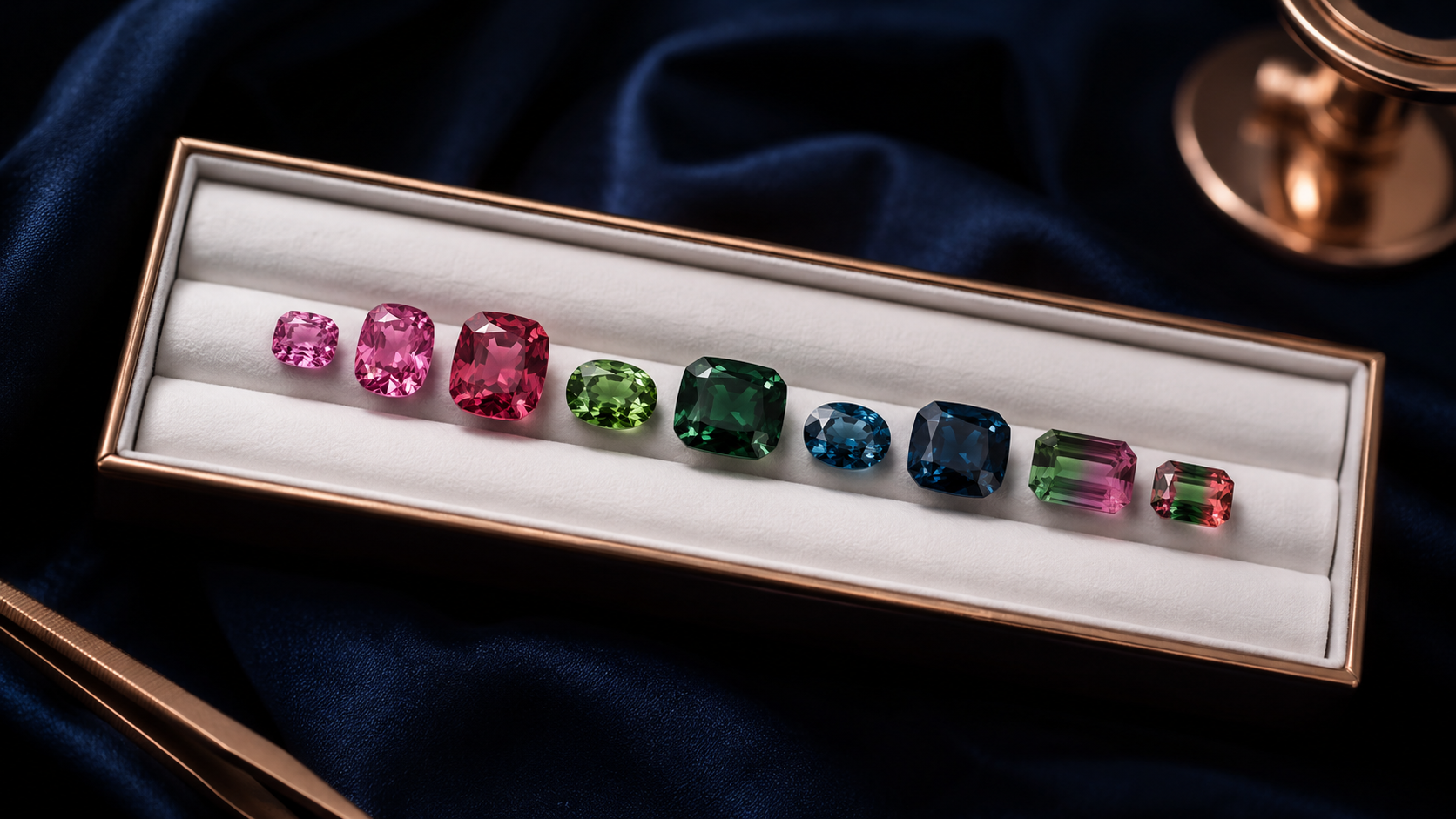
No other gem species offers as many colours as tourmaline. It is not one mineral but a family of closely related ones, and between them they cover nearly the whole visible spectrum, sometimes within a single crystal. Tourmaline jewellery therefore ranges from the inexpensive to the seriously collectable, with the price driven almost entirely by which colour you are looking at.
The basics
Hardness. 7 to 7.5 on the Mohs scale. Suitable for rings with sensible settings, though it scratches more readily than sapphire and should be kept away from harder stones in the jewellery box.
Pleochroism. Tourmaline shows different colours down different crystal directions, often strongly. A good cutter orients the stone to show the best one, which is why two stones from the same crystal can look quite different.
Treatment. Some pinks and reds are heated to lighten them; some are irradiated to deepen colour. Both are stable. Paraiba material is routinely heated. Disclosure is expected.
The main trade colours
Rubellite. Red to pinkish red. The name is reserved by most dealers for stones that hold their red under both daylight and incandescent light; pink stones that turn brownish are sold as pink tourmaline. Rubellite tends to be included, so a clean stone with saturated colour is uncommon.
Pink tourmaline. From pale blush to hot pink, widely available, and one of the best-value pink stones for jewellery.
Green tourmaline. The most common colour. Ranges from olive through to a clean leaf green. Darker stones can look almost black in a ring and should be cut shallow.
Chrome tourmaline. A vivid, slightly bluish green coloured by chromium and vanadium, mostly from East Africa. Small, rarely above a few carats, and priced well above ordinary green.
Indicolite. Blue to greenish blue. Pure blue without green is rare and valued accordingly.
Watermelon. A single crystal with a pink core and a green rind, cut as slices to show the pattern. Charming, fragile at the colour boundary, and best in pendants and earrings rather than rings.
Bicolour and particoloured. Any two or more colours in one stone, cut as a faceted stone rather than a slice. Every one is different.
Black tourmaline. Opaque, inexpensive, and used in men's pieces and beads.
Paraiba
Paraiba tourmaline is the exception to everything above. First found in the Brazilian state of Paraiba in the late 1980s, it is coloured by copper, which gives an electric blue to green that looks lit from inside. Nothing else in the gem world quite matches it.
Copper-bearing tourmaline was later found in Nigeria and Mozambique. Laboratories generally call all copper-bearing material "Paraiba-type" or use the name with an origin note. Brazilian stones command the highest prices; Mozambican material can be equally beautiful in larger sizes.
Fine Paraiba is priced per carat among the top of all coloured stones. Even small, pale stones cost far more than any other tourmaline. Any stone sold as Paraiba should come with a laboratory report confirming copper content.
Choosing tourmaline for jewellery
Rings. Choose bezel or protected prong settings. Avoid slices and watermelon in rings.
Earrings and pendants. Almost any tourmaline suits these, including the more fragile cuts.
Colour under your light. Tourmaline changes character between daylight and warm indoor light more than most stones. Look at any candidate under both before deciding.
Metal. Pinks and rubellite suit rose and yellow gold. Greens and blues generally read cleaner in white metals, though chrome green against yellow gold is a classic.
What good value looks like
Ordinary greens and pinks in clean, well-cut stones of several carats are among the most affordable ways to own a large, bright gem. Money moves quickly upward for rubellite, indicolite and chrome. It leaps for Paraiba. Knowing which name is attached to the colour you like is most of the work.
Book a complimentary design consultation at the C'Garden atelier, The MET Corporate Towers, Kuala Lumpur: 010-766 7448 · hq@cgarden.com.my
C'Garden is an independent bespoke jeweller in Kuala Lumpur. We are not affiliated with, endorsed by, sponsored by or certified by any organisation, laboratory or brand named in this article. Third-party names are used only to refer factually to those organisations and their published standards. All text and imagery in this article is original work created by C'Garden.
Reference
Gemological Institute of America. (n.d.). Tourmaline. GIA. https://www.gia.edu/tourmaline
All journal entries