
The Mohs Scale for Jewellery Buyers: Hardness Is Not Toughness
The gemstone hardness scale tells you one thing about a stone and is read as if it tells you everything. What Mohs measures, what it misses, how to use it.
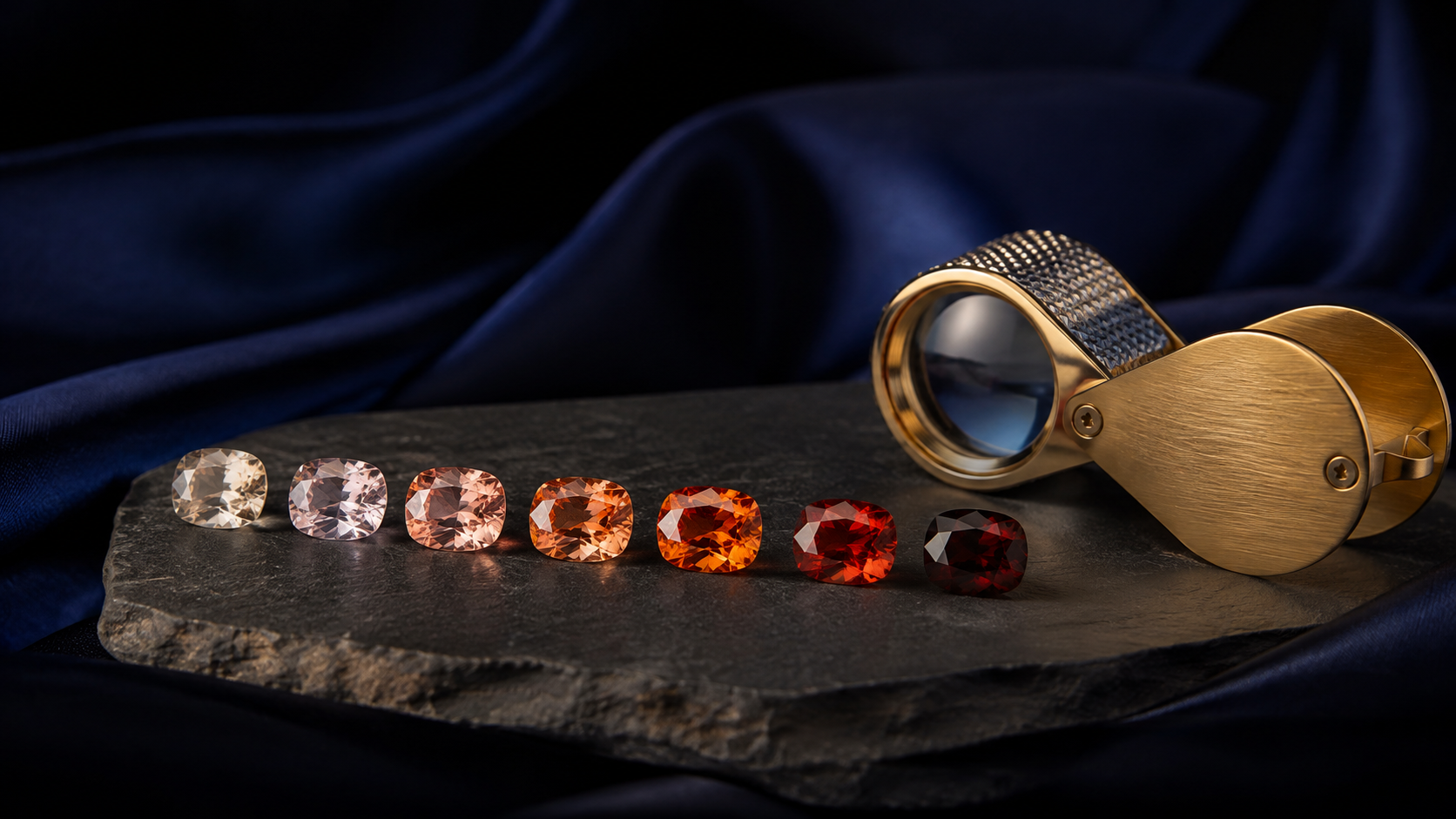
Almost every gemstone description quotes a Mohs number. Diamond is 10, sapphire is 9, and the implication is that a higher number means a stone that will last. The gemstone hardness scale is useful, but it answers a narrower question than most buyers think, and a stone can score well on it and still break.
What Mohs actually measures
The scale was devised by Friedrich Mohs in 1812. It ranks ten reference minerals by which can scratch which. Talc is 1, gypsum 2, calcite 3, fluorite 4, apatite 5, orthoclase 6, quartz 7, topaz 8, corundum 9 and diamond 10.
It is an ordinal scale, not a linear one. The steps are not equal. The gap between 9 and 10 is far larger than the gap between 1 and 9. Diamond is not ten percent harder than corundum; on absolute measurements it is several times harder.
So a Mohs number tells you one thing: what will scratch the stone, and what it will scratch. Nothing else.
Why 7 is the number that matters
Ordinary dust contains quartz. Quartz is 7. Any stone softer than 7 will, over years of wiping and daily wear, be slowly abraded by the dust on your clothes and hands. The polish dulls and facet edges soften.
That is why 7 is the informal line for a stone that can be worn daily without visible wear. Diamond, sapphire, ruby, spinel, topaz, chrysoberyl, and most quartz varieties clear it. Peridot sits on the line. Tanzanite, opal, moonstone, apatite and pearl do not.
Toughness is a different property
Toughness is resistance to breaking. It depends on how the crystal is bonded internally and whether it has cleavage, which is a direction along which it splits cleanly.
Diamond is the hardest material known and has perfect cleavage in four directions. A sharp blow at the right angle can split it. Topaz is 8 and has perfect cleavage in one direction. Emerald is 7.5 to 8 and is so commonly fractured that it is treated as fragile in the workshop.
Jade is the reverse case. Nephrite is around 6 to 6.5, softer than quartz, yet its interlocking fibrous structure makes it one of the toughest gem materials there is. It can be carved thin and struck without shattering. Jade will scratch; jade does not easily break.
Stability is the third factor
Some stones are hard enough and tough enough but react badly to heat, light or chemicals. Opal can crack as it dries. Some amethyst and kunzite fade in strong sunlight. Pearl and coral dissolve in acid. Turquoise absorbs oils and discolours.
A stone's real durability is the combination of all three: hardness, toughness and stability. The Mohs number is only the first.
How to use this when buying
For an everyday ring. Want 8 or above for hardness, no easy cleavage, and no chemical sensitivity. Diamond, sapphire, ruby and spinel are the sensible list. Topaz and aquamarine are workable with a protective setting.
For earrings and pendants. Almost anything works. These pieces are rarely knocked or abraded, so softer and more delicate stones live happily here.
For a bracelet. This is the harshest position on the body. Bracelets hit desks, door frames and steering wheels. Treat a bracelet like a ring, and be more cautious.
For anything worn in Kuala Lumpur humidity. Heat and sweat are not a hardness problem, but they are a stability problem for porous stones and organic materials. Pearls, turquoise and untreated opal need more attention here than they would in a dry climate.
The question that cuts through it
Rather than asking "how hard is it", ask the jeweller: "if I wear this every day for ten years, what will happen to it, and how would you set it to prevent that". A jeweller who can answer in terms of scratches, chips and chemicals separately is thinking about the right things.
Book a complimentary design consultation at the C'Garden atelier, The MET Corporate Towers, Kuala Lumpur: 010-766 7448 · hq@cgarden.com.my
C'Garden is an independent bespoke jeweller in Kuala Lumpur. We are not affiliated with, endorsed by, sponsored by or certified by any organisation, laboratory or brand named in this article. Third-party names are used only to refer factually to those organisations and their published standards. All text and imagery in this article is original work created by C'Garden.
Reference
Gemological Institute of America. (n.d.). Gem encyclopedia. GIA. https://www.gia.edu/gem-encyclopedia
Gem-A. (n.d.). The Gemmological Association of Great Britain. https://gem-a.com
All journal entries