
The 4Cs of Diamonds Explained, Without the Jargon
The 4Cs of diamonds, cut, colour, clarity and carat, explained in plain language by a Kuala Lumpur bespoke jeweller, including which one actually changes how a diamond looks.
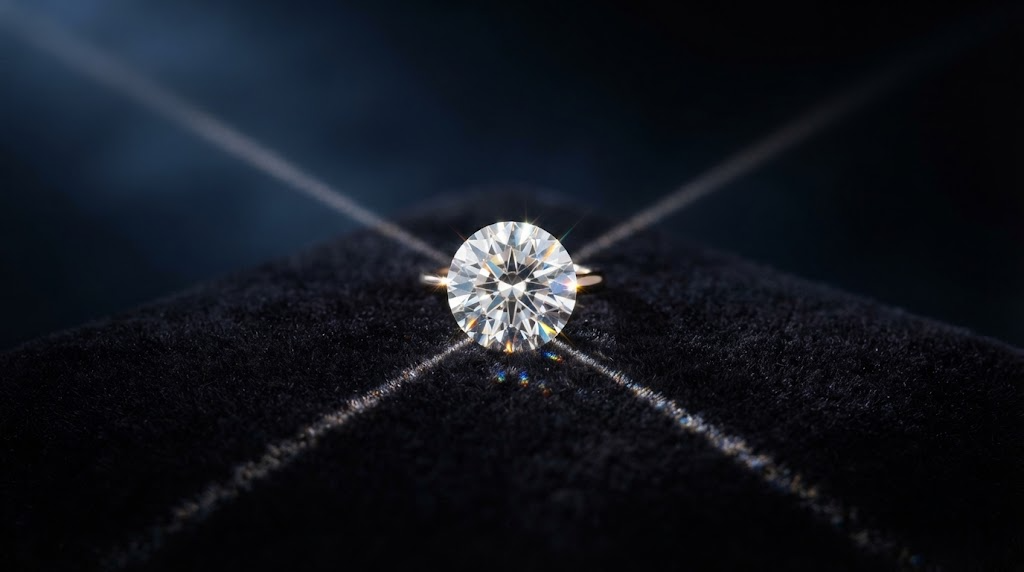
Four words do most of the work in the diamond trade. Cut, colour, clarity and carat. They are genuinely useful, and they are also where most buyers quietly get lost, because the words are explained to you at the exact moment you are trying to make an expensive decision.
This guide explains what each of the 4Cs of diamonds actually measures, which ones you can see and which ones you cannot, and how we would spend a fixed budget across them.
Where the 4Cs came from
The 4Cs are not marketing language. They were developed by the Gemological Institute of America as a universal system for describing diamond quality, and their purpose was to make a stone in one country comparable to a stone in another.
Before that, "quality" was whatever the seller said it was.
Understanding this matters, because it tells you what the 4Cs are for: they are a description, standardised so it can be trusted. They were never intended to be a beauty score.
Cut, the one that changes what you see
Cut is not the shape of the diamond. Round, oval, marquise, emerald, that is shape.
Cut is how well the stone was made: its proportions, its symmetry, how precisely the facets were placed and polished.
A diamond is essentially a device for handling light. Light enters through the top, travels into the stone, reflects off the internal surfaces and returns to your eye. Cut quality determines how much of that light comes back.
The grading system for a standard round brilliant evaluates a set of components, brightness, fire and scintillation for face-up appearance, then weight ratio, durability, polish and symmetry for craftsmanship.
In plain terms:
- Brightness, the white light returned
- Fire, the flashes of colour
- Scintillation, the sparkle as the stone or the viewer moves
Get the proportions right and a diamond is alive. Get them wrong, too deep, too shallow, facets slightly misaligned, and light leaks out of the bottom where nobody can see it. The weight is still on the invoice. The performance is gone.
This is the C that decides whether a stone looks expensive.
Colour, measuring an absence
For a white diamond, colour grading measures how little colour is present. The scale runs from D, completely colourless, down through the alphabet as faint warmth appears.
Here is what nobody tells you at the counter: the differences at the top of the scale are extremely subtle. D, E and F are all described as colourless, and telling them apart usually requires the stones to be unmounted, upside down, against a white tray, under controlled lighting, beside a master set.
That is not how anybody wears a ring.
Once a stone is set, particularly in rose gold or yellow gold, which contribute warmth of their own, the practical differences between adjacent grades in the colourless and near-colourless range become very difficult to see.
Practical guidance: in a warm-toned setting, a near-colourless stone often looks identical to a colourless one on the hand, at a considerably lower price.
Clarity, what is inside, and whether you can see it
Almost every natural diamond contains internal characteristics, inclusions, formed while the crystal grew. They are the stone's history.
The clarity scale runs from Flawless at the top, through Internally Flawless, Very Very Slightly Included, Very Slightly Included, Slightly Included, and finally Included.
The critical detail: clarity is graded under 10× magnification.
That means a stone graded VS1 and a stone graded VVS2 may look completely identical to your eye, in every real-world situation, forever. The difference exists. It is simply not visible without equipment.
Where clarity genuinely matters:
- Step cuts, emerald and Asscher shapes have long, open facets that behave like windows. Inclusions show far more readily.
- Large stones, inclusions scale with the stone.
- Inclusions near the surface at a vulnerable point, which can be a durability question rather than a beauty one.
Where it matters less: brilliant cuts, where the facet pattern breaks light up and camouflages small inclusions effectively.
Ask the jeweller to show you the inclusion under magnification. Then look at the stone without magnification. If you cannot find it, you have learned something worth knowing before you pay for a higher grade.
Carat, weight, not size
Carat is a measure of weight, not dimensions. One carat is 0.2 grams.
Two stones of identical carat weight can look noticeably different on a hand, because weight can be distributed in different places. A deeply cut stone carries mass below the girdle, hidden inside the setting. A well-proportioned stone spreads more of its weight across the face, where it is visible.
This is why an elongated shape like a marquise often looks larger than a round stone of the same weight, it is long and comparatively shallow, so more of its mass sits where the eye can see it.
There is also a pricing quirk worth knowing: prices jump at the round numbers. A stone just under 1.00ct can cost meaningfully less than one just over, while looking essentially identical on a finger. Buying just below a threshold is one of the few genuinely free savings in this trade.
How we would spend a fixed budget
Every client arrives with a number. Here is the order we work in.
1. Spend on cut, first and without compromise. It is the only C that changes how the stone performs.
2. Choose colour relative to the metal. Warm metals forgive warmer stones.
3. Take clarity down to eye-clean, then stop. Pay for what you can see. Do not pay for a better line on a document.
4. Let carat absorb what is left, and consider sitting just below a price threshold.
A well-cut stone one grade down in colour and clarity will consistently out-perform a poorly cut stone two grades up, in the only test that matters: how it looks on a hand, across a table, in a restaurant.
Frequently asked questions
Which of the 4Cs is most important?
Cut. It governs brightness, fire and scintillation, everything the eye registers as sparkle.
Do I need a certified diamond?
You need a report from an independent laboratory with a consistent, respected standard, and you need the number on the report to match the inscription on the stone.
What does eye-clean mean?
No inclusions visible to an unaided eye at normal viewing distance. It is not an official grade, but it is the practical threshold most buyers should target.
Is a bigger diamond always better?
No. A larger, poorly cut stone frequently looks duller than a smaller, well-cut one.
Does the setting affect how the diamond looks?
Considerably. Metal colour influences apparent stone colour, and the setting style affects how much light reaches the stone from the sides.
The short version
The 4Cs describe a diamond. They do not rank beauty, and they cannot replace looking at the stone.
Use the report to confirm what you are buying. Use your eye to decide whether you want it. And spend your money where it shows, which, nine times out of ten, means cut.
Book a complimentary design consultation at the C'Garden atelier, The MET Corporate Towers, Kuala Lumpur: 010-766 7448 · hq@cgarden.com.my
C'Garden is an independent bespoke jeweller in Kuala Lumpur. We are not affiliated with, endorsed by, sponsored by or certified by any organisation, laboratory or brand named in this article. Third-party names are used only to refer factually to those organisations and their published standards. All text and imagery in this article is original work created by C'Garden.
Reference
Gemological Institute of America. (n.d.). GIA diamond grading & reports. GIA 4Cs. https://4cs.gia.edu/en-us/grading-diamond-4cs/
All journal entries