
The Anatomy of a Diamond, in Plain English
Table, crown, girdle, pavilion, culet. The five words that let you discuss a diamond properly, and why the girdle matters most on a marquise.
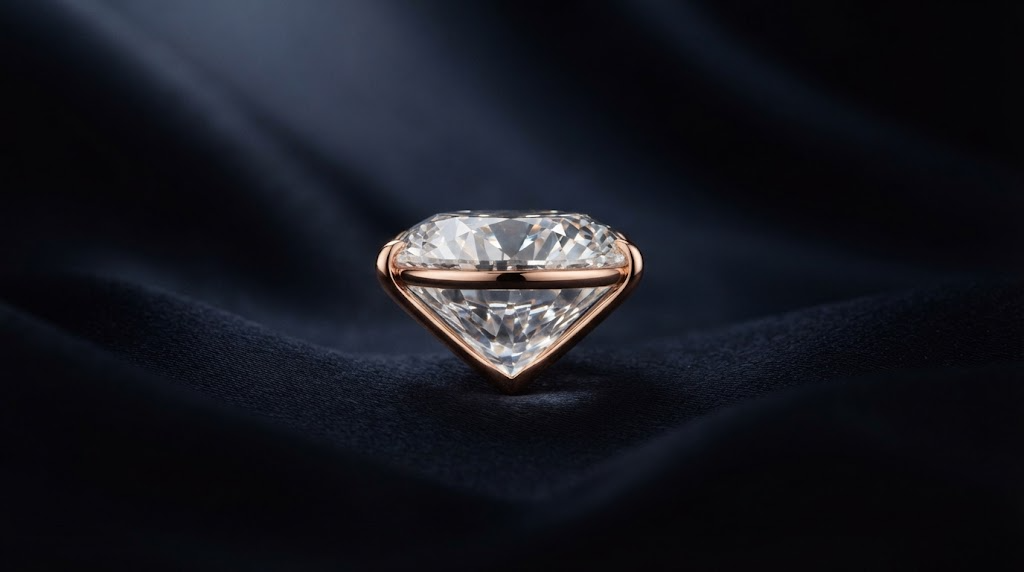
Five words. Learn them and you can hold a conversation with any jeweller in the world without nodding along to something you did not follow.
The map
Table, the large flat facet on top. The main window light enters through.
Crown, the sloped section between the table and the widest point.
Girdle, the widest part, the outline of the stone. This is where a diamond is usually gripped by its setting.
Pavilion, the cone beneath the girdle, running down to the point.
Culet, the very bottom. On many modern stones it is a point rather than a facet.
Why the proportions matter
Light enters through the table, travels down into the pavilion, reflects off the internal surfaces and returns to your eye. If the pavilion is too deep or too shallow, light escapes through the bottom instead of coming back. The stone looks dull or glassy at the centre.
This is what cut quality is measuring. Not shape, geometry.
Where these words appear on your report
Once you know the five words, the block of numbers at the top of a grading report stops being noise.
Table percentage is the width of the table compared with the width of the whole stone. Depth percentage is the height from table to culet compared with that same width. Girdle is described by thickness, from extremely thin to extremely thick. Culet is described by size, and on most modern stones it reads as none or pointed.
You do not need to memorise ideal ranges. You need to know that these lines describe the shape of the stone in profile, and that the shape in profile is what decides how it behaves.
The two failures you can name now
Too deep. Light entering the table runs down the pavilion and escapes out of the side rather than returning. The centre goes dark. The stone also looks smaller than its weight, because the extra depth is buried in the setting where nobody sees it.
Too shallow. Light passes straight out of the bottom instead of reflecting. The centre looks watery and you can almost see through it. The stone spreads wider for its weight, which sounds like a bargain and is not.
The weight on the invoice is identical in both cases. You paid for the mass either way.
The one that matters on a marquise
The girdle.
On a marquise the girdle narrows to a point at both ends, and at those points it is extremely thin. A girdle that is too thin at the tips is fragile, it chips. A girdle that is too thick adds weight you paid for but cannot see, because the extra material is buried inside the setting.
When we set a marquise, both points are covered by prongs. Not for decoration. Because that is where the stone is vulnerable.
Why a jeweller looks at the girdle first
Beyond the marquise, the girdle is where the setting does its work, so it is where a bench decision gets made.
An extremely thin girdle needs a gentler setting and more careful handling for the life of the piece. A very thick one changes how deep the stone must sit, which changes the profile of the finished ring. A girdle that varies in thickness around the stone points to symmetry that was compromised somewhere.
None of this makes a stone unbuyable. It changes how it should be set, and it is far better discussed before the metal is cut than after.
The practical use of all this
Next time you look at a stone, look at it from the side rather than face-up.
Almost nobody does, and the side profile tells you most of what the face-up view is hiding.
Book a complimentary design consultation at our Kuala Lumpur atelier: 010-766 7448 · hq@cgarden.com.my
C'Garden is an independent bespoke jeweller in Kuala Lumpur. We are not affiliated with, endorsed by, sponsored by or certified by any organisation, laboratory or brand named in this article. Third-party names are used only to refer factually to those organisations and their published standards. All text and imagery in this article is original work created by C'Garden.
Reference
Gemological Institute of America. (n.d.). Anatomy of a diamond. GIA 4Cs. https://4cs.gia.edu/interactive-4cs/cut/anatomy.html
All journal entries