
Tanzanite: One Source, One Colour, Some Caution
A tanzanite ring offers a blue-violet found nowhere else, from a single mine. What the stone is, why it needs a careful setting, and what to check first.
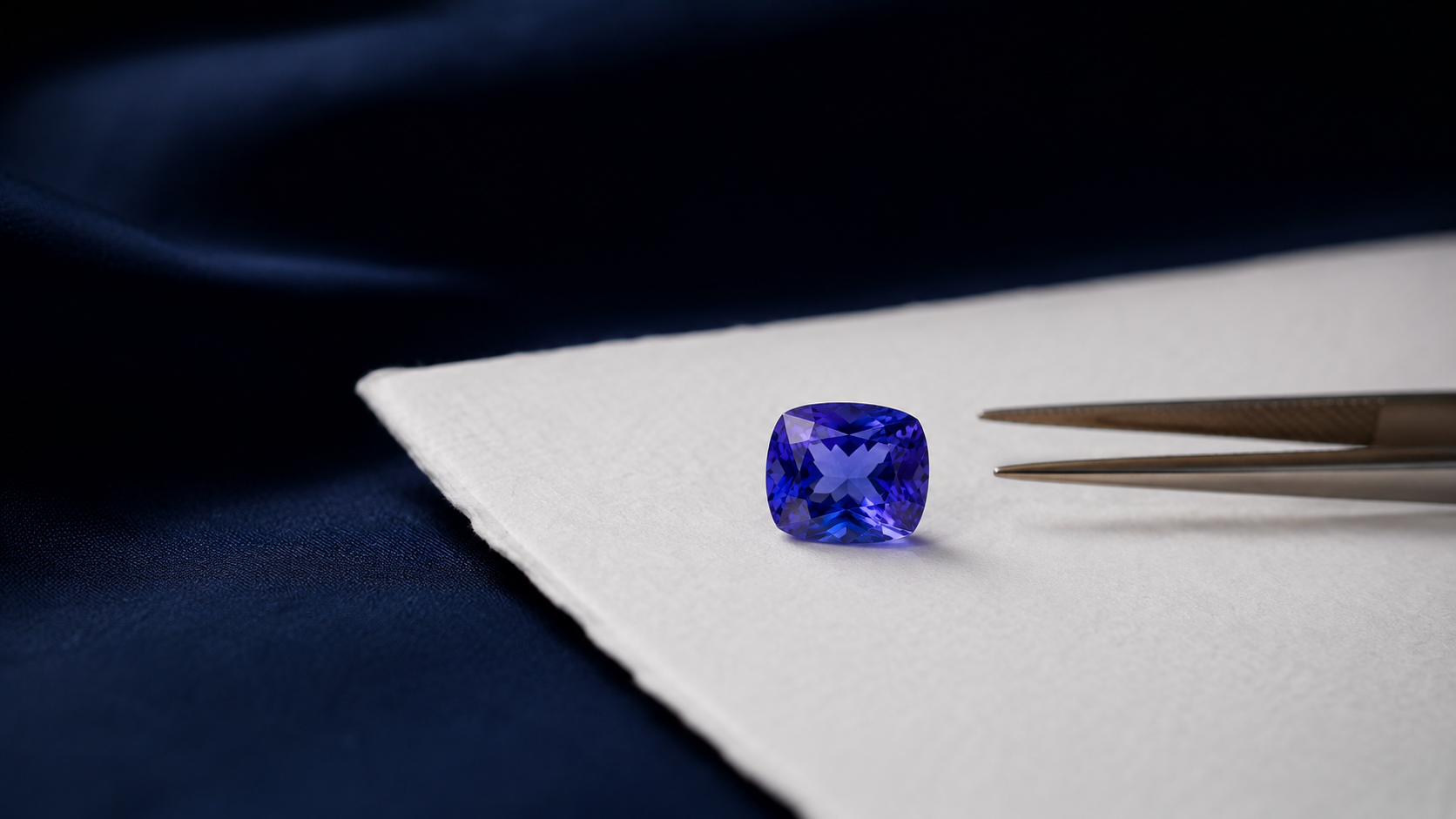
Almost every gem has several sources. Tanzanite has one: a few square kilometres in the Merelani Hills of northern Tanzania, near Kilimanjaro. It was identified in the 1960s and reached jewellery counters within a decade. A tanzanite ring offers a blue with violet in it that no sapphire quite matches, which is the reason to buy one. The reason for caution is that tanzanite is not as tough as the stones it is often compared with.
What tanzanite is
Tanzanite is the blue-violet variety of the mineral zoisite. Its colour comes from vanadium. The stone is strongly pleochroic, showing blue down one direction, violet down another and sometimes a reddish tone down a third. A cutter must choose which face to present, and the choice affects both colour and yield.
Blue-dominant stones are generally priced higher because the cutter has sacrificed weight to orient for blue.
Violet-dominant stones retain more weight and are usually somewhat cheaper. Many buyers prefer them.
The heating question
Almost all tanzanite is heated. Rough from the mine is often brownish, and gentle heating, at temperatures far below those used for sapphire, converts it to blue-violet. The treatment is universal, stable and accepted, and does not need to be a factor between one stone and another. Unheated blue tanzanite exists but is not routinely distinguished at retail.
Durability
This is where the caution comes in.
Hardness. 6 to 7 on the Mohs scale. Softer than quartz sand, which means ordinary dust will scratch it over time.
Cleavage. Tanzanite has a direction of perfect cleavage. A sharp knock at the wrong angle can split it. This is the more serious concern for a ring.
Heat sensitivity. Sudden temperature changes can cause fractures. Avoid ultrasonic and steam cleaners entirely. Warm soapy water and a soft cloth are sufficient.
None of this makes tanzanite unwearable. It makes it a stone for pendants, earrings and occasional-wear rings, or for a daily ring only with a protective setting and an owner who takes it off for anything physical.
Tanzanite versus sapphire
The comparison comes up constantly.
Colour. Tanzanite's violet component gives it a softness sapphire does not have. Fine tanzanite in strong light can look extraordinary.
Toughness. Sapphire at 9 on the Mohs scale, with no cleavage, wins decisively for daily wear.
Price. Tanzanite of good colour costs a fraction of sapphire at the same size, and large clean stones are far easier to find.
Size. Because it is cheaper per carat and forms in large crystals, tanzanite makes sense in sizes where sapphire would be prohibitive.
Grading
There is no universal grading system, though several sellers use their own letters. What matters is saturation, tone, and clarity. Look for a deep, vivid blue-violet without grey, in a stone that is clean to the eye. Pale tanzanite, however large, has limited value.
Setting a tanzanite ring
Bezel or half-bezel settings protect the girdle and reduce the risk of a cleavage-plane knock.
Avoid tension settings and high prong settings that expose the stone.
Choose a cushion or oval over shapes with sharp corners, which are the points most likely to chip.
Metal. White metals emphasise the blue. Rose gold makes the violet come forward and is an unusual, effective pairing.
Buying sensibly
Buy from a seller who states the heating plainly and provides a laboratory report for significant stones. Check that the colour holds in daylight and not only under the shop's lamps. And decide before purchase whether this is an everyday ring or a piece for occasions, because the setting and the expectations should follow from that answer.
Book a complimentary design consultation at the C'Garden atelier, The MET Corporate Towers, Kuala Lumpur: 010-766 7448 · hq@cgarden.com.my
C'Garden is an independent bespoke jeweller in Kuala Lumpur. We are not affiliated with, endorsed by, sponsored by or certified by any organisation, laboratory or brand named in this article. Third-party names are used only to refer factually to those organisations and their published standards. All text and imagery in this article is original work created by C'Garden.
Reference
Gemological Institute of America. (n.d.). Tanzanite. GIA. https://www.gia.edu/tanzanite
All journal entries