
Star Sapphires and Cat's-Eye: Stones With a Moving Light
A star sapphire carries a six-rayed light that moves with the stone. What causes the star, how to judge one, how cat's-eye differs and how to set both.
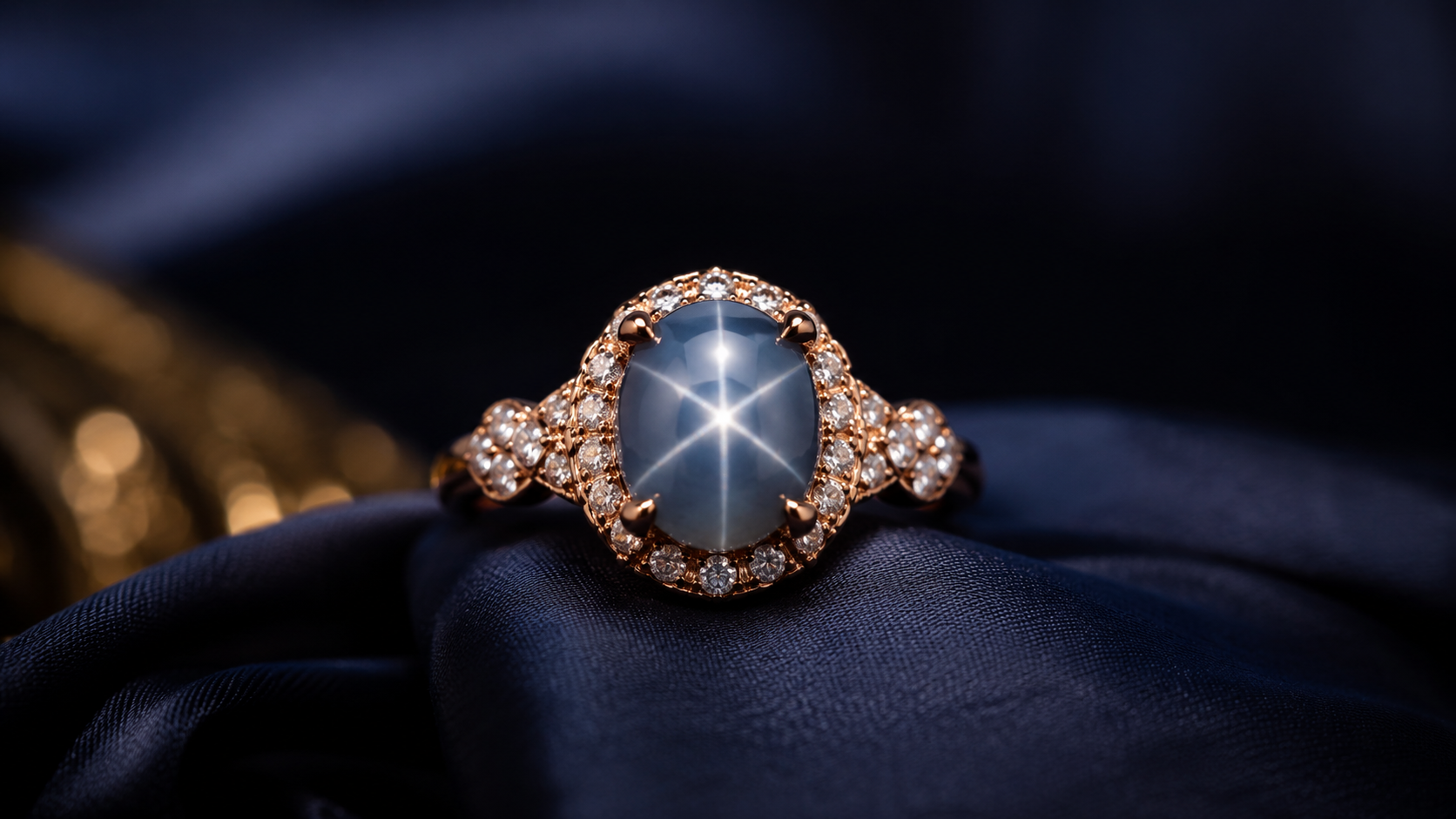
Most gemstones are cut to send light back out in flashes. A star sapphire does something different. Cut as a smooth dome, it shows a six-rayed star that slides across the surface as the hand turns. Cat's-eye stones show a single bright line that does the same. Both effects come from inclusions that would be a fault in a faceted stone and are the whole point here.
What makes the star
Corundum often contains fine needles of rutile, a titanium oxide, which grow in three directions at sixty degrees to one another. When there are enough needles, densely and evenly spread, light reflecting off them forms three bright lines that cross at the top of a cabochon. That is a six-rayed star. The effect is called asterism.
The needles also scatter light generally, which is why star sapphires are translucent rather than transparent, and why their body colour tends to be softer than a faceted sapphire's: greyish blue, milky blue, sometimes black or purplish. A stone cannot be both a sharp star and a saturated transparent blue. The two qualities compete for the same silk.
Star rubies work the same way, in red.
What makes a cat's-eye
Chatoyancy, the single line, comes from needles or hollow tubes that all run in one direction. Many minerals can show it, but when the trade says "cat's-eye" without qualification it means chrysoberyl, which produces the sharpest and most valued eye. Any other stone with the effect must be named: cat's-eye tourmaline, cat's-eye quartz, and so on.
The finest chrysoberyl cat's-eye shows what is called milk and honey. Held under one light with the eye across the stone, one half appears milky and the other half a warm honey colour, and they swap when the stone is rotated.
How to judge one
The light source matters. Stars and eyes need a single point of light: the sun, a torch, a single bulb. Under diffuse office lighting they largely disappear. Any seller who shows you a star only under a spotlight and never in daylight is managing your impression.
Sharpness. The rays should be crisp and reach from the centre to the edge of the dome. Fuzzy, broken or short rays reduce value sharply.
Centering. The star should sit at the top of the dome and stay centred when viewed straight on. Off-centre stars mean the cutter oriented the stone poorly, often to save weight.
Body colour. Given equal stars, a stone with more colour is worth more. A vivid blue star sapphire with a sharp star is rare and priced accordingly.
The dome. A high dome tightens the star and looks better. A very flat cabochon shows a weak star and is usually cut that way to keep weight.
Check the base. Cabochons are sometimes left with a rough or heavy base to add carat weight. That is dead weight you pay for.
Treatments and synthetics
Star sapphires can be heated, and stars can be induced or improved by diffusion of titanium into the surface. Synthetic star sapphires and rubies have been made since the mid twentieth century and are common; they typically show unnaturally perfect, sharp stars on evenly coloured bodies. For any stone of consequence, a laboratory report identifying the material as natural and stating treatment is the sensible step.
Setting and wear
Star sapphire and chrysoberyl are both hard, 9 and 8.5, and cabochons have no facet edges to chip. They are excellent everyday stones, which is why star sapphires have a long history in men's rings.
A bezel suits them well. A closed back is fine because the effect comes from reflected light off the dome, not light passing through. Set the stone so the star is centred when the hand is held naturally, not when the ring is viewed from above on a bench, which is a detail a careful setter will check on the finger.
Book a complimentary design consultation at the C'Garden atelier, The MET Corporate Towers, Kuala Lumpur: 010-766 7448 · hq@cgarden.com.my
C'Garden is an independent bespoke jeweller in Kuala Lumpur. We are not affiliated with, endorsed by, sponsored by or certified by any organisation, laboratory or brand named in this article. Third-party names are used only to refer factually to those organisations and their published standards. All text and imagery in this article is original work created by C'Garden.
Reference
Gemological Institute of America. (n.d.). Sapphire. GIA. https://www.gia.edu/sapphire
All journal entries