
Spinel: The Stone That Was Mistaken for Ruby for Centuries
Spinel gemstone was confused with ruby in crown jewels for centuries. What it is, how it differs from corundum, which colours matter, and how it wears.
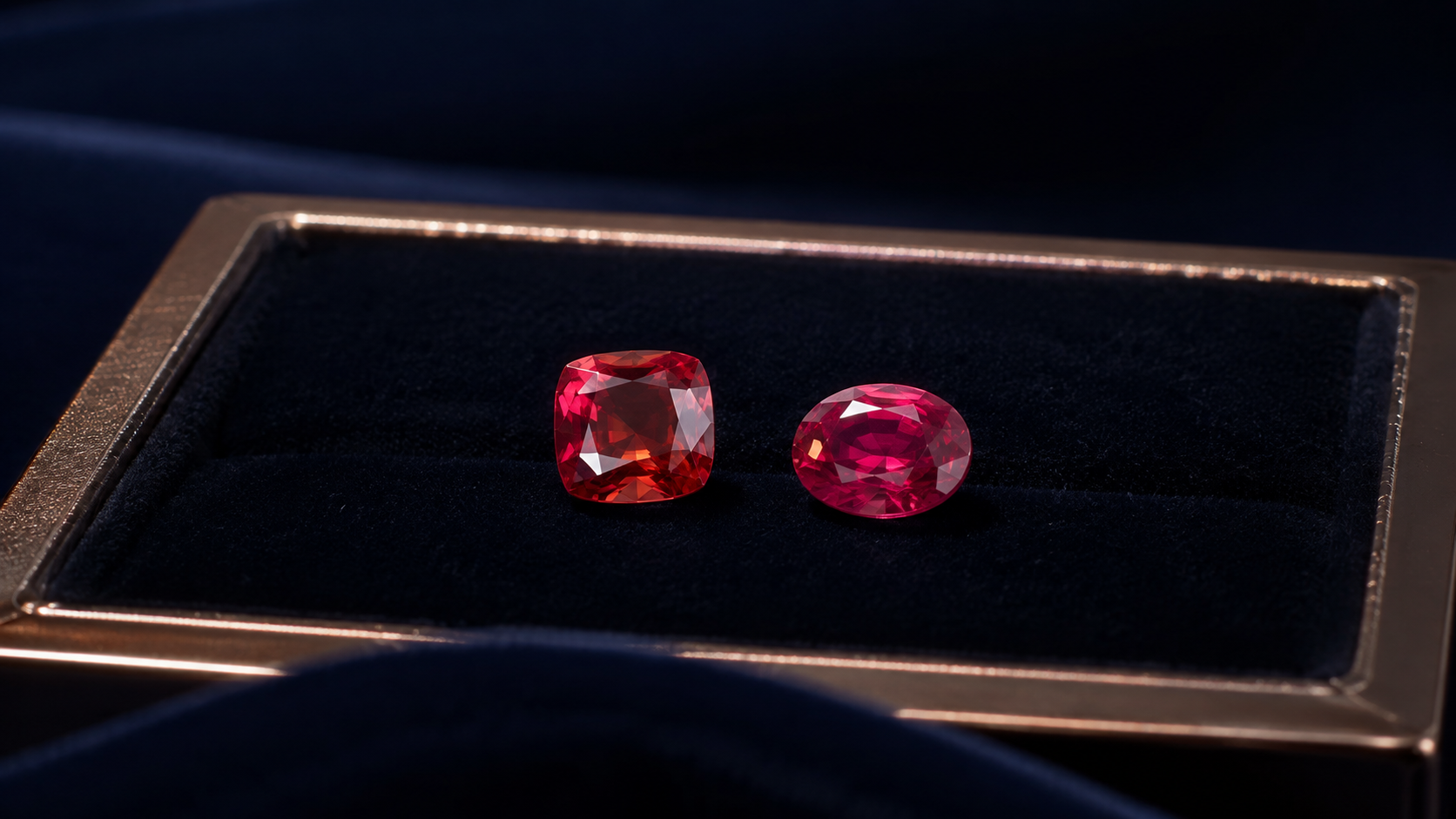
Several of the most famous "rubies" in European royal collections are not rubies. They are spinel, identified as such only once gemmology caught up with the stones in the eighteenth and nineteenth centuries. The spinel gemstone spent most of history in ruby's shadow and is only now being valued for what it is: a hard, bright, untreated stone available in a range of colours that corundum cannot match.
What spinel is
Spinel is a magnesium aluminium oxide. Ruby and sapphire are aluminium oxide. The two form in the same geological environments, often in the same marble deposits, which is why they were dug up together and confused for so long. Red spinel and ruby both owe their colour to chromium.
Hardness. Spinel is 8 on the Mohs scale. Corundum is 9. Both are well above the threshold for daily wear.
Optics. Spinel is singly refractive, like diamond and garnet. Corundum is doubly refractive. This is the simplest laboratory test, and it settles the question in seconds.
Crystal shape. Spinel forms octahedra, and well-formed crystals are sometimes so clean they are set uncut.
Why it was mistaken for ruby
Before optical instruments, stones were identified by colour, hardness and where they were found. Red spinel matched ruby on all three well enough. Large clean red spinel is actually more common than large clean ruby, so the most impressive "rubies" of the period were disproportionately spinel.
The colours that matter
Red. The classic. Fine red spinel is a pure, slightly softer red than ruby, without the purplish or pinkish overtones some rubies carry. Top material from Burma and Tanzania is priced seriously, though still well below ruby of similar quality.
Pink and hot pink. Vivid pinks from Tanzania and Vietnam have become the most sought-after colours of the past two decades.
Cobalt blue. Coloured by cobalt rather than iron, a saturated blue rare enough that fine stones are collector pieces. Most blue spinel is greyish; true cobalt blue is a different proposition.
Grey, lavender and violet. Fashionable, subtle, and inexpensive relative to their charm.
Black. Opaque, hard, and a sensible alternative to onyx in men's pieces.
The untreated advantage
Almost all spinel on the market is untreated. There is no routine heating, no filling, no diffusion. What you see is what came out of the ground. For buyers wary of the treatment disclosure questions that follow ruby and sapphire, this is spinel's quiet strength. A laboratory report still makes sense for a significant stone, but the report will usually be short.
Synthetic spinel
Synthetic spinel has been made for a century and was common in class rings and inexpensive birthstone jewellery, often in colours natural spinel rarely shows. Any spinel offered as natural at a serious price should have a report saying so. Laboratories separate the two reliably.
Spinel in jewellery
Engagement rings. Hard enough, bright enough, and the pinks and reds carry well against both white and yellow metals.
Daily wear. Handles knocks and heat well; no special care beyond the ordinary.
Value. Prices have risen considerably as the stone has been recognised, but fine spinel still costs a fraction of comparable ruby or pink sapphire. It offers the best colour per ringgit of any stone in its hardness class.
Buying well
Look for even colour without grey or brown modifiers, good transparency, and a cut that returns light rather than a window through the middle. Ask for origin only if paying for it. And be pleased, rather than disappointed, if an old family "ruby" turns out to be spinel. The kings who owned them were not disappointed either, because nobody told them.
Book a complimentary design consultation at the C'Garden atelier, The MET Corporate Towers, Kuala Lumpur: 010-766 7448 · hq@cgarden.com.my
C'Garden is an independent bespoke jeweller in Kuala Lumpur. We are not affiliated with, endorsed by, sponsored by or certified by any organisation, laboratory or brand named in this article. Third-party names are used only to refer factually to those organisations and their published standards. All text and imagery in this article is original work created by C'Garden.
Reference
Gemological Institute of America. (n.d.). Spinel. GIA. https://www.gia.edu/spinel
All journal entries