
Signet Rings: An Old Form With a Modern Use
A signet ring is one of the oldest jewellery forms still in daily use. Shapes, engraving methods, which finger to wear it on and how to make one last.
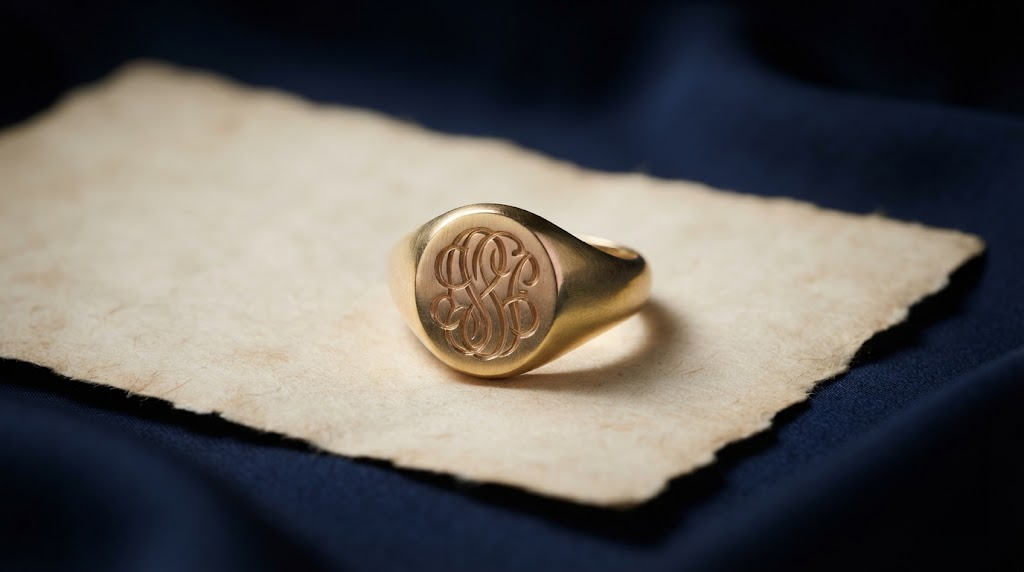
A signet ring was originally a tool. The flat face carried a reversed design that, pressed into wax, sealed a letter and proved who had sent it. Nobody seals letters now, but the form survived because it turned out to be a very good ring: a solid, low, plain object that carries a small amount of personal meaning on its face.
It is now worn by men and women, in every metal, with everything from family crests to a single initial. Here is what goes into designing one properly.
The face
Shape. Oval is the classic and the most flattering on most hands. Cushion, round, rectangular and shield shapes are all traditional. Oval faces are usually set with the long axis along the finger; some people prefer it across.
Size. Small faces, around 10mm by 8mm, suit a little finger and read as discreet. Large faces, 14mm by 12mm and up, suit a broader hand and give the engraver room. The face should not overhang the finger on either side.
Flat or slightly domed. A flat face is the traditional surface for engraving. A gently domed face is more comfortable against the neighbouring finger and catches light better if left plain.
The engraving
This is what separates a signet from a plain flat-top ring.
Seal engraving is the historic method: the design is cut in reverse and in relief, deep enough to leave a raised impression in wax. It is skilled, slow work done by hand with gravers, and the result reads as dark and shadowed on the ring. Very few engravers still do it well.
Surface engraving cuts the design the right way round, shallow, for reading directly. Most modern signets use this. It can be done by hand or by machine; hand work has more depth and character.
What to put on it. Initials in a monogram are the most common. Family crests where they exist. A single motif: an animal, a plant, a small geometric device. Chinese family name characters engrave beautifully and are a natural choice here. Keep it simple; a signet face is small and a busy design becomes a smudge.
Leaving it blank is also a choice. A plain polished face is a modern look, and the ring can be engraved later.
Metal and weight
A signet needs weight. The face has to be thick enough for deep engraving, and the shoulders have to carry it without the ring feeling top-heavy. In practice this means 750 gold or platinum for anything with detail, because they hold crisp edges. 916 gold makes a handsome plain signet but softens engraving faster.
A well-made signet in a medium size typically weighs somewhere between 8 and 15 grams. Light signets look and feel like costume pieces.
Which finger
Tradition puts a signet on the little finger of the non-dominant hand, and that is still where most are worn. It keeps the ring away from the fingers that do the work, and it sits clear of a wedding band.
The ring finger of the right hand, and the index finger, are also common now, particularly for larger faces. There is no wrong answer, but the finger decides the face size, so choose the finger first.
Adding a stone
Some signets set a flat slice of hardstone in the face instead of engraving the metal: bloodstone, onyx, carnelian, lapis, jade. The stone can itself be engraved, which is a specialist skill, or left plain. Stone-faced signets are slightly more fragile at the edges and should be bezel-set with a decent rim of metal.
Designing one that will be inherited
A signet is one of the few pieces of jewellery that is genuinely designed to be passed down, and the design choices that make it last are simple: a thick face, a substantial shank, an engraving with real depth, and a metal that can be refinished a dozen times over a century without losing the design.
Book a complimentary design consultation at the C'Garden atelier, The MET Corporate Towers, Kuala Lumpur: 010-766 7448 · hq@cgarden.com.my
C'Garden is an independent bespoke jeweller in Kuala Lumpur. We are not affiliated with, endorsed by, sponsored by or certified by any organisation, laboratory or brand named in this article. Third-party names are used only to refer factually to those organisations and their published standards. All text and imagery in this article is original work created by C'Garden.
Reference
Victoria and Albert Museum. (n.d.). Jewellery. V&A. https://www.vam.ac.uk/collections/jewellery
Jewelers of America. (n.d.). Buying jewelry. Jewelers of America. https://www.jewelers.org/buying-jewelry
All journal entries