
Salt-and-Pepper and Black Diamonds: The Unconventional Choice
A salt and pepper diamond is a stone the traditional trade would reject. Why some buyers want one, how black diamonds are made, and the durability issues.
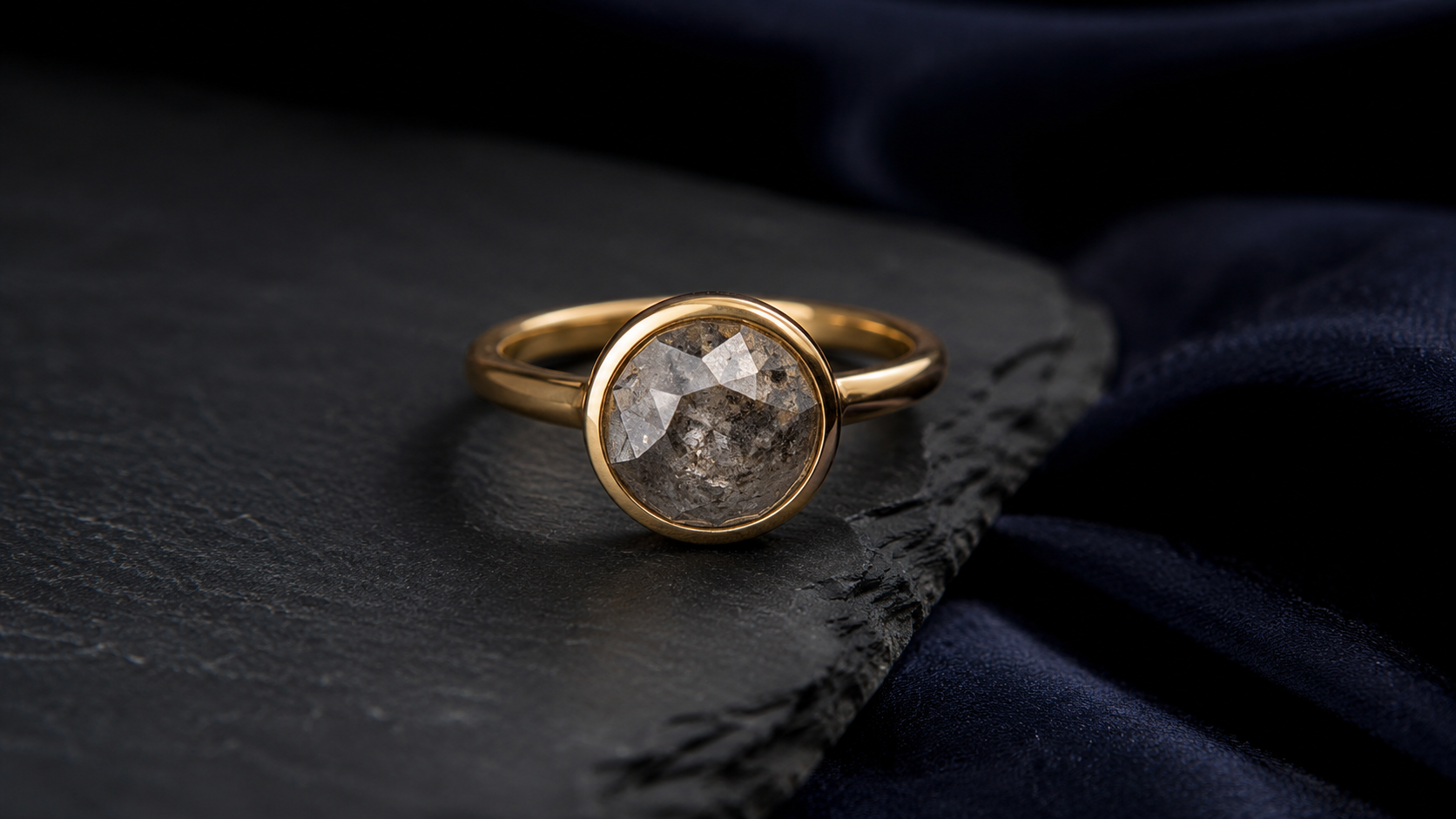
A salt and pepper diamond is exactly what the name suggests: a diamond so full of black and white inclusions that it looks speckled, smoky or galaxy-like rather than clear. Twenty years ago these stones were cut for industrial use or sold for almost nothing. Now they have a following, mostly among buyers who want a diamond without the conventions that come with one.
Black diamonds are the extreme end of the same idea. Both deserve a clear-eyed look before you commit, because they behave differently from the clean stones most advice is written for.
What is actually in a salt and pepper diamond
The black specks are usually graphite or sulphide minerals trapped when the crystal grew. The white clouds are tiny fractures and mineral inclusions that scatter light. In a clarity-graded diamond these would all be counted against the stone. In a salt and pepper diamond they are the point.
Because the interior is the feature, these stones are rarely cut as brilliants. Brilliant cutting is designed to bounce light around a transparent interior, which an included stone cannot do. Instead they are usually rose cut, with a flat back and a low dome of triangular facets, or cut as flat slices. The shape shows the pattern and keeps the stone low on the finger.
No two are alike, and they are not graded on colour or clarity in the usual way. You buy the individual stone on its look.
Durability, honestly
Diamond is still diamond: the hardest natural material, Mohs 10, resistant to scratching by anything else you will encounter. That does not change.
What changes is toughness. A heavily included stone has internal planes of weakness. A hard knock on a fracture that reaches the surface can propagate it. Salt and pepper diamonds are not fragile, but they are not as forgiving as a clean stone of the same size, and the flat rose cut has a thin edge that a brilliant does not.
The practical response is a bezel setting, with metal covering the girdle all the way round, and a low profile. That suits the aesthetic in any case; most of these rings are designed that way.
Black diamonds are a separate story
Natural black diamonds get their colour from dense graphite inclusions throughout the stone. They are opaque and take a polish, but the surface often shows tiny pits where inclusions meet the facets. Truly natural black stones of good appearance are uncommon.
Treated black diamonds are the ones you will usually be offered. Low-quality, heavily included grey or brown diamonds are irradiated or heated at high temperature until they turn uniformly black. The result is stable and inexpensive. It is still diamond, but the colour is not natural and a reputable seller will say so. A laboratory report on a black diamond will state whether the colour is natural or treated, and gives a single colour description, Fancy Black, rather than a graded scale.
Polishing is harder. The graphite that makes a stone black is much softer than diamond, so facet edges on black diamonds are frequently rougher than on a colourless stone. This is normal and not a defect.
Who these stones suit
Buyers who want something individual and are comfortable with a stone that will never be compared on a grading chart. Buyers who prefer a low, quiet ring to a bright one. Buyers on a limited budget who would rather have a large, characterful diamond than a small clean one.
They suit less well anyone who wants a stone that can be valued, insured or resold on the basis of a report, since the market for them is small and appearance-driven.
Questions to ask
Is the stone natural and untreated, or treated, and is that in writing? Are there fractures that reach the surface? What cut is it, and how thin is the edge? What setting is proposed to protect it? And, because it is the only thing that matters with these stones, do you like this exact one.
Book a complimentary design consultation at the C'Garden atelier, The MET Corporate Towers, Kuala Lumpur: 010-766 7448 · hq@cgarden.com.my
C'Garden is an independent bespoke jeweller in Kuala Lumpur. We are not affiliated with, endorsed by, sponsored by or certified by any organisation, laboratory or brand named in this article. Third-party names are used only to refer factually to those organisations and their published standards. All text and imagery in this article is original work created by C'Garden.
Reference
Gemological Institute of America. (n.d.). Diamond clarity. GIA. https://www.gia.edu/diamond-clarity
All journal entries