
Rings for Nurses, Chefs and Other Hands-On Jobs
Rings for nurses, chefs, dentists and tradespeople face gloves, hand washing, heat and impact all day. What survives, and how to design around it.
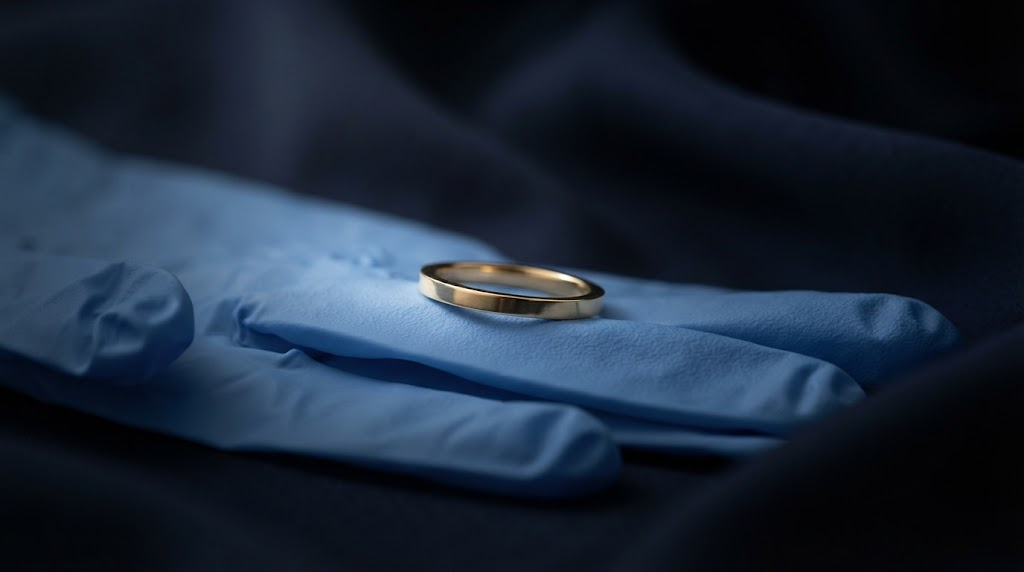
Rings for nurses, chefs, dentists, mechanics, physiotherapists and anyone else who works with their hands are a specific design problem. The ring is not just worn; it is washed forty times a day, pushed through gloves, knocked against steel and heated over a stove. Most engagement ring conventions were not written for that.
What the job does to a ring
Hand washing and sanitiser. Constant water and alcohol gel do little harm to gold or platinum, but they strip oils from the skin under the band, and residue builds up under a setting with a gallery. Soap film also dulls stones.
Gloves. A raised stone or prong tears nitrile gloves and, in clinical settings, makes glove changes slower. Many hospitals restrict rings for exactly this reason and some infection control policies allow only a plain band, if that.
Heat and grease. Kitchens coat a ring in fat that hardens into a film around stones. Heat alone does not damage gold, but a hot pan handle against a ring conducts heat to the finger fast.
Impact and torque. Trades that involve spanners, trolleys or patient handling bend shanks and loosen stones. A ring caught on equipment can cause degloving injuries; this is the reason many workplaces ban rings outright, and it should be taken seriously.
Designs that work as rings for nurses and chefs
A plain band. Low, smooth, no stones. The only design that meets most clinical policies, and the one that survives everything above.
Flat or low-dome profile, with a comfort-fit interior so it turns freely and does not trap water.
Two to three millimetres wide. Narrow enough to sit under a glove without a ridge, wide enough not to cut in.
Flush-set stones, if a stone is wanted. A small diamond sunk into the band with its table level with the surface has no prong and cannot snag. It is the most durable stone setting made.
Bezel-set stones, as the next step up. A low bezel presents a smooth edge, though it still adds height.
Platinum or 18k gold. Platinum wears by displacement rather than loss, so a band keeps its weight. 18k gold is harder than 22k and holds a flush setting better. Both are nickel-free in the right alloy, which matters with hands that are constantly wet.
What to avoid
Prong settings, cathedral shanks, halos, pavé and anything above about two millimetres off the finger. Soft stones such as emerald and opal. Very thin bands, which bend under torque. Plated white gold, because plating wears through in weeks under constant washing.
The two-ring approach
Many people in hands-on work simply own two rings. A plain band or a silicone band for work, and the engagement or dress ring for the rest of the week. It removes every compromise from the design of the ring that matters, and it is what most experienced nurses and chefs eventually do anyway.
A silicone band is inexpensive, breaks away under load rather than injuring the finger, and can be thrown away when it discolours. It is not jewellery, but it does the job.
Sizing for gloves and swelling
Hands that are wet, hot and active swell through a shift. Size a work band slightly generous and choose a comfort-fit profile. Check the fit at the end of a long shift, not at the start.
The honest answer
If the workplace bans rings, wear it on a chain, and design the ring you actually want for the life outside work.
Book a complimentary design consultation at the C'Garden atelier, The MET Corporate Towers, Kuala Lumpur: 010-766 7448 · hq@cgarden.com.my
C'Garden is an independent bespoke jeweller in Kuala Lumpur. We are not affiliated with, endorsed by, sponsored by or certified by any organisation, laboratory or brand named in this article. Third-party names are used only to refer factually to those organisations and their published standards. All text and imagery in this article is original work created by C'Garden.
Reference
World Health Organization. (2009). WHO guidelines on hand hygiene in health care. World Health Organization. https://www.who.int/publications/i/item/9789241597906
All journal entries