
Ring Profiles: Comfort Fit, Flat and D-Shape Explained
A comfort fit ring, a flat band and a D-shape can be the same width and feel completely different. What each profile is, how it wears and how it is sized.
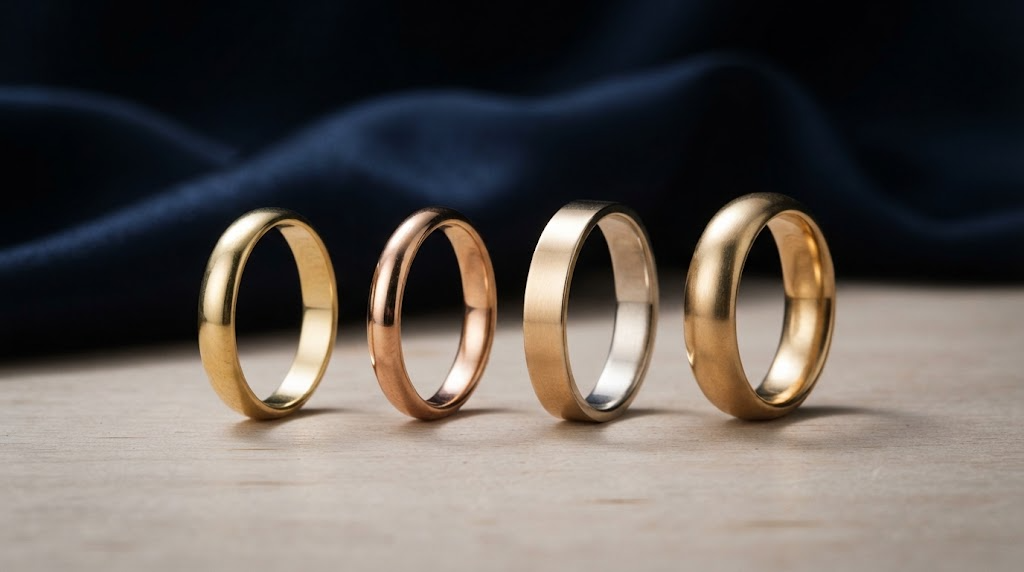
Most people choosing a wedding band think about width, metal and finish. The profile, meaning the shape of the band in cross-section, is decided by default. Yet the profile is what the finger actually feels all day. A comfort fit ring and a flat band of identical width can be worn by the same person and one will be forgotten by lunchtime while the other is noticed every hour.
The four common profiles
D-shape. Flat on the inside, rounded on the outside. Cut the band through and the section looks like a capital D. The traditional profile for a plain wedding band. Slim, sits close to the finger, and the rounded top catches light softly.
Flat. Flat on the inside and the outside, with squared or lightly softened edges. Modern, architectural, and gives the widest surface for engraving or a brushed finish. The edges are what you notice, against the neighbouring finger and when making a fist.
Court, also called comfort fit. Rounded on both the inside and the outside. The inner curve means only a narrow band of metal touches the finger, so the ring slides on and off more easily and does not press a hard edge into the skin. This is the profile most workshops now recommend for a band worn every day.
Flat court. Flat on the outside, rounded on the inside. The look of a flat band with the feel of a comfort fit. A good answer for anyone who wants the modern outside without the edges inside.
How each one wears
D-shape and court roll past the knuckle easily and rarely pinch. Because the outer surface is curved, scratches show less and polish out easily.
Flat bands show scratches on their flat faces and edges, particularly in a high polish, and a wide flat band in a fist can dig at the sides. Brushed or matte finishes suit them because the marks blend in.
Flat court behaves like a flat band on the outside and like a court on the inside.
Width interacts with all of this. A 2.5 mm D-shape is barely noticed in any profile. A 7 mm band is where the inside curve matters, because a flat inside on a wide band traps the skin between the knuckle and the band and makes the ring feel tight in heat.
Profile and sizing
This is the practical point most people miss. A comfort fit ring touches the finger only along its inner ridge, so it feels looser than a flat-inside band of the same nominal size. Workshops commonly recommend that a court or comfort fit band be made a fraction smaller, often a quarter to half a size, than the wearer's measurement in a flat-inside band. The reverse applies when moving from a comfort fit to a flat profile.
Wide bands need a slightly larger size again, regardless of profile, because they cover more of the finger.
The reliable way to settle it is to be sized with a sizer of the same profile and width as the intended ring. A thin sizing ring gives the wrong answer for a wide court band. In Kuala Lumpur, where fingers swell through the day in the heat, size in the afternoon, not first thing.
Profile and weight
For a given width and thickness, a court band uses more metal than a D-shape, and a flat band uses the most. The difference is not large on a narrow band but becomes noticeable in platinum or heavy gold at 5 mm and above. It affects cost and how the ring feels on the hand.
Matching an engagement ring
The wedding band's profile should sit against the engagement ring without a gap. A court band next to a flat-shouldered engagement ring leaves a sliver of daylight. If the engagement ring has a low, straight shank, a flat or flat court band sits flush. If it has a rounded shank, D-shape or court matches. Bring the engagement ring to the fitting.
Choosing
Try the same width in two or three profiles. Make a fist. Slide each over the knuckle. Wear one for the length of the appointment. The right profile is the one you stop feeling, and that is usually a court or flat court for daily wear.
Book a complimentary design consultation at the C'Garden atelier, The MET Corporate Towers, Kuala Lumpur: 010-766 7448 · hq@cgarden.com.my
C'Garden is an independent bespoke jeweller in Kuala Lumpur. We are not affiliated with, endorsed by, sponsored by or certified by any organisation, laboratory or brand named in this article. Third-party names are used only to refer factually to those organisations and their published standards. All text and imagery in this article is original work created by C'Garden.
Reference
Jewelers of America. (n.d.). Buying jewelry. Jewelers of America. https://www.jewelers.org/buying-jewelry
All journal entries