
Resetting a Diamond Into a New Ring: What It Involves
To reset diamond ring stones into a new mount, a workshop unsets, measures, records and redesigns around the stone. Each step, with risks and timing.
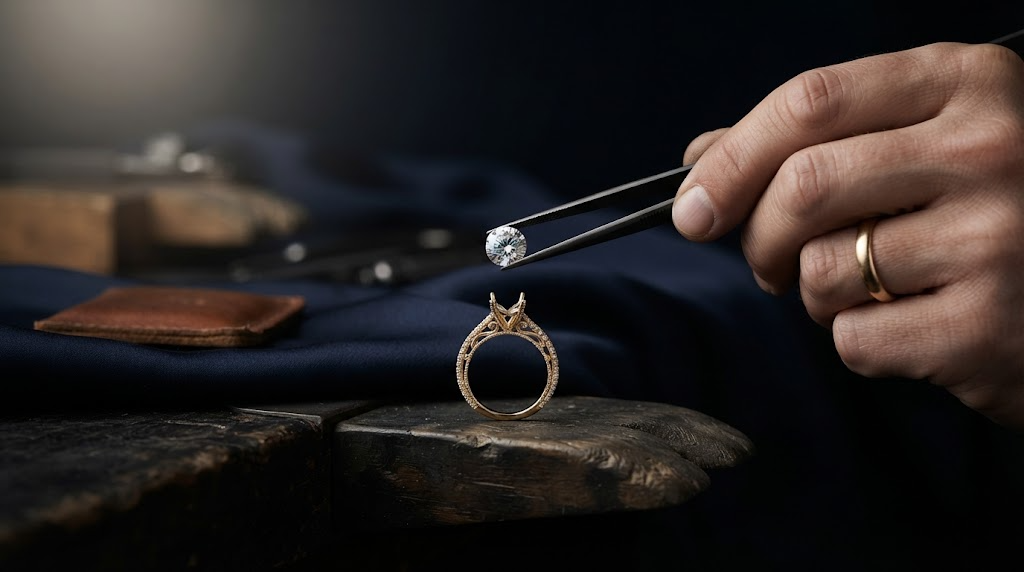
People come to reset diamond ring stones for three main reasons: the setting has worn out, the design no longer suits them, or the stone has been inherited and its original ring belongs to someone else's taste. In every case the diamond is the valuable part and the mount is the replaceable part, which makes resetting one of the most sensible commissions in jewellery.
It is also one that people worry about, because it means handing over a stone. This is what actually happens.
Step one: assessment
Before anything is unset, the workshop examines the ring under magnification. They are looking at the stone for chips, particularly at the girdle and the culet, and for any existing damage that could worsen when the prongs are lifted. They are looking at the setting for how the stone is held and what it will take to release it.
This is also when the stone's identity is recorded. Measurements to a hundredth of a millimetre, weight if it can be established, and a plot of any visible inclusions. If the stone has a laboratory report, its laser inscription on the girdle is checked. All of this is written down and given to you, so that the stone that goes back is provably the stone that came out.
Step two: unsetting
Prongs are lifted with fine tools; bezels are eased back; channel walls are opened. Done carefully, unsetting takes minutes and does no harm to the diamond. The old mount is usually damaged in the process and is either returned to you or credited as scrap gold, which offsets some of the cost of the new ring.
Diamonds are hard but not unbreakable. A stone with an existing feather at the girdle can chip when pressure is applied. A good workshop will tell you about this risk before starting rather than after.
Step three: designing around the stone
Now the stone can be measured properly, off the mount, and the new ring designed to its exact dimensions. Old stones are often slightly out of round, or cut to older proportions with a smaller table and a higher crown, and the new setting is built to suit. This is where resetting differs from buying a ready-made mount: a mount made for a generic 6.5mm round will not fit a 6.3mm by 6.6mm antique stone well.
The design conversation is the same as for any bespoke ring, with one difference: the stone is fixed, and everything else is chosen to flatter it.
Step four: making and setting
The new ring is modelled, approved, cast and finished as an empty mount. Only then is the diamond set, by hand, and every prong or wall checked under magnification. The finished ring is cleaned and the stone re-measured against the record from step one.
Timing and cost
Resetting typically takes the same time as any bespoke ring, commonly three to six weeks from approved design, because the mount is made from scratch. Cost is the cost of the new ring minus the stone, and minus whatever the old gold is worth. A simple solitaire mount is a modest project; a full pavé halo is not.
Three questions to ask
Will you document the stone before and after? The answer should be yes, in writing.
Can I watch the unsetting? Many workshops will do it in front of you, and it removes any doubt.
What happens to the old mount? It is yours. Decide in advance whether you want it back.
What resetting cannot do
It cannot make a small stone larger, though a halo or a raised setting can make it appear so. It cannot fix a chipped or poorly cut diamond; recutting is a separate process that removes weight. And it cannot change the stone's colour or clarity. What it can do is take a diamond that has been unworn for years and put it back on a hand, in a ring made for the person wearing it.
Book a complimentary design consultation at the C'Garden atelier, The MET Corporate Towers, Kuala Lumpur: 010-766 7448 · hq@cgarden.com.my
C'Garden is an independent bespoke jeweller in Kuala Lumpur. We are not affiliated with, endorsed by, sponsored by or certified by any organisation, laboratory or brand named in this article. Third-party names are used only to refer factually to those organisations and their published standards. All text and imagery in this article is original work created by C'Garden.
Reference
Gemological Institute of America. (n.d.). Diamond quality factors. GIA. https://www.gia.edu/diamond-quality-factor
Jewelers of America. (n.d.). Jewelry repair and care. Jewelers of America. https://www.jewelers.org/buying-jewelry/jewelry-repair-and-care
All journal entries