
Radiant and Asscher Cuts: Two Squares That Behave Very Differently
Radiant cut vs asscher cut: both are squares with cut corners, but one sparkles and one glows. How each is faceted, what each demands and who each suits.
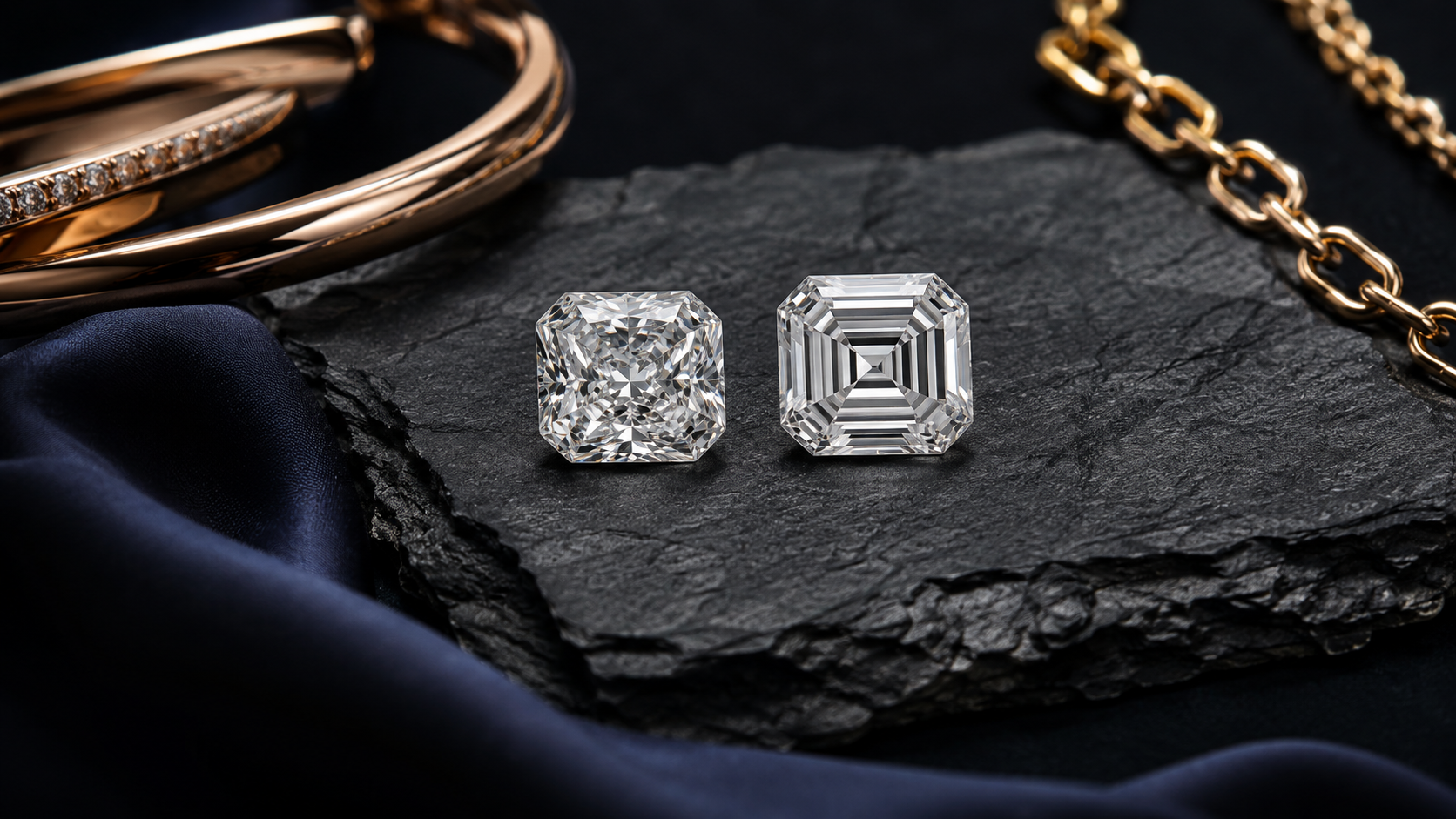
Put a radiant and an Asscher side by side, outlines only, and they are nearly the same shape: a square with the corners cut off. Turn them face up and they could not be more different. The question of radiant cut vs asscher cut is really a question about what kind of light you want from a square stone.
The Asscher
The Asscher is a square step cut. Its facets are arranged in concentric squares stepping down toward a small culet, like looking down a staircase from above. The corners are cut wide, which gives the stone an almost octagonal outline. Face up, the pattern reads as a series of nested squares, sometimes with an X across the centre where the pavilion facets meet.
It does not sparkle. It flashes, slowly, in broad planes of light and dark, and at rest it has a deep, clear, almost liquid quality. It is the same optical family as the emerald cut, and it makes the same demands.
Colour shows. The open facets give the eye time to read tint. G or better in white metal is the usual advice.
Clarity shows. Inclusions under the table are exposed. VS1 is the comfortable floor; anything lower needs to be seen loose.
Cut quality shows. Uneven steps, an off-centre culet or corners of different sizes are all obvious.
It looks smaller. Asschers carry a good deal of their weight in depth, so a one carat Asscher typically has a smaller face-up spread than a one carat round or radiant.
The Radiant
The radiant is a square or rectangular brilliant with cut corners. It was developed to bring the sparkle of a round brilliant to a squared outline, and it succeeds. The pavilion is faceted in the brilliant style, with many triangular and kite-shaped facets that break light into fine, lively flashes.
It behaves like a brilliant.
Colour is masked. The scatter of light hides body tint well. Radiants are often chosen for fancy coloured diamonds for the opposite reason, because the same faceting intensifies colour when the stone has it, but in a near colourless stone the effect is flattering.
Clarity is forgiving. SI1 radiants are frequently eye clean.
Cut quality is harder to judge. Because most reports do not grade radiant cut quality, and because the faceting is busy, faults are less obvious but also harder to identify. Look for even brightness with no dark patches at the corners.
It looks larger. Radiants tend to spread well for their weight, and elongated radiants at a ratio of 1.20 to 1.35 read distinctly larger than a square of the same carat.
Which corners
Both cuts have clipped corners, and in both cases that is the reason they wear well. There are no points to chip. Standard prongs at the corners are sufficient; V-prongs are not needed the way they are for a princess cut.
The Asscher's corners are typically cut wider than the radiant's, which is part of why it reads as octagonal.
Choosing between them
Choose an Asscher if you like architecture, restraint and a stone that rewards being looked into rather than at. It suits vintage and Art Deco designs, plain bands and bezel settings. Budget for a higher colour and clarity grade.
Choose a radiant if you want maximum light from a squared shape, a stone that hides its imperfections and a face-up size that flatters the carat weight. It suits halos, pavé and modern settings, and it tolerates a lower clarity grade with confidence.
Choose neither without seeing both in the same light. They are the clearest demonstration in diamond cutting that shape and faceting are separate decisions, and that the faceting is the one that decides how a stone feels.
One caution on the Asscher
The name is used loosely. The original design is a specific patented cut, and many stones sold as Asschers are simply square emerald cuts of varying quality. That is not a problem in itself, but it means the name guarantees nothing. Judge the stone.
Book a complimentary design consultation at the C'Garden atelier, The MET Corporate Towers, Kuala Lumpur: 010-766 7448 · hq@cgarden.com.my
C'Garden is an independent bespoke jeweller in Kuala Lumpur. We are not affiliated with, endorsed by, sponsored by or certified by any organisation, laboratory or brand named in this article. Third-party names are used only to refer factually to those organisations and their published standards. All text and imagery in this article is original work created by C'Garden.
Reference
Gemological Institute of America. (n.d.). Diamond cut. GIA. https://www.gia.edu/diamond-cut
All journal entries