
Princess Cut Diamonds: Protecting the Corners
A princess cut diamond has four sharp corners, the most vulnerable points on any diamond. Why they chip, how V-prongs protect them and what to check first.
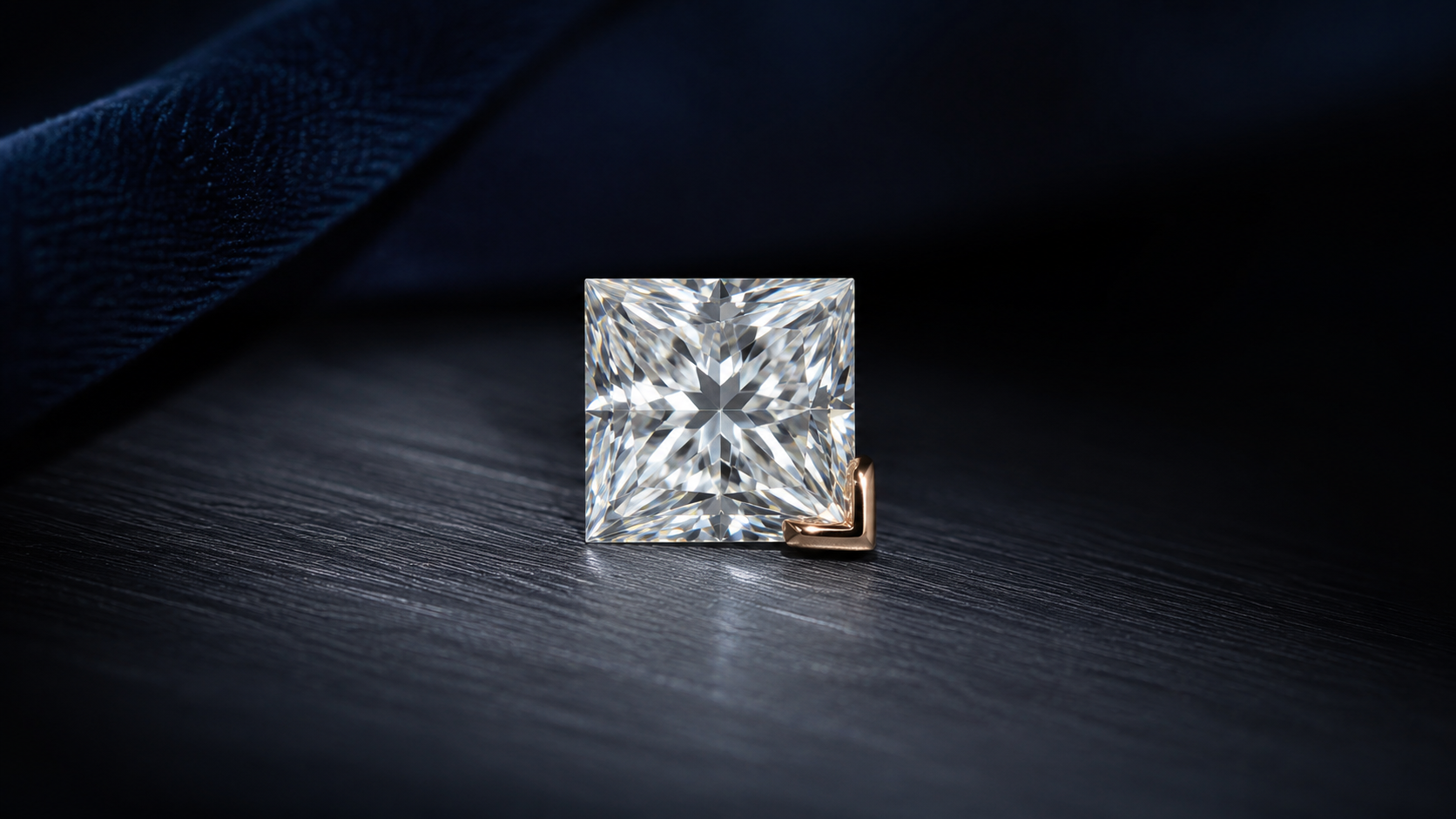
A princess cut diamond is a square brilliant: the outline of a square, the faceting of a round, and more sparkle per carat than almost any other square shape. It also has four sharp, unprotected corners, and those corners are the reason this cut needs more thought at the setting stage than any other.
Why corners chip
Diamond is the hardest natural material, but hardness is resistance to scratching. Toughness, resistance to breaking, is a different property, and diamond is only moderately tough. It has cleavage planes, directions along which it can split cleanly if struck the right way.
A corner is a point where the stone is thin and where any impact concentrates. A round brilliant spreads a knock across a curved girdle. A princess cut takes the same knock on a point. If the point is at or near a cleavage direction, and the corners of a princess cut often are, a sharp tap on a door frame can remove a flake of stone.
Chipped corners are the most common damage seen on princess cuts. It is not a design flaw so much as a design consequence, and the setting exists to manage it.
What protects them
V-prongs. The standard solution. Instead of a round claw resting on the corner, a prong shaped like a small V wraps around it, covering the point on both sides. A well-made V-prong takes the impact before the stone does. Ask for them specifically; a princess set with ordinary round prongs is under-protected.
Bezel or half bezel. Metal running around the whole outline, or around the corners only, removes the problem entirely. It changes the look, making the stone read slightly smaller and softer, but it is the most secure option for anyone who is hard on rings.
Channel setting. Small princess cuts set in a row, with the corners tucked under a rail of metal on either side, are well protected. This is why the princess cut is so common in channel-set bands.
Low setting. Any stone that sits low catches less. A princess cut set high on thin prongs is asking for trouble.
Before buying: check the corners loose
Because chipping is the known risk, inspect the stone before it is set.
Look at each corner under a loupe. A chip or a small area of missing material may already be there, and the setting will hide it until the day the prong is moved.
Check the girdle thickness at the corners. Some cutters leave the girdle very thin at the points to save weight. A thin corner girdle is far more fragile than a medium one. The report may note girdle thickness as a range; "very thin" anywhere on a princess cut is a reason to pause.
Look for inclusions near the corners. A feather or crystal sitting close to a point weakens it. The plotted diagram will show this.
Ratio and cut
A princess should be square or very close to it. A ratio of 1.00 to 1.05 reads as square; above about 1.10 it begins to look like a rectangle and loses its character.
Most laboratory reports do not give a cut grade for princess cuts, so proportions must be judged by eye. Look for even brightness across the stone. A dark cross through the centre or dark patches at the corners are signs of a pavilion cut too deep or too shallow.
Colour and clarity
The brilliant faceting hides inclusions and colour reasonably well, though not as well as a round. The corners concentrate colour, so a grade one step higher than you would choose for a round is a safe adjustment in white metal.
The honest summary
The princess cut delivers a great deal of light from a square outline and usually costs less per carat than a round, because less of the rough is lost in cutting. In return it asks for a setting that respects its corners. Choose the V-prongs, keep it low, and it will wear as well as anything.
Book a complimentary design consultation at the C'Garden atelier, The MET Corporate Towers, Kuala Lumpur: 010-766 7448 · hq@cgarden.com.my
C'Garden is an independent bespoke jeweller in Kuala Lumpur. We are not affiliated with, endorsed by, sponsored by or certified by any organisation, laboratory or brand named in this article. Third-party names are used only to refer factually to those organisations and their published standards. All text and imagery in this article is original work created by C'Garden.
Reference
Gemological Institute of America. (n.d.). Diamond cut. GIA. https://www.gia.edu/diamond-cut
All journal entries