
Polished, Brushed, Hammered or Matte: Choosing a Finish
A brushed gold ring, a hammered band or a matte finish each changes how a ring looks and how it ages. What each finish involves and which ones last.
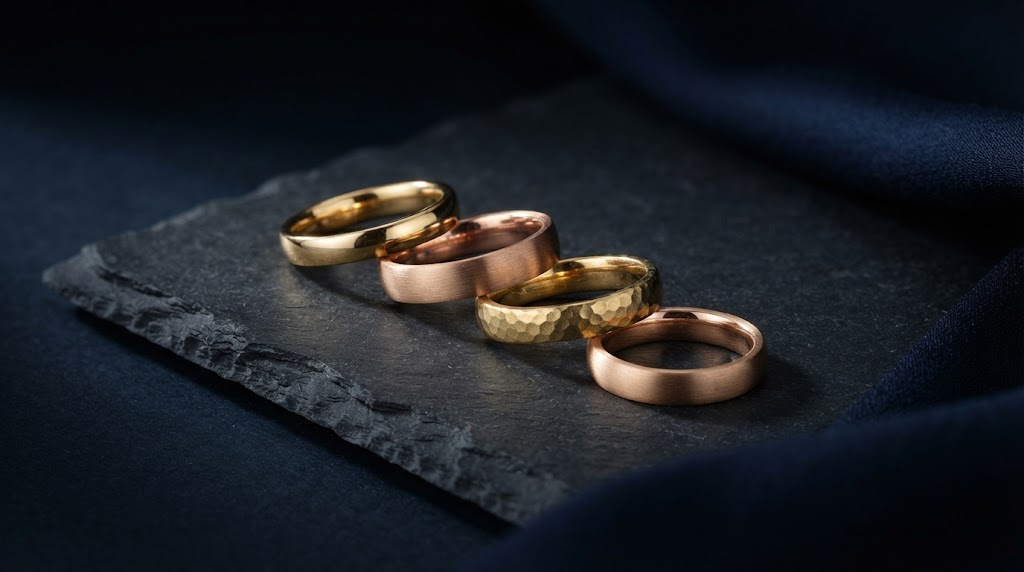
The finish on a ring is the last thing the workshop does and the first thing the eye notices. A brushed gold ring and a high-polished one can be the same design, same alloy, same weight, and read as two entirely different objects. One looks modern and quiet; the other looks classic and bright.
Finish is also the least permanent thing about a ring. Every surface below changes with wear, some of them within weeks. Knowing how each one ages helps you choose one you will still like in five years.
High polish
The default. The metal is taken through progressively finer abrasives and then buffed with compound until it reflects like a mirror.
How it ages. A polished ring picks up fine scratches from the first day. Within a few months the mirror softens to a gentle sheen, which most people find they prefer. Any workshop can bring it back to full polish in minutes.
Best for. Anything with stones, because polish maximises reflected light around them. Classic bands. Pieces that will be worn occasionally rather than daily.
Brushed and satin
A brushed finish is made by drawing an abrasive across the surface in one direction, leaving fine parallel lines. Satin is the same idea with a finer, less directional texture, often done with a fibre wheel. Both cut the reflection and give the metal a soft, even glow.
How it ages. Brushed finishes hide small scratches well at first, because scratches simply join the existing lines. But daily contact gradually polishes the high points, so a brushed band worn every day slowly turns semi-polished, especially on the underside. It can be re-brushed easily.
Best for. Men's bands, wide bands, modern designs, and anyone who dislikes a shiny ring. Brushed 750 gold or platinum looks particularly good; 916 gold is soft enough that the texture wears through faster.
Hammered
The surface is struck repeatedly with a rounded hammer, leaving a pattern of small overlapping facets. It can be left matte or polished afterwards so the facets flash. No two hammered rings are identical.
How it ages. Very well. The texture is deep enough that ordinary wear does not remove it, and small scratches are lost in the pattern. Polished hammer marks dull over time but remain visible.
Best for. Bands, particularly wide ones, where the texture has room to show. A textured surface also disguises the small dents that soft gold picks up.
Matte and sandblasted
A matte finish is produced by blasting the surface with fine abrasive particles, giving a uniform, non-reflective grain. Some workshops use a chemical or laser process for a similar effect.
How it ages. This is the finish that changes fastest. The grain sits on the very surface and is polished away by contact within months on a daily-wear ring. It can be redone, but it is a finish for people who accept that it will evolve.
Best for. Contrast. Matte next to polished on the same ring is a strong look, and the polished section holds up while the matte section softens.
Combining finishes
Two finishes on one ring, a brushed centre with polished edges, or a hammered band with a polished inner rim, is a common and practical approach. The polished element wears well and gives the ring a clean line, while the textured element provides character. It also hides the transition as the textured area evolves.
Two things to know before deciding
Finish is not free. Hammering and hand-brushing are hours of bench time. A high polish is the least expensive to produce and to restore.
Every finish can be changed later. If a brushed band turns out to be too quiet, it can be polished. If a polished band shows too many marks, it can be brushed. The finish is a choice you can revisit, which is a good reason not to agonise over it.
Book a complimentary design consultation at the C'Garden atelier, The MET Corporate Towers, Kuala Lumpur: 010-766 7448 · hq@cgarden.com.my
C'Garden is an independent bespoke jeweller in Kuala Lumpur. We are not affiliated with, endorsed by, sponsored by or certified by any organisation, laboratory or brand named in this article. Third-party names are used only to refer factually to those organisations and their published standards. All text and imagery in this article is original work created by C'Garden.
Reference
Jewelers of America. (n.d.). Jewelry care. Jewelers of America. https://www.jewelers.org/buying-jewelry/jewelry-repair-and-care/jewelry-care
All journal entries