
Platinum or White Gold: Which Should You Choose?
They look nearly identical on the day and behave quite differently over twenty years. The real differences are maintenance, weight and how each metal ages.
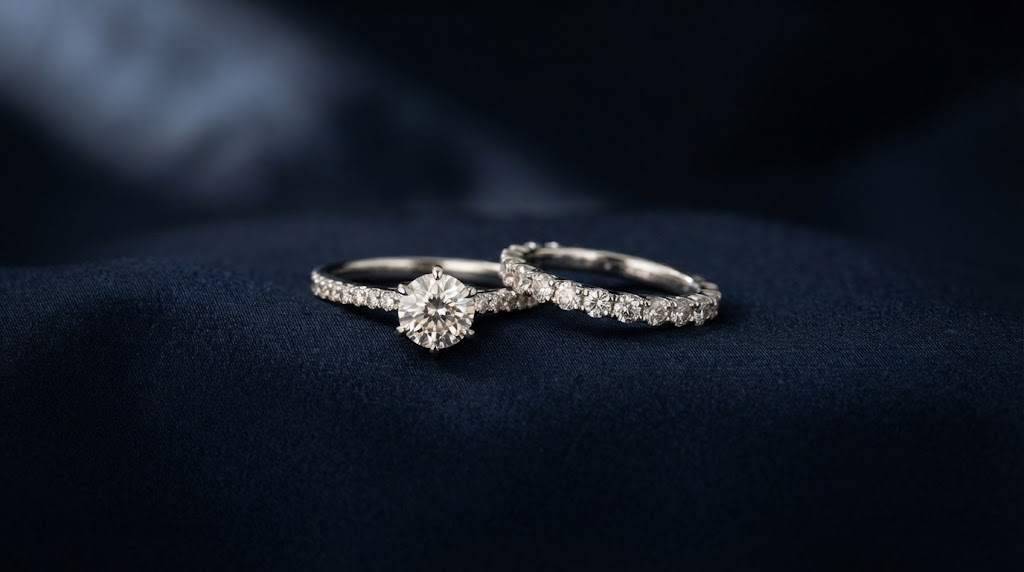
New, side by side, most people cannot tell them apart. The differences show up in ownership, and they are worth understanding before choosing.
What each actually is
White gold is yellow gold alloyed with white metals, palladium, nickel, silver, which lightens it to a pale grey-yellow. Almost all white gold jewellery is then rhodium plated: a very thin layer of a bright white platinum-group metal, which produces the crisp white people associate with the material.
Platinum is used at high purity, typically 950. Its whiteness is intrinsic. It is not plated and never needs to be.
How they age, which is the real difference
White gold will, over time, wear through its rhodium plating. Underneath, the alloy is a warmer, greyer white. It happens gradually, first at the back of the shank where the ring rubs, and how quickly depends entirely on the wearer.
Replating restores it, and it is not expensive. But it is recurring maintenance, typically every one to three years for a ring in daily wear. If nobody mentions this before you buy, you will experience it as the ring going wrong.
Platinum does not change colour. What it does is develop a patina, a soft matte surface of countless tiny scratches. Some people love this and consider it the metal's character. Others dislike it and have the piece polished periodically.
Crucially, when platinum is scratched the metal is displaced rather than removed. It is not losing mass in the way a plated finish is.
Weight, and why it surprises people
Platinum is considerably denser. The same ring in platinum feels noticeably heavier on the hand.
Many people read that weight as quality. Others find a heavy ring tiring to wear. Try both before deciding, because it is a strong preference in both directions.
Cost
Platinum pieces usually cost more, for two compounding reasons: the metal price at the time of making, and the higher density meaning more grams for the same design. Platinum is also slower to work, so making charges tend to be higher.
Security of stones
Platinum prongs are often preferred for significant stones. The metal is tough and tends to bend rather than snap, and it wears slowly.
This is why some rings are made as a hybrid: a white gold or yellow gold shank with a platinum head. Practical, and rarely offered unless you ask.
Which to choose
Choose platinum if you want to never think about colour maintenance, you like a substantial ring, the stone is significant, or you have a nickel sensitivity.
Choose white gold if the budget is better spent on the stone, you prefer a lighter ring, or you are comfortable with a replating visit every couple of years.
Ask before buying: what the replating interval is likely to be, and what it costs at that jeweller. If the answer is vague, ask again.
Book a complimentary design consultation at the C'Garden atelier, The MET Corporate Towers, Kuala Lumpur: 010-766 7448 · hq@cgarden.com.my
C'Garden is an independent bespoke jeweller in Kuala Lumpur. We are not affiliated with, endorsed by, sponsored by or certified by any organisation, laboratory or brand named in this article. Third-party names are used only to refer factually to those organisations and their published standards. All text and imagery in this article is original work created by C'Garden.
Reference
Jewelers of America. (n.d.). Jewelry buying guides. Jewelers of America. https://www.jewelers.org/buying-jewelry/jewelry-buying-guides
All journal entries