
Pink Diamonds: Why They Cost What They Cost
Pink diamond price is driven by rarity, a closed mine and a colour nature makes by accident. What sets the figure, and the cheaper routes to pink.
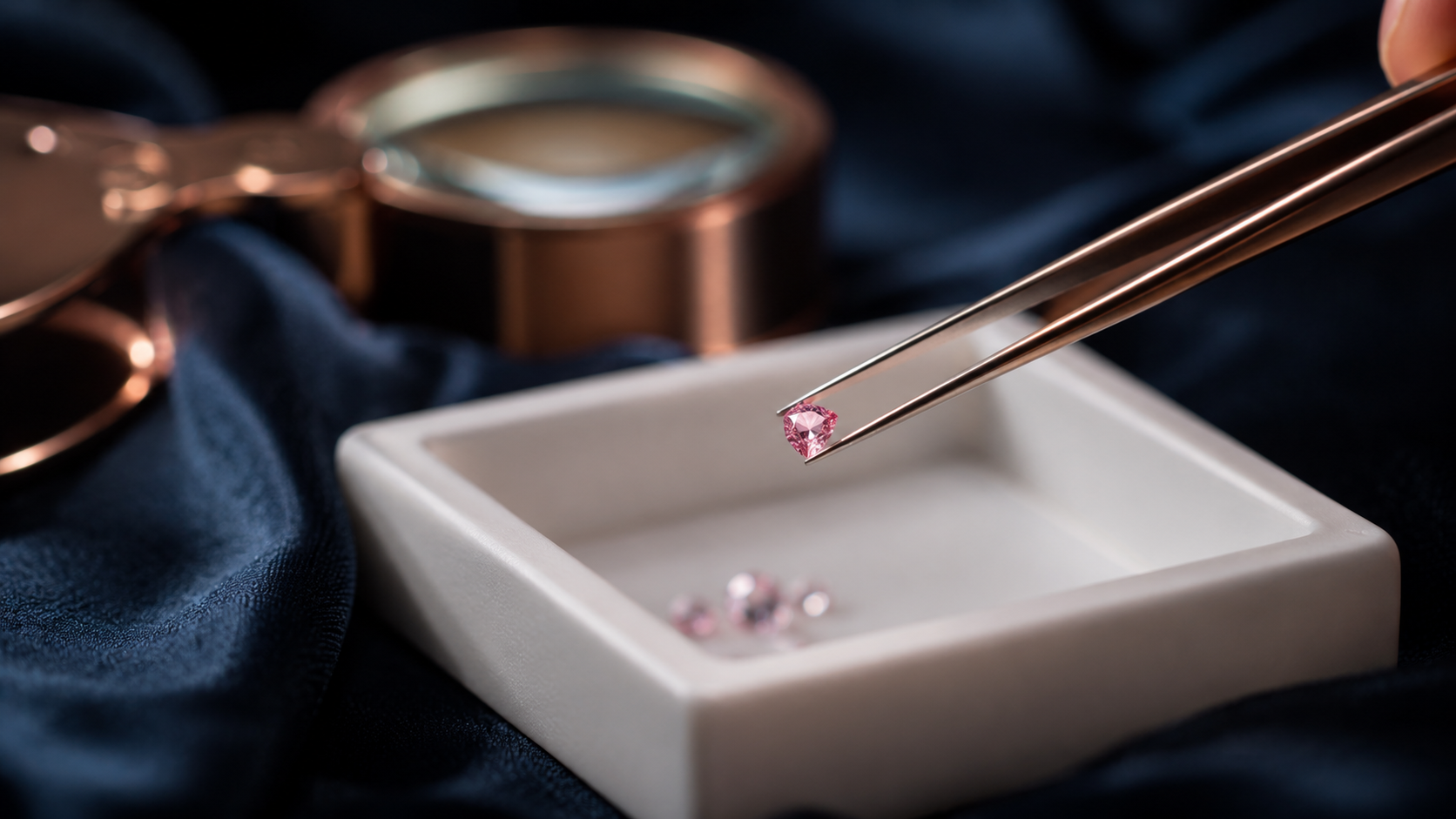
Ask about pink diamond price and the first answer is usually a shrug. Pink stones are quoted per stone, not per carat from a list, and the range between a faint pink chip and a vivid pink of a carat is wider than in any other diamond colour. The reasons are physical, geological and, since 2020, commercial.
Colour by accident
Yellow diamonds owe their colour to nitrogen and blue diamonds to boron. Pink is different. There is no pink trace element. The colour is generally attributed to distortion in the crystal lattice, produced by immense pressure while the stone was still deep in the earth. That distortion changes how the crystal absorbs light.
Because it is a structural defect rather than a chemical one, pink is not evenly distributed. Many pink diamonds show the colour in narrow bands, called graining, with near colourless material in between. Cutters plan the stone so that the bands sit where they will tint the whole face. It is delicate work, and it explains why pink diamonds are so often cut into shapes that hold colour, such as cushions and radiants.
The mine that closed
For roughly four decades, the great majority of the world's pink diamonds came from a single source in Western Australia. The mine had its own colour scale, its own annual invitation-only sale of the best stones, and a loyal collector following. It stopped production in late 2020.
Nothing has replaced it. Small quantities of pink appear from other countries, but not in volume and rarely in strong colour. Every pink stone now on the market is either from existing stock or from a trickle of new supply. That alone would hold prices up. The closure also turned pink diamonds into a collectors' category, which pushed the top of the market further still.
How the grade drives pink diamond price
Pink is graded on the fancy colour scale: Faint, Very Light, Light, Fancy Light, Fancy, Fancy Intense, Fancy Vivid, with Fancy Deep and Fancy Dark for the darker tones. Each step up is a large jump in value, and the steps are not evenly spaced. The difference between Fancy and Fancy Intense can be greater than the difference between Faint and Fancy.
Modifiers matter as much. Purplish pink and pure pink are the most sought after. Brownish pink and orangy pink are noticeably less expensive, sometimes by a wide margin, even when the overall strength is similar. A report will state the full description, and the difference between the words is the difference in the price.
Clarity is treated more leniently than in white diamonds, because strongly coloured pink rough is almost never clean. Carat weight compounds everything: a strong pink above a carat is rare enough that each one is priced on its own.
The cheaper routes to pink
Treated natural diamonds. Brown or pale stones can be irradiated and heated, or subjected to high pressure and temperature, to shift them towards pink. These are natural diamonds with an altered colour and must be disclosed as treated. They cost a fraction of untreated pink.
Lab-grown pink diamonds. Pink can be produced in grown stones, usually by treatment after growth. The stones are real diamond, and the colour can be striking. They are priced like other lab-grown diamonds rather than like natural pinks, which is to say modestly and falling.
Pink sapphire. Not diamond at all, but hard, durable and available in every shade from blush to hot pink. For a wearable pink stone at a sensible cost, this is often the honest answer.
Buying one
Insist on a report from a major laboratory that states natural origin and no treatment. View the stone in daylight; shop lighting exaggerates warmth. Ask about the graining and how the colour looks face up, since the report cannot show that. And set it low and protected, because the rarity is in the material, and a chipped pink diamond is a painful thing.
Book a complimentary design consultation at the C'Garden atelier, The MET Corporate Towers, Kuala Lumpur: 010-766 7448 · hq@cgarden.com.my
C'Garden is an independent bespoke jeweller in Kuala Lumpur. We are not affiliated with, endorsed by, sponsored by or certified by any organisation, laboratory or brand named in this article. Third-party names are used only to refer factually to those organisations and their published standards. All text and imagery in this article is original work created by C'Garden.
Reference
Gemological Institute of America. (n.d.). Diamond colour. GIA. https://www.gia.edu/diamond-color
All journal entries