
Peridot: Bright Green, With a Few Limits
Peridot jewellery gives a yellow-green no other stone matches, at a sensible cost. Its hardness, its dislike of acids and heat, and where to wear it.
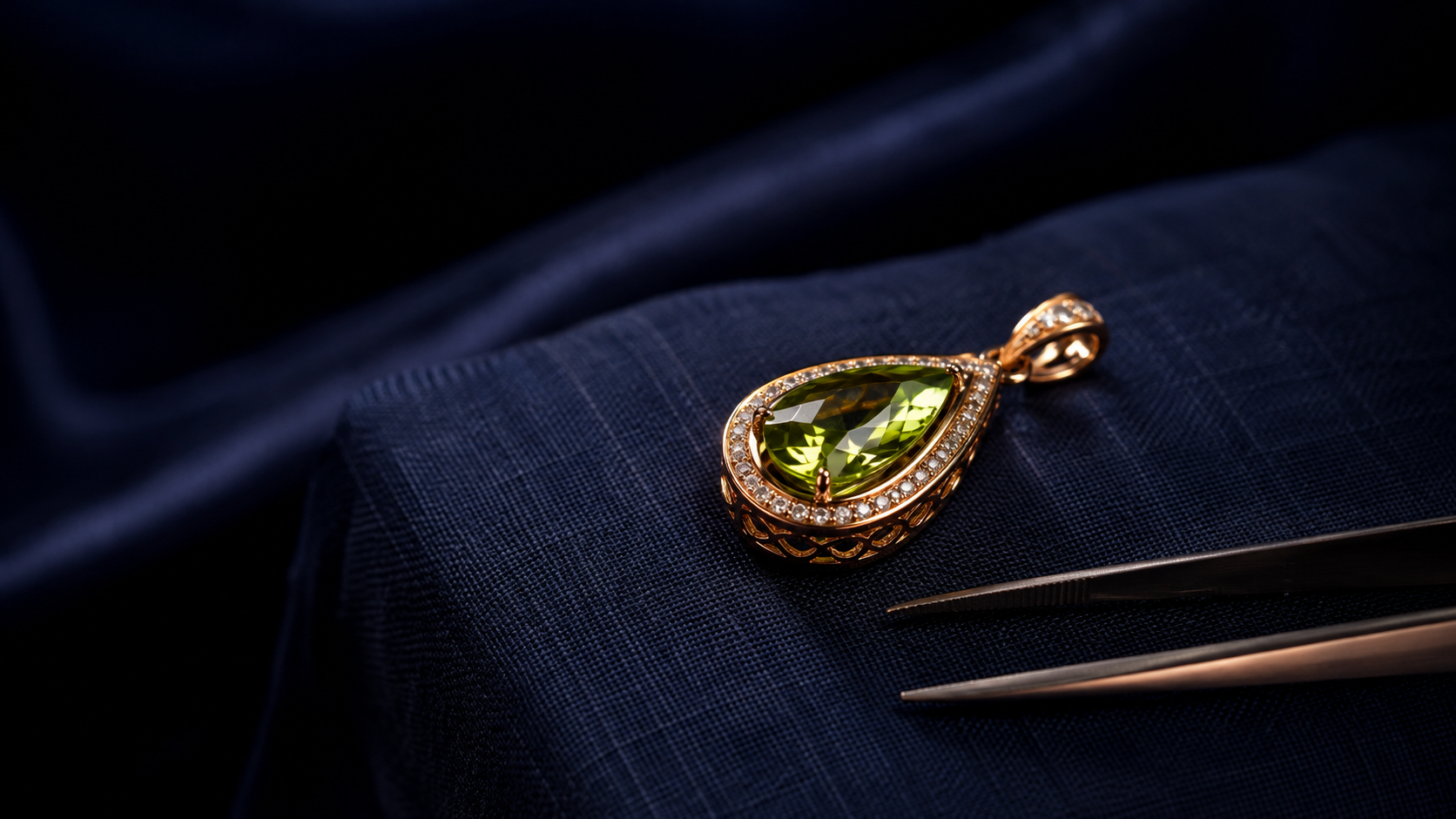
Peridot is one of the few gemstones that comes in exactly one colour. It is always green, somewhere between yellow-green and olive, because the iron that colours it is part of the mineral itself rather than an impurity. That makes peridot jewellery unusually consistent and unusually honest: what you see is what the stone is.
It is also the August birthstone, which is why most enquiries for it arrive in the weeks before that month.
What peridot actually is
Peridot is the gem variety of olivine, a magnesium iron silicate. The colour depends on how much iron is present. Less iron gives a lighter, yellower green; more iron pushes towards olive and brown. The most valued stones are a pure, saturated green with no brown, and those are uncommon in larger sizes.
Commercial sizes come mostly from Arizona and China. The finest large crystals have historically come from Pakistan and Myanmar. A small amount of peridot has even been recovered from pallasite meteorites, which is a pleasant fact for a dinner table but not something you will encounter in a shop.
Where it sits on the hardness scale
Mohs 6.5 to 7. Peridot is softer than quartz, and household dust contains quartz. A peridot worn daily on a hand will pick up fine scratches over the years in a way a sapphire will not.
No cleavage worth worrying about, but brittle. It does not split along planes like topaz, but a sharp knock on a faceted corner can chip it.
Sensitive to acids and rapid heat. Peridot is attacked by strong acids over time and can crack under sudden temperature change. That rules out steam cleaners and ultrasonic tanks for anything with inclusions, and it argues against wearing it while cleaning the kitchen.
Choosing a stone
Look for even colour. Peridot often shows a slightly oily or sleepy lustre, which is normal. What matters is that the green is consistent across the stone with no brownish zones.
Inspect for inclusions. Small dark crystals and disc-shaped stress fractures called lily pads are typical. A clean stone to the naked eye is the standard for jewellery; a stone with visible clouds will look dull.
Do not expect large clean stones cheaply. Peridot is affordable in one to three carats. Above five carats with fine colour, it stops being affordable, and stones of that size are collectors' territory.
Check the cut. Because the stone is not expensive, cutters sometimes leave it heavy or windowed to save weight. A stone that looks pale in the centre when tilted is showing you a window.
Where it belongs
Peridot does its best work in earrings and pendants, where it is protected from knocks and can catch light against skin. It is workable in a ring if the setting is sensible: a bezel or a low setting with substantial prongs, worn on a hand that does not do heavy work.
For an everyday ring that will be worn without thought for twenty years, we would steer a client towards a harder green stone. For a piece worn on occasion, or for someone who wants that specific yellow-green and understands the trade, peridot is a very good answer.
Care in a Kuala Lumpur climate
Humidity itself does no harm to peridot. Sweat and skin oils dull it quickly, so the usual advice applies: a soft brush, lukewarm soapy water, rinse and dry. Avoid any cleaner that lists acid on the label, and never move a peridot from cold to hot water.
Store it separately from harder stones. A sapphire or diamond in the same pouch will scratch it.
Book a complimentary design consultation at the C'Garden atelier, The MET Corporate Towers, Kuala Lumpur: 010-766 7448 · hq@cgarden.com.my
C'Garden is an independent bespoke jeweller in Kuala Lumpur. We are not affiliated with, endorsed by, sponsored by or certified by any organisation, laboratory or brand named in this article. Third-party names are used only to refer factually to those organisations and their published standards. All text and imagery in this article is original work created by C'Garden.
Reference
Gemological Institute of America. (n.d.). Peridot. GIA. https://www.gia.edu/peridot
All journal entries