
Pearl Lustre, Size and Matching: What Makes a Good Strand
Pearl necklace quality comes down to seven factors, and lustre outranks the rest. How to judge lustre, surface, shape, size, colour, nacre and matching.
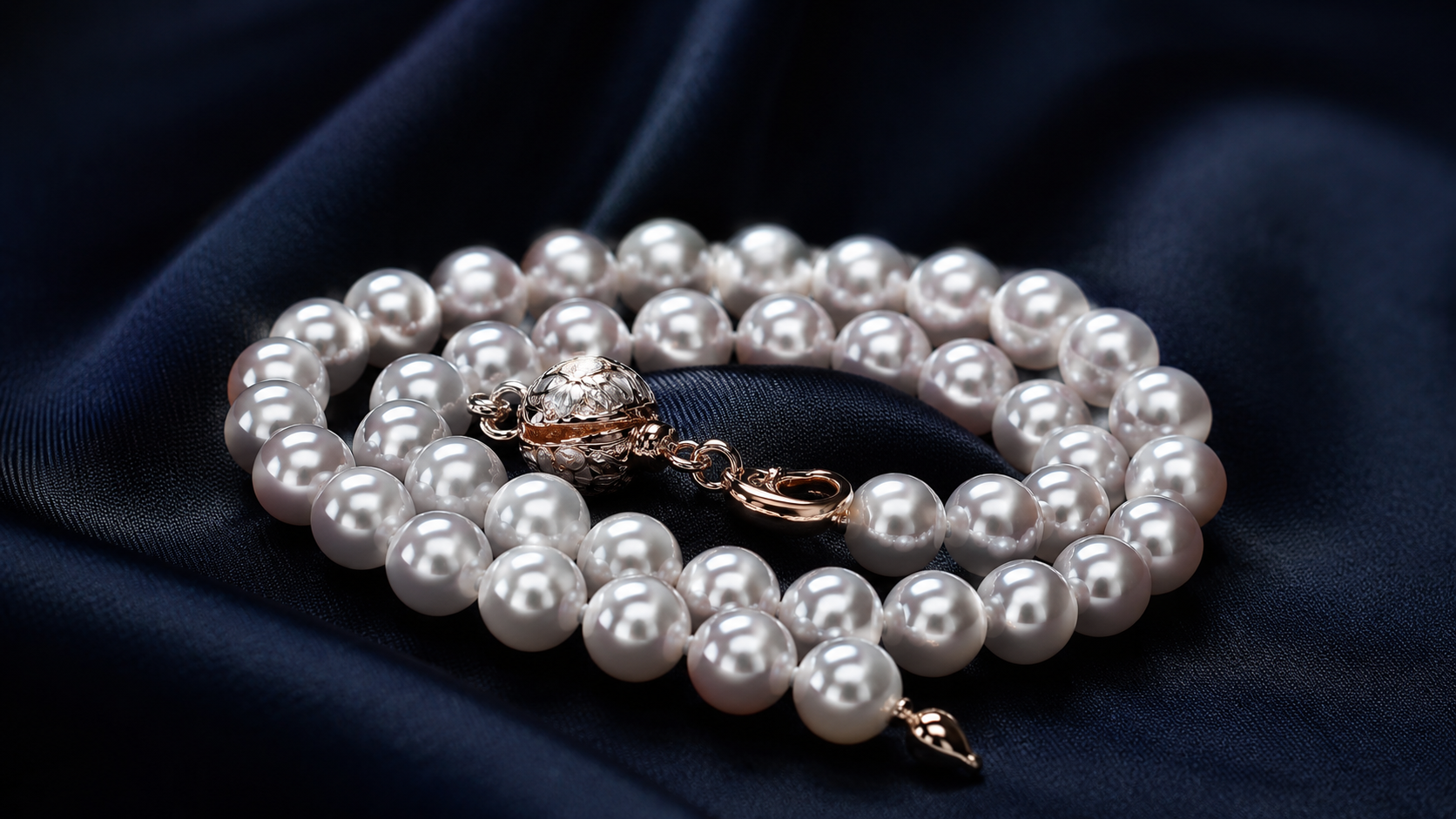
Two pearl strands can look similar in a photograph and differ several times over in price. The photograph hides most of what matters. Pearl necklace quality is judged on a set of factors the trade has used for decades, and once you know them, the difference between the two strands becomes obvious on a tray.
Lustre comes first
Lustre is the quality and sharpness of the light reflected from the pearl's surface. Hold a pearl near a window or lamp. On a high-lustre pearl, the reflection is crisp and mirror-like, with the edges of the window or bulb clearly defined. On a low-lustre pearl the reflection is soft, milky and blurred.
Lustre comes from the nacre: the layered material the mollusc lays down around the nucleus. Thicker, more even nacre reflects more sharply. Thin nacre looks chalky and can wear through to the bead within a few years.
If you remember one thing, remember this: a smaller pearl with excellent lustre is a better strand than a larger pearl with dull lustre, at any price.
Surface
Pearls are grown by animals and almost none are flawless. Pits, bumps, spots and faint circles around the pearl are normal. What matters is how many, how visible, and where. Blemishes near the drill hole disappear in a strand. Blemishes on the face of the pearl do not.
A clean-looking strand at arm's length, with only minor marks under close inspection, is the sensible standard for jewellery.
Shape
Round is the rarest shape and commands the highest price. Near-round, oval, drop, button and baroque follow. Shape is a matter of taste as much as value; a drop shape is right for earrings and a baroque strand can be more interesting than a round one. But in a classic strand, the more truly round the pearls, the more they cost.
Size
Measured in millimetres across the pearl. Akoya pearls typically run from around 6 to 9 mm. Freshwater pearls cover a similar range and can go larger. South Sea and Tahitian pearls typically start around 8 to 9 mm and reach 15 mm and beyond.
Price rises steeply with size within each type, because large pearls need a large mollusc and a long growing period. A half millimetre step is a real difference in cost.
Colour
Pearl colour has three parts: the body colour, such as white, cream, silver or black; the overtone, a translucent tint over the body, often rosé, silver or green; and orient, a faint rainbow shimmer seen on some pearls. Preference varies by market and by skin tone. What matters for quality is that the colour is even and the overtone is attractive. Some pearls are bleached or dyed, and that should be disclosed.
Nacre thickness
Closely tied to lustre. Thin nacre can be spotted by a blinking effect when the pearl is rolled under a light, as the bead shows through. Laboratories can measure nacre thickness; for a fine strand it is worth asking.
Matching
A strand is only as good as its worst pearl. Matching means every pearl on the strand agrees in lustre, colour, overtone, surface and shape, with sizes either uniform or smoothly graduated. Assembling a well-matched strand of large pearls takes a very large number of pearls to select from, and that labour is a real part of the cost.
Look down the length of the strand. Any pearl that catches your eye as different, brighter, duller, pinker, greyer, is a matching fault.
Comparing two strands
Same light, same background. A white pearl on white looks different from the same pearl on grey. Compare like with like.
Lustre, then matching, then surface. Those three decide how the strand looks on the neck.
Size and roundness last. They decide the price more than the appearance.
Ask what type. Akoya, freshwater, South Sea and Tahitian are different products with different price bases. A strand should be sold with its type stated.
Judged in that order, you will find a strand that looks better than its price suggests. Judged on size alone, you will usually pay for the wrong thing.
Book a complimentary design consultation at the C'Garden atelier, The MET Corporate Towers, Kuala Lumpur: 010-766 7448 · hq@cgarden.com.my
C'Garden is an independent bespoke jeweller in Kuala Lumpur. We are not affiliated with, endorsed by, sponsored by or certified by any organisation, laboratory or brand named in this article. Third-party names are used only to refer factually to those organisations and their published standards. All text and imagery in this article is original work created by C'Garden.
Reference
Gemological Institute of America. (n.d.). Pearl quality factors. GIA. https://www.gia.edu/pearl-quality-factor
All journal entries