
Pear-Shaped Diamonds: Point Protection and Which Way to Wear It
A pear shaped diamond pairs a rounded end with one sharp point. How to protect that point, how ratio changes the look and which way the point should face.
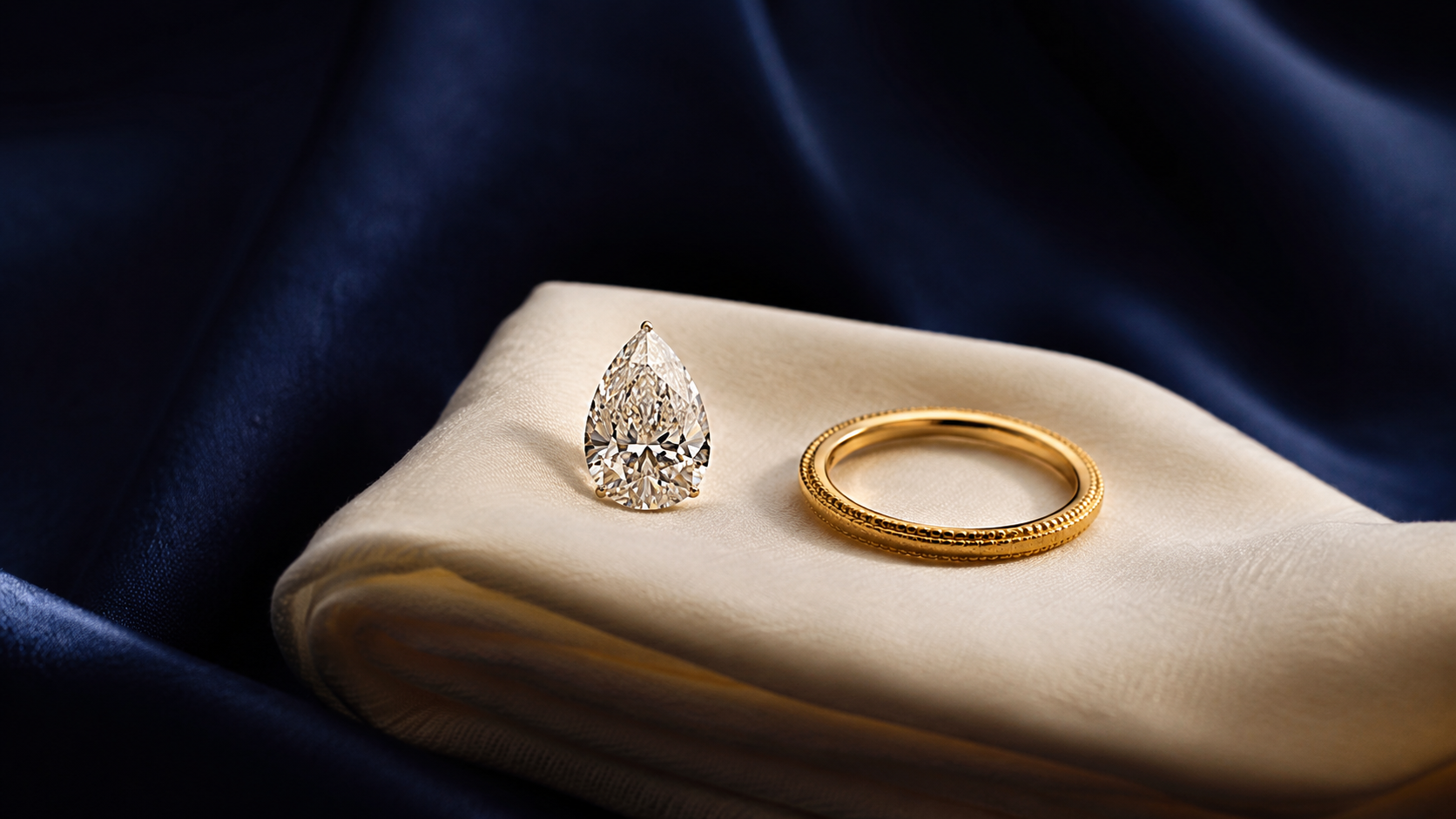
A pear shaped diamond is half oval and half marquise: rounded at one end, tapering to a single point at the other. It is one of the oldest fancy shapes and one of the most flattering, because the taper draws the eye along the finger. It also has one point to protect and one decision to make that no other shape asks for: which way round to wear it.
The point
The point of a pear is its most fragile feature, for the same reason the corners of a princess cut are. It is thin, it concentrates any impact, and it sits in a direction where the crystal can cleave. Left exposed, it will eventually meet a door frame.
A V-prong on the point is the standard protection. The prong wraps the tip on both sides so that anything the ring catches on hits metal first. This should be assumed for any pear worn daily, not requested as an extra.
A bezel encloses the whole outline and removes the concern entirely. It suits a pear well because the shape is already so clearly defined; the metal rim reads as a frame rather than a cage.
Prong count. Three prongs, one at the point and two at the shoulders, is the minimum. Five, adding two at the rounded end, holds a larger stone more securely and keeps the outline symmetric.
Before setting, examine the point under a loupe for existing chips and check the girdle thickness at the tip. A very thin girdle at the point is a weak point waiting for a reason.
Ratio
The length to width ratio sets the character of a pear more than any other single factor.
1.45 to 1.55 is the classic proportion, a full rounded end and a clear taper without looking stretched.
1.55 to 1.70 is longer and more dramatic, and elongates the finger further. The point becomes sharper and the shoulders narrower.
Below 1.40 starts to look short and wide, closer to a rounded triangle.
As with all elongated shapes, the right ratio is the one that suits the hand. Try more than one.
The bow-tie and the shoulders
Like ovals and marquises, pears show a dark band across the widest part of the stone. A faint one that moves with the stone is normal; a fixed dark stripe is a cutting fault. It cannot be judged from a report and needs to be seen in ordinary light.
The shoulders, the curves between the rounded end and the point, should be even on both sides. Some pears have high square shoulders that make the stone look boxy, and some have one shoulder fuller than the other. Hold the stone point up and check that the two halves mirror each other.
Point up or point down
There is no rule. There are two conventions and a practical argument.
Point toward the fingertip is the more common choice for engagement rings. The taper follows the direction of the finger and appears to lengthen it. The rounded end sits against the knuckle, which is comfortable.
Point toward the wrist reads as more unusual and has a certain confidence to it. The rounded end faces outward, which some people find more balanced when the ring is viewed by others.
The practical argument favours point toward the fingertip. That orientation puts the fragile tip in the position least likely to be struck, because the fingertip end of a ring is shielded by the finger itself, while the wrist end takes the knocks from hands reaching into bags and pockets.
Whichever way it faces, the setting should be designed for that orientation from the start, so that the prongs, the band and any side stones are placed correctly. A pear is not a stone that can be rotated after the fact.
Colour and clarity
The point concentrates colour, so pears benefit from a grade one step whiter than a round of the same setting. Clarity is forgiving in the brilliant-faceted body but less so at the tip, where a dark inclusion is exposed.
Book a complimentary design consultation at the C'Garden atelier, The MET Corporate Towers, Kuala Lumpur: 010-766 7448 · hq@cgarden.com.my
C'Garden is an independent bespoke jeweller in Kuala Lumpur. We are not affiliated with, endorsed by, sponsored by or certified by any organisation, laboratory or brand named in this article. Third-party names are used only to refer factually to those organisations and their published standards. All text and imagery in this article is original work created by C'Garden.
Reference
Gemological Institute of America. (n.d.). Diamond cut. GIA. https://www.gia.edu/diamond-cut
All journal entries