
Padparadscha Sapphire: The Colour Between Pink and Orange
Padparadscha sapphire is the rare pink-orange variety named for the lotus. What qualifies, why laboratories disagree, and what to check before buying.
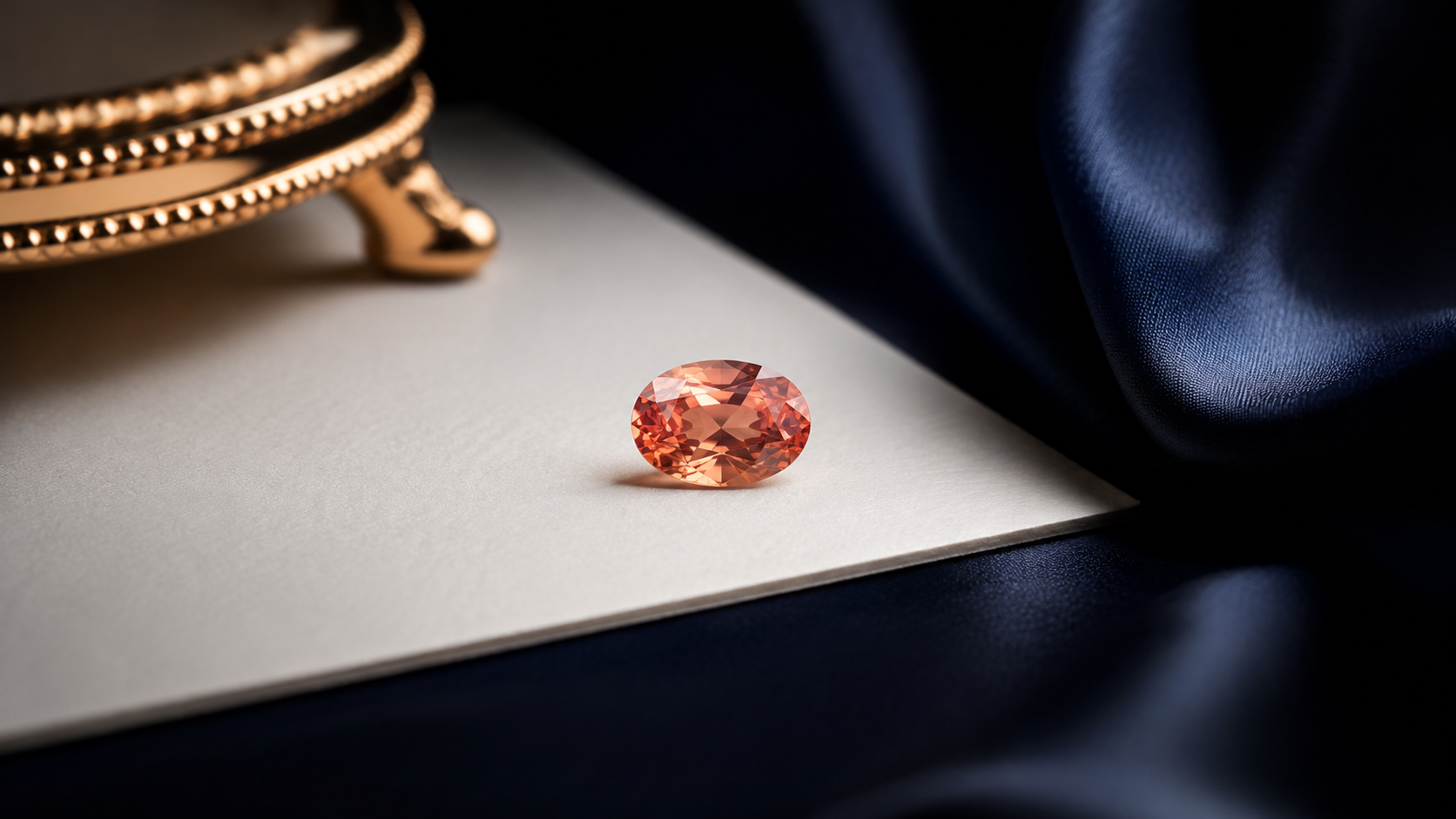
Most sapphire colours have a plain name: blue, pink, yellow. One has a Sinhalese one. Padparadscha sapphire takes its name from the lotus blossom, and it describes a narrow band of colour where pink and orange meet and neither dominates. It is among the rarest of the corundum family, and the name alone attaches a premium, which is why it is worth knowing what actually qualifies.
What the colour is
Corundum is coloured by trace elements. Chromium gives pink and red; iron and colour centres give orange and yellow. Padparadscha needs both in delicate balance. Too much chromium and the stone is simply pink. Too much orange and it is an orange sapphire. The classic description is a light to medium tone of pinkish orange or orangey pink, often compared to a sunset or the inside of a ripe papaya.
Saturation is typically soft rather than vivid. A very dark or very intense stone usually falls outside the definition, however attractive.
Why laboratories do not always agree
There is no single numerical standard. Each major laboratory has its own colour reference set and its own boundaries. A stone called padparadscha by one may be called "pink-orange sapphire" by another. Some laboratories also exclude stones whose colour comes from certain treatments, or stones that shift colour under different lighting.
For the buyer this means the word on the report matters as much as the stone. Ask which laboratory issued it and be aware that a second opinion may differ.
Treatment and what to watch for
Heating. Accepted, as with other sapphires, and must be disclosed. Some laboratories will call a heated stone padparadscha; the premium is lower than for unheated.
Beryllium diffusion. This is the important one. Diffusing beryllium into pale pink or near-colourless sapphire can produce a convincing pink-orange. The colour is real but induced, and reputable laboratories will not call a diffused stone padparadscha. Insist on a report that specifically addresses diffusion.
Colour stability. Some pink-orange sapphires have an unstable orange component that fades under prolonged light and returns in the dark. Several laboratories now test for this and note it. A stable colour is worth more.
Origins
Sri Lanka is the historical and best-known source, and the name reflects that. Madagascar has produced significant quantities since the late 1990s. Material also comes from Tanzania and, occasionally, elsewhere. Origin affects price at the top end; for most buyers, colour and treatment status matter more than the country.
What it costs, in relative terms
Fine unheated padparadscha with a report from a respected laboratory is priced among the most expensive of all sapphires per carat, above most blue. Heated stones cost less. Stones just outside the colour boundary, sold honestly as pink-orange sapphire, cost substantially less again and can be very beautiful.
Choosing one for jewellery
Size. Because the colour is soft, small stones can look washed out. The colour shows best above about a carat.
Cut. Cushions and ovals dominate because they hold colour well. Very shallow cuts drain the tone.
Metal. Rose gold and yellow gold warm the stone; white metals make the pink read cooler and the orange stand out. There is no wrong answer, but the choice changes the apparent colour and should be tested with the stone in hand.
Wear. Sapphire is 9 on the Mohs scale and suits daily wear. Protective settings still make sense for a stone of this value.
A sensible purchase
Buy on the stone, then confirm on the report. If the colour pleases you, the report says natural corundum, no diffusion, and states the treatment plainly, the word padparadscha becomes a bonus rather than the whole reason for the price.
Book a complimentary design consultation at the C'Garden atelier, The MET Corporate Towers, Kuala Lumpur: 010-766 7448 · hq@cgarden.com.my
C'Garden is an independent bespoke jeweller in Kuala Lumpur. We are not affiliated with, endorsed by, sponsored by or certified by any organisation, laboratory or brand named in this article. Third-party names are used only to refer factually to those organisations and their published standards. All text and imagery in this article is original work created by C'Garden.
Reference
Gemological Institute of America. (n.d.). Sapphire. GIA. https://www.gia.edu/sapphire
All journal entries