
Opal and Moonstone: The Fragile Beauties
Some of the most beautiful stones are also the least suited to a ring worn every day. How to enjoy them without losing them.
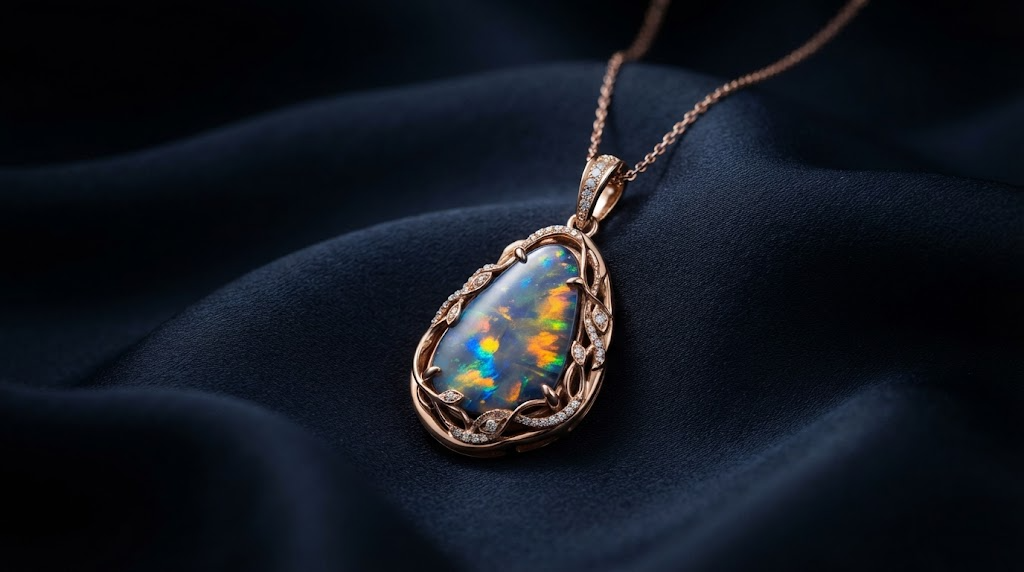
Opal and moonstone produce optical effects nothing else can imitate. They are also genuinely delicate, and they are routinely sold into settings that will destroy them.
Why opal is different
Opal is not crystalline. It is a hydrated silica, a structure of microscopic spheres, containing water, typically several percent by weight.
That water is the vulnerability. Opal can craze: develop a network of fine surface cracks, usually from drying out or from sudden temperature change. Once crazed, it cannot be undone.
Opal is also soft, around 5.5 to 6.5 on the Mohs scale, well below quartz, which means ordinary household dust, which contains quartz, can scratch it.
Types worth knowing
Solid opal, a single piece of opal. The most valuable and the most straightforward.
Doublet, a thin opal layer bonded to a dark backing.
Triplet, a thin opal layer, a backing, and a clear cap on top.
Doublets and triplets are much cheaper and can look spectacular. But they contain glue, and water can penetrate the bond over time, causing cloudiness or separation. They should never be submerged and never go in an ultrasonic cleaner.
Ask which you are buying. The price difference is large and the care requirements differ.
Moonstone
Moonstone's floating blue sheen, adularescence, comes from its internal layered structure.
That layering is also a weakness: moonstone has distinct cleavage and can split along those planes under a sharp knock. It is also fairly soft, around 6 to 6.5.
How to wear them and keep them
Prefer pendants and earrings to rings. A pendant lives a much gentler life than a ring. This is the single most effective piece of advice here.
If it must be a ring, use a bezel setting, a rim of metal around the stone protects the edges, which are where damage starts. Avoid designs where the stone stands proud and exposed.
Take it off for washing up, gardening, the gym, the beach and cleaning.
Avoid temperature shocks. Do not leave opal in a hot car, in direct sun on a windowsill, or under a spotlight in a display case.
Do not store opal in a bank vault long-term without thought, very dry environments have been associated with crazing. A normal drawer at household humidity is fine, and in this climate humidity is not our problem.
Never ultrasonic. Never steam. Lukewarm water, mild soap, soft cloth, dry gently.
The honest recommendation
If someone wants an opal engagement ring, we will make it, with a bezel, and with a conversation about what it will need.
But if the question is "which stone will still look like this in thirty years of daily wear", the answer is sapphire, not opal. Save the opal for a pendant and enjoy it without anxiety.
Book a complimentary design consultation at the C'Garden atelier, The MET Corporate Towers, Kuala Lumpur: 010-766 7448 · hq@cgarden.com.my
C'Garden is an independent bespoke jeweller in Kuala Lumpur. We are not affiliated with, endorsed by, sponsored by or certified by any organisation, laboratory or brand named in this article. Third-party names are used only to refer factually to those organisations and their published standards. All text and imagery in this article is original work created by C'Garden.
Reference
Gemological Institute of America. (n.d.). Gem encyclopedia. GIA. https://www.gia.edu/gem-encyclopedia
All journal entries