
Old Mine and Old European Cuts: Buying an Antique Diamond
An old european cut diamond was cut by hand for candlelight. How old mine and old European cuts differ and what to check when buying an antique stone.
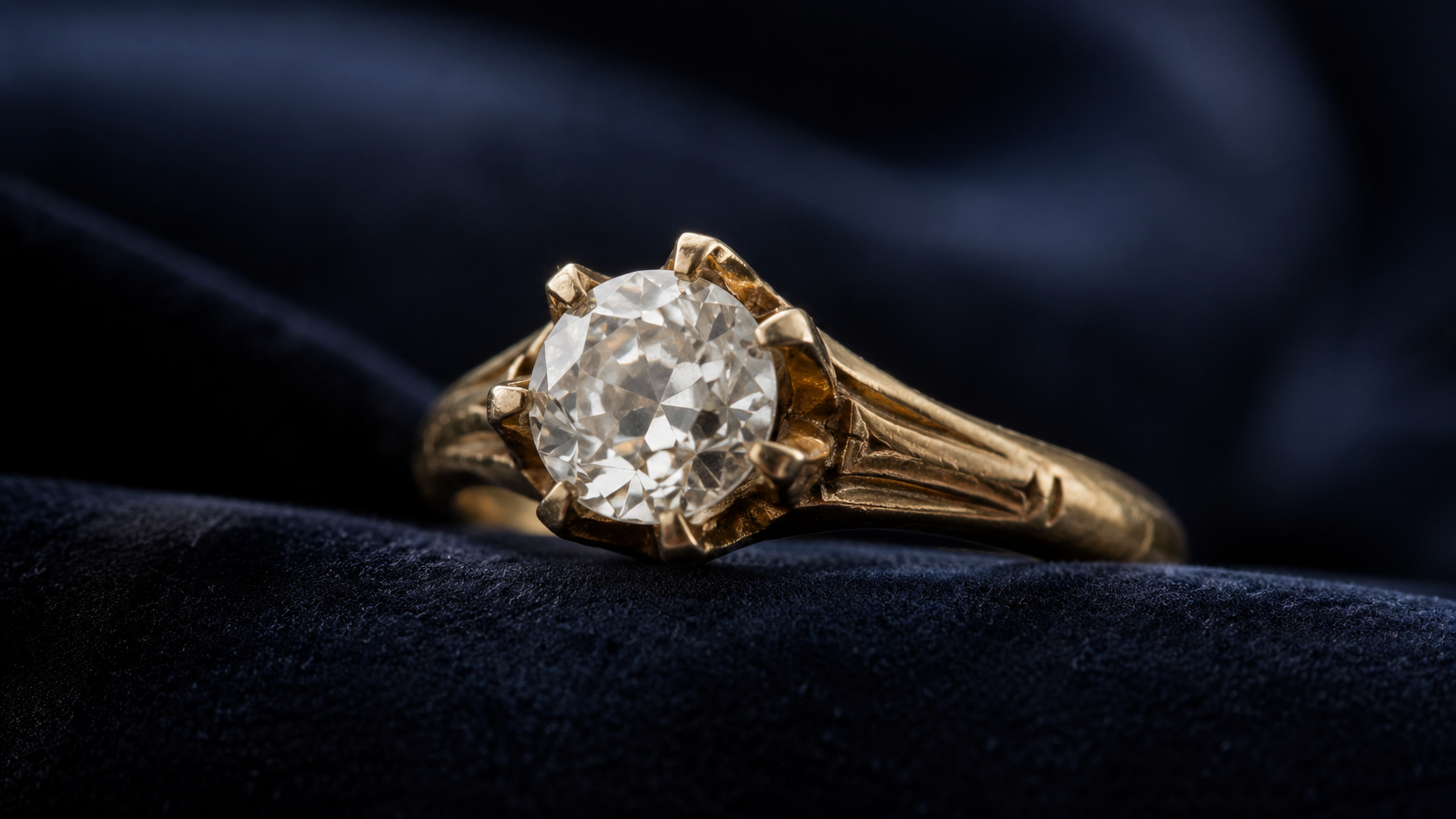
An old european cut diamond does not sparkle the way a modern round does, and that is the point. It was cut by hand, by eye, for rooms lit by candles and gas, and its proportions were chosen to throw broad, slow flashes of light in dim conditions. In electric light it looks softer and warmer than a modern brilliant. Some people find that dull. A growing number find it the most beautiful thing a diamond can do.
The two cuts
Old mine cut. The earlier of the two, common from the eighteenth century through the late nineteenth. Its outline is a cushion, a rounded square or rectangle, because it followed the shape of the rough. It has a small table, a high crown, a deep pavilion and a large flat facet at the bottom, the culet, which is often visible face up as a small circle in the centre of the stone. Facets are few and large. Symmetry is approximate.
Old European cut. The transitional form between the old mine and the modern round, common from the late nineteenth century into the 1930s. The outline is round or nearly round, cut on the newly available mechanical bruting machines. The crown is still high and the table still small, but the culet is smaller than an old mine's and the facets are more regular. It is the cut most antique engagement rings carry.
Both have 58 facets, the same count as a modern brilliant. The difference is entirely in proportion and placement.
Why they look different
A modern round brilliant has a large table and a shallow crown, proportions calculated to return as much light as possible through the top of the stone. The result is a dense, fine sparkle.
An old cut has a small table and a tall crown. Light enters through the crown facets at steeper angles and returns in wider, fewer flashes. The stone appears to glow from within rather than glitter on the surface. The open culet, which a modern cutter would consider a fault, lets a small amount of light through the bottom and creates the characteristic dark circle at the centre.
Old cuts also tend to look slightly smaller than modern stones of the same weight, because so much of their weight is in the crown and pavilion depth.
What to check
Chips and abrasion. A stone that has been worn for a century has been knocked. Look at the girdle, which on old cuts is often thin and unpolished, and at the facet junctions on the crown, which wear to a soft frosting over decades. Small wear is expected; chips are a concern.
Colour. Many antique diamonds are warmer than modern buyers expect, often in the J to M range, because the mines of the period produced that material and because the cut concentrates colour. This is part of the character. A warm old cut in yellow gold looks right. The same stone in platinum can look yellow.
Recutting. Some old stones have been recut to modern proportions, which removes their character and weight. Others have been lightly repolished to remove wear while keeping the old form. A report will describe the cutting style; ask.
Report. Antique stones are often sold without one. A modern laboratory report costs relatively little, confirms the stone is natural and untreated, and describes the cutting style. It is worth obtaining before purchase.
The mount. Antique settings are frequently worn thin, with prongs that have been retipped several times. Decide whether the ring is being bought for the stone or for the whole object, because an original mount that needs rebuilding is a different purchase from a stone to be reset.
Reproductions
Old cuts are now made new. Some cutters produce modern stones in old mine and old European proportions from fresh rough, with the same small tables and open culets. These give the look with none of the wear and are a sensible choice for a new ring in an antique style. They are not antiques and should not be priced as such.
An old cut is a diamond that asks to be looked at in the evening, in warm light, from across a room. Bought with open eyes, it is a very good thing to own.
Book a complimentary design consultation at the C'Garden atelier, The MET Corporate Towers, Kuala Lumpur: 010-766 7448 · hq@cgarden.com.my
C'Garden is an independent bespoke jeweller in Kuala Lumpur. We are not affiliated with, endorsed by, sponsored by or certified by any organisation, laboratory or brand named in this article. Third-party names are used only to refer factually to those organisations and their published standards. All text and imagery in this article is original work created by C'Garden.
Reference
Gemological Institute of America. (n.d.). Diamond cut. GIA. https://www.gia.edu/diamond-cut
All journal entries