
Moissanite, Cubic Zirconia and White Sapphire: Diamond Alternatives Compared
The three common diamond alternatives look similar in a shop and behave very differently over ten years. Hardness, sparkle, weight and ageing compared.
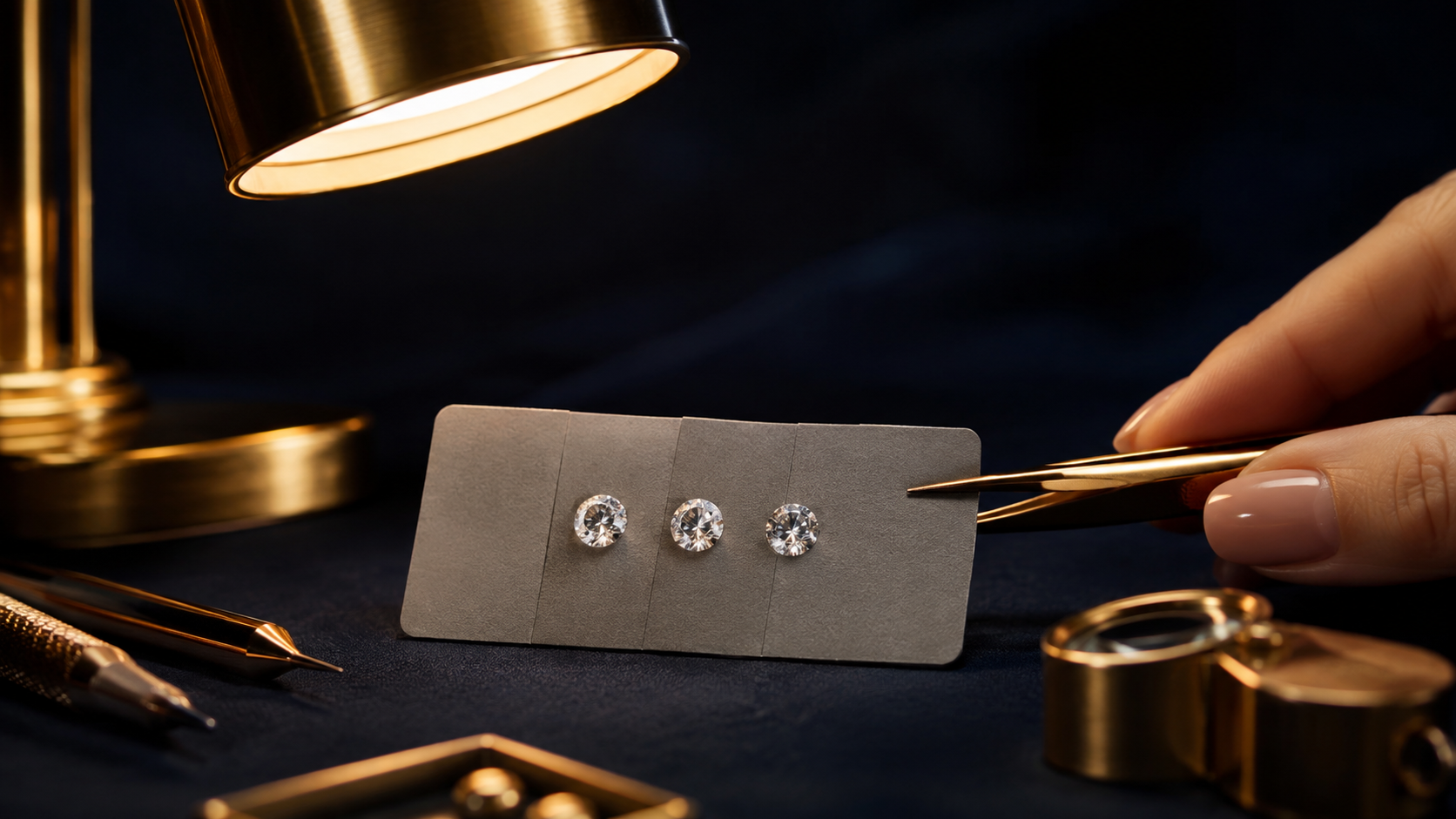
Diamond alternatives are usually presented as one category, as if the only question were how much you want to save. In fact the three common options are three different materials with different hardness, different optics and different lifespans. Choosing between them is easier once you know what each one actually is.
Moissanite
Silicon carbide, grown in a laboratory. It occurs naturally only in trace amounts, so every jewellery stone is manufactured.
Hardness. About 9.25 on the Mohs scale, second only to diamond among stones you will find in a ring. It resists scratching in everyday wear and holds its polish for decades.
Look. More fire than diamond. Its dispersion, the splitting of white light into colour, is well over double that of diamond, so it throws rainbow flashes that are obvious in sunlight. Some people love this; others find it looks artificial, particularly in larger sizes. It is also doubly refractive, which under a loupe shows as a slight doubling of the back facets.
Ageing. It does not cloud or dull. Older material carried a faint green or yellow tint; current production is available near colourless.
Weight. Lighter than diamond, so sizes are quoted in millimetres or diamond-equivalent weight rather than actual carats.
Cubic zirconia
Zirconium oxide, crystallised in a laboratory. The most common diamond simulant and by far the cheapest.
Hardness. Around 8 to 8.5 on Mohs. Adequate against most things, but household dust contains quartz at 7, and years of wiping and knocking leave fine scratches. The polish softens visibly.
Look. More fire than diamond, less than moissanite, and a slightly glassy brilliance. New, in good light, it passes at a glance. It is also noticeably heavier than diamond, so a stone of diamond-like dimensions weighs more.
Ageing. This is where it fails. Cubic zirconia absorbs skin oils and picks up surface wear, and after a few years it looks cloudy in a way that cleaning does not fully reverse. It is a fine choice for a travel ring or a temporary stone while a design is finalised, and a poor choice for something meant to last.
White sapphire
Corundum, the same mineral as blue sapphire and ruby, without the trace elements that give colour. Natural white sapphire exists; most sold today is lab-grown.
Hardness. 9 on Mohs, very durable, and it has been used in rings for centuries.
Look. The weakest of the three at imitating diamond. Its refractive index and dispersion are both much lower, so it has little fire and a softer, greyer brilliance. Clean and well cut, it is an attractive stone in its own right. It simply does not sparkle like diamond, and buyers who expect it to are disappointed.
Ageing. Sapphire holds up well, but its lower brilliance means that any grime on the pavilion dulls it quickly. It needs cleaning more often than diamond to look its best.
Which of the diamond alternatives, then
For a lifelong ring on a limited budget: moissanite. It is the only alternative with the hardness and stability to be worn daily for decades, and the only one that keeps its looks.
For a placeholder or a piece worn occasionally: cubic zirconia, with no illusions about its lifespan.
For someone who wants a natural-looking, understated white stone and does not mind less sparkle: white sapphire.
One point on honesty
None of these is a diamond, and none should be sold as one. In the humid Kuala Lumpur climate, all three attract the same film of sweat and lotion that diamond does, and all look better for regular cleaning. Whatever you choose, ask for it to be described accurately on the invoice, by material, so that anyone valuing the piece later knows what they are looking at.
Book a complimentary design consultation at the C'Garden atelier, The MET Corporate Towers, Kuala Lumpur: 010-766 7448 · hq@cgarden.com.my
C'Garden is an independent bespoke jeweller in Kuala Lumpur. We are not affiliated with, endorsed by, sponsored by or certified by any organisation, laboratory or brand named in this article. Third-party names are used only to refer factually to those organisations and their published standards. All text and imagery in this article is original work created by C'Garden.
Reference
Gemological Institute of America. (n.d.). Diamond simulants and imitations. GIA. https://www.gia.edu/gia-news-research
All journal entries