
Milgrain, Filigree and Other Finishing Details
A milgrain ring, a filigree gallery or an engraved shoulder can lift a plain design. What each finishing detail is, how it is made and how it wears.
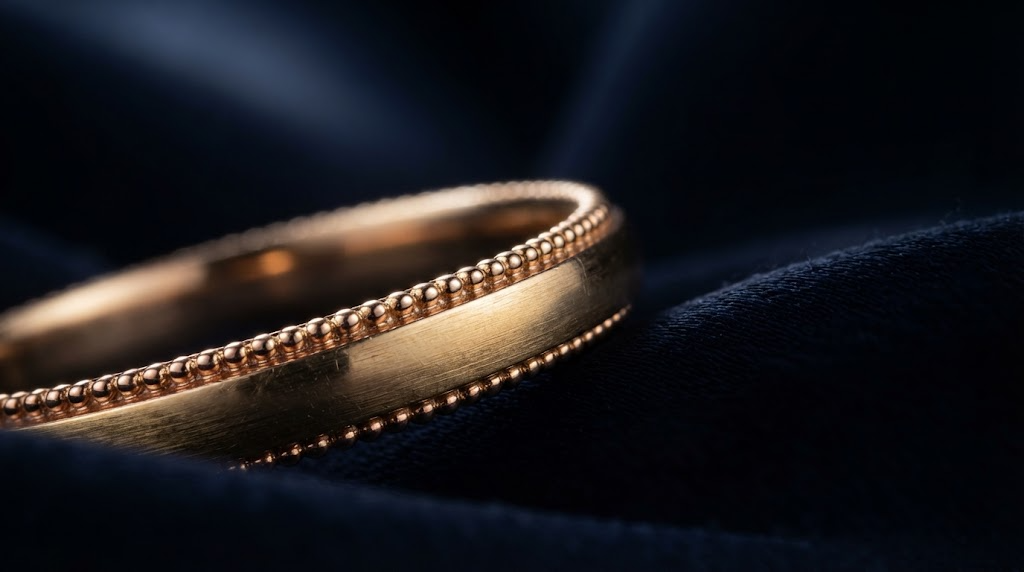
A milgrain ring is the usual example when someone asks for a design that looks "a bit vintage" without being able to say why. The detail is tiny, a row of beads along an edge, and yet it changes the whole character of a piece. The same is true of filigree, engraving and the other small finishing techniques that jewellers use to take a plain ring somewhere else.
This is a short guide to what those details are, how they are actually made, and what they mean for the ring over the years.
Milgrain
The word comes from the French for a thousand grains. It describes a line of very small raised beads running along an edge, usually the rim of a bezel or the borders of a band.
How it is made. Traditionally a knurling tool, a small wheel with a beaded rim, is rolled along the edge of the metal, pressing the bead pattern in. In cast pieces the milgrain is often modelled in CAD and cast as part of the ring, then tidied by hand. Hand-rolled milgrain is slightly irregular, which is part of its appeal.
How it wears. The beads are the highest point on the edge, so they take the first contact with everything. Over ten or fifteen years milgrain on a daily-wear ring softens noticeably. It can be re-rolled, though not indefinitely, because each pass removes a little metal.
Where it works. Framing a bezel, along the edges of a flat band, or bordering a channel of small stones. It suits both 750 and 916 gold, and looks particularly good in platinum, which holds a crisp edge.
Filigree
Filigree is openwork made from fine wires, twisted or plain, soldered into lace-like patterns. Historically it was built up wire by wire. Today most filigree is cast from a wax or CAD model, which is more consistent but loses some of the delicacy.
Where it belongs. Under the centre stone, in the gallery, where it can be seen from the side without being touched by anything. Filigree on the outside of a shank is beautiful and impractical, because the fine wires catch and deform.
Cleaning. Openwork traps skin, soap and lotion. A filigree ring needs an ultrasonic clean more often than a plain one.
Hand engraving
A graver, a hardened steel point, is pushed through the metal to cut a line. Scrollwork, wheat patterns, leaves and lettering are all done this way. Machine engraving exists and is fine for inscriptions inside a band, but the two are easy to tell apart under a loupe: hand cuts have bright, faceted walls.
Engraving is shallow, typically a fraction of a millimetre, so it is the first detail to fade on a surface that rubs. On the shoulders of a ring it lasts well. On the underside of a band it lasts a few years.
Beading and bright-cutting
These are the details around pavé and small set stones: tiny raised beads that hold the stones, and the polished cuts around them that reflect light. They are what makes a set of small stones look like more than the sum of their carat weight, and they are the details that suffer most from wear. A well-made piece keeps them off the underside of the ring.
A few honest caveats
Detail adds cost, mostly in hours rather than metal. Hand engraving is charged by time.
Detail adds maintenance. Every technique above is a texture, and textures wear. Choose them for the parts of the ring that do not rub.
Detail should serve the design. One well-placed row of milgrain does more than three competing techniques on the same ring. Restraint reads as quality.
Book a complimentary design consultation at the C'Garden atelier, The MET Corporate Towers, Kuala Lumpur: 010-766 7448 · hq@cgarden.com.my
C'Garden is an independent bespoke jeweller in Kuala Lumpur. We are not affiliated with, endorsed by, sponsored by or certified by any organisation, laboratory or brand named in this article. Third-party names are used only to refer factually to those organisations and their published standards. All text and imagery in this article is original work created by C'Garden.
Reference
Gemological Institute of America. (n.d.). Jewelry design and manufacturing. GIA. https://www.gia.edu/jewelry-design
Jewelers of America. (n.d.). Buying jewelry. Jewelers of America. https://www.jewelers.org/buying-jewelry
All journal entries