
Men's Wedding Bands: Choosing the Metal
A mens wedding band is worn harder than most jewellery. How yellow, white and rose gold, platinum and the alternative metals compare on the hand.
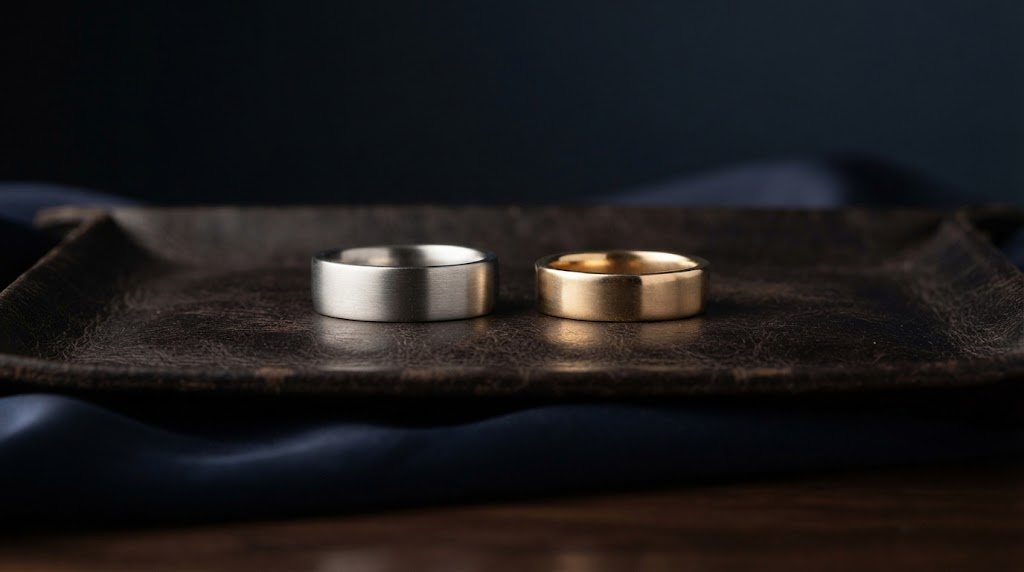
A mens wedding band has a harder life than most jewellery. It is often the only ring its owner wears, it goes on once and rarely comes off, and it is knocked against steering wheels, gym equipment and door frames for decades. The metal it is made from decides how it copes.
There is no single right answer. But each metal has a character, and it helps to know it before ordering.
Yellow gold
The traditional choice, and in Malaysia the one with the strongest cultural pull.
916 (22k) is 91.6 percent gold. It has the deepest colour and the highest resale value by weight, and it is the softest option here. A plain 916 band will dent and go slightly out of round with rough use. For a man who works at a desk it is fine; for one who uses his hands it needs to be made thick.
750 (18k) is 75 percent gold, alloyed with copper and silver. Slightly paler, considerably harder, and the practical choice for anything with an engraved or textured surface. It holds its shape well.
Both are easy to resize, polish and repair, which counts for a ring that will be worn for forty years.
White gold
Gold alloyed with palladium or nickel to pale it, then usually rhodium-plated to give it a bright white surface. The plating wears through in a year or two on a daily ring and needs redoing. Beneath it the metal is a warm grey-white, which some men prefer to leave unplated.
White gold is hard-wearing and lighter in the hand than platinum. If someone wants a white ring and does not want the maintenance of plating, a palladium-white alloy left bare is a sensible middle ground.
Rose gold
Gold alloyed with a higher proportion of copper. The colour deepens slightly over the years as the surface oxidises, which most owners like. It is roughly as hard as yellow 750 and wears the same way. On a wide band it reads as warm rather than pink.
Platinum
Dense, naturally white, and does not need plating. A platinum band feels noticeably heavier than the same ring in gold, which many men like. It does not wear away in the way gold does; instead it displaces, so scratches move metal rather than removing it. Over time it develops a soft grey patina that can be polished back or left alone.
It is the most expensive of the conventional options per gram, and it is the one that repairs most easily in the long run because nothing is lost from the ring.
Tungsten, titanium and the alternatives
These are popular for men's bands because they are hard and inexpensive.
Titanium is light, strong and hypoallergenic. It cannot be resized, and resizing is something most men need at least once.
Tungsten carbide is extremely scratch-resistant and extremely brittle. It cannot be resized and it can crack on impact. In an emergency it has to be shattered off rather than cut.
Stainless steel and cobalt alloys sit somewhere between. Hard, cheap, not resizable.
None of these carry intrinsic value, none can be reworked, and none can be passed down in any meaningful sense. They are a reasonable choice for a second ring for the gym or workshop, worn in place of the real one.
The practical recommendation
For a ring worn every day for life, the metals that can be repaired, resized and refinished are the ones that last: gold and platinum. Between them, the choice comes down to colour, weight and budget.
For a man who is hard on his hands, a 750 gold or platinum band at 5mm or wider, with a brushed or hammered surface and a comfort-fit interior, is close to indestructible in practice.
Book a complimentary design consultation at the C'Garden atelier, The MET Corporate Towers, Kuala Lumpur: 010-766 7448 · hq@cgarden.com.my
C'Garden is an independent bespoke jeweller in Kuala Lumpur. We are not affiliated with, endorsed by, sponsored by or certified by any organisation, laboratory or brand named in this article. Third-party names are used only to refer factually to those organisations and their published standards. All text and imagery in this article is original work created by C'Garden.
Reference
World Gold Council. (n.d.). Gold jewellery. World Gold Council. https://www.gold.org/about-gold/gold-demand/sectors-of-demand/jewellery
Jewelers of America. (n.d.). Buying jewelry. Jewelers of America. https://www.jewelers.org/buying-jewelry
All journal entries