
Men's Jewellery Beyond the Wedding Band
Mens gold jewellery has a small vocabulary: chains, bracelets, cufflinks, pendants and rings. Which pieces work, how they should be made, what to avoid.
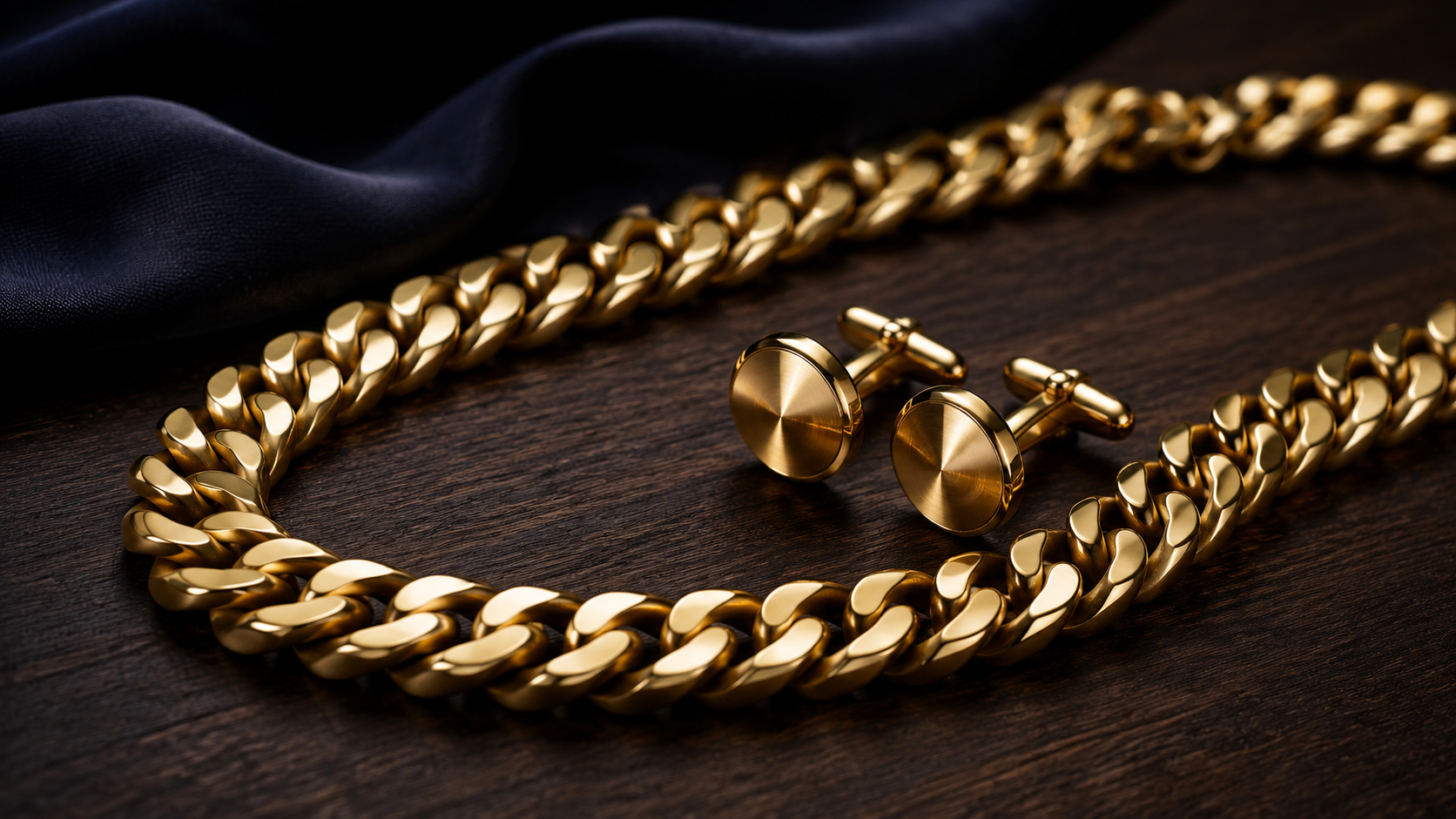
Mens gold jewellery in Malaysia has a longer history than the current fashion for it suggests. Chains, bracelets and rings have been worn by men here for generations, as ornament, as portable savings and as gifts marking a birth or a business milestone. What has changed is that more men now want pieces designed for them rather than bought by weight from a tray.
The vocabulary is small. That is an advantage. A few well-made pieces cover almost every situation.
Chains
The most worn piece after the wedding band, and the one with the most variation in quality.
Link type matters more than weight. A curb chain, with flattened interlocking links, lies flat and is the most robust. Rope, Figaro and box chains each have a different texture. Fine chains with tiny links are the ones that break.
Solid, not hollow. Hollow chains look substantial for less money and dent permanently. For a chain that will be worn daily, solid links are the only sensible choice.
Clasp. A lobster clasp is more secure than a spring ring. On a heavy chain, a box clasp with a safety catch is better still.
Length. Most men's chains sit between 50cm and 60cm. Shorter shows above a collar; longer sits under a shirt.
Bracelets
A bracelet takes more knocks than a chain, because the wrist meets desks and door handles. The same rules apply: solid links, a strong clasp, and a weight that matches the wearer's build. A slim man in a heavy bracelet looks weighed down; a broad wrist makes a fine bracelet disappear.
Curb and cable bracelets in 916 or 750 gold are the standard. A flat, plain bangle in 750 is a quieter option that suits a man who does not want anything that moves.
Cufflinks
The one piece of jewellery a man can wear to almost any formal occasion without comment. Plain gold ovals or rectangles, with a swivel or chain back, are the classic form. Engraving initials or a family motif is the usual personalisation.
Cufflinks are also where a man can use a stone he would not wear on a ring: a flat piece of black onyx, a slice of jade, a small sapphire cabochon. They are rarely knocked, so softer materials survive.
Pendants
A pendant on a chain is a personal choice rather than a formal one. Small crosses, religious motifs, zodiac animals, initials and family symbols are the common subjects. Keep the pendant in proportion to the chain: a heavy pendant on a fine chain will break it, and a tiny pendant on a heavy chain looks lost.
Rings beyond the band
A signet on the little finger, a plain band on the right hand, or a single-stone ring are the conventional options. Two rings on one hand is about the practical limit before they start clashing and scratching each other.
Gold choice for men
916 for chains and bracelets that will be worn as visible gold and that may one day be sold or traded. It is soft, so make the links heavy.
750 for anything with a mechanism, a stone or fine detail: cufflinks, signets, clasps. It holds its shape.
White gold and platinum for men who want the piece to read as steel from a distance. Platinum is the more durable of the two for a bracelet.
What to avoid
Hollow anything. It dents and cannot be fixed.
Very fine chains for daily wear. They snag and snap.
Plated pieces. The plating wears off at exactly the points that show.
Too many pieces at once. A chain, a band and a watch is already a full hand. Adding a bracelet and a second ring rarely improves it.
Book a complimentary design consultation at the C'Garden atelier, The MET Corporate Towers, Kuala Lumpur: 010-766 7448 · hq@cgarden.com.my
C'Garden is an independent bespoke jeweller in Kuala Lumpur. We are not affiliated with, endorsed by, sponsored by or certified by any organisation, laboratory or brand named in this article. Third-party names are used only to refer factually to those organisations and their published standards. All text and imagery in this article is original work created by C'Garden.
Reference
World Gold Council. (n.d.). Gold jewellery. World Gold Council. https://www.gold.org/about-gold/gold-demand/sectors-of-demand/jewellery
Jewelers of America. (n.d.). Buying jewelry. Jewelers of America. https://www.jewelers.org/buying-jewelry
All journal entries