
Matching His and Hers Wedding Bands Without Matching Everything
Couple wedding bands need not be identical to belong together. How to share a metal, profile, finish or hidden detail while each ring suits its wearer.
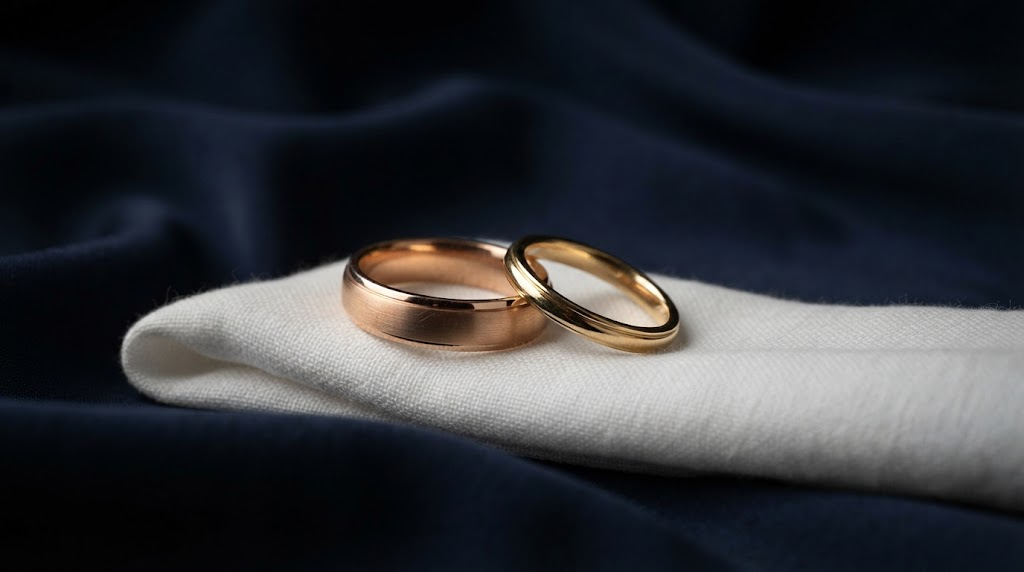
Couple wedding bands used to mean a pair of identical rings in two sizes. That still suits some people. For many others it produces one ring that is right and one that is a compromise, because two hands, two lifestyles and two sets of taste rarely want the same object.
The better approach is to decide what the rings will share and what they will not. A pair can be unmistakably a pair while each ring fits its wearer.
Start with the differences
Before talking about matching, be honest about where the two rings need to diverge.
Width. Most men's bands are wider than most women's. Forcing a 5mm band onto a slim hand, or a 2.5mm band onto a broad one, helps neither.
Profile. One partner may want a flat, modern band; the other a rounded, classic one. These can still be made to relate.
Wear. If one partner works with their hands, or trains hard, that ring needs more metal and a simpler surface. The other ring does not have to carry the same constraints.
Engagement ring. If one partner has an engagement ring, their band must sit against it. That often dictates its width and sometimes its shape, and the other band is free.
Ways to link the pair
Same alloy. The simplest and most reliable link. Both rings in the same 750 rose gold, or both in platinum, look like they came from the same hand even when the shapes differ. This also keeps the pair ageing at the same rate.
Same profile, different width. A D-shaped 3mm band and a D-shaped 5mm band read as a set immediately. This is the most common way we make couple wedding bands.
Same finish. A brushed centre with polished edges on both rings ties them together strongly, even across different widths and metals.
A shared detail. A single small diamond set flush into each band. A line of milgrain on both. A matching engraved motif inside. The detail can be the only thing the rings have in common and it will still be enough.
Inside engraving. Two halves of a phrase, a date, coordinates. Invisible to everyone else, which is often the point.
Mixing metals deliberately
A pair does not have to share a metal. A white band and a yellow band can be linked by profile and finish and look intentional rather than mismatched. This is useful when one partner prefers a colour that does not suit the other, or when one wants platinum for its weight and the other wants the warmth of 916 gold.
If you mix metals, keep something else constant. Two rings that differ in metal, width, profile and finish are just two rings.
Malaysian practicalities
916 for one, 750 for the other is common here. A plain 916 band for the partner who wants traditional gold, a 750 band with a small stone for the partner who wants something that will hold a setting. Same colour, different alloy, and the difference is invisible on the hand.
Engraving in two scripts is a nice touch when families speak different languages. Chinese characters inside one, romanised text inside the other, or both on both.
Order them together
Whatever the design, have both rings made in the same workshop at the same time. Alloys vary slightly between suppliers, and a rose gold from one source can be noticeably pinker than another. Made side by side, from the same casting batch, the pair will match in colour exactly, which is the one thing you cannot fix afterwards.
Book a complimentary design consultation at the C'Garden atelier, The MET Corporate Towers, Kuala Lumpur: 010-766 7448 · hq@cgarden.com.my
C'Garden is an independent bespoke jeweller in Kuala Lumpur. We are not affiliated with, endorsed by, sponsored by or certified by any organisation, laboratory or brand named in this article. Third-party names are used only to refer factually to those organisations and their published standards. All text and imagery in this article is original work created by C'Garden.
Reference
Jewelers of America. (n.d.). Buying jewelry. Jewelers of America. https://www.jewelers.org/buying-jewelry
World Gold Council. (n.d.). Gold jewellery. World Gold Council. https://www.gold.org/about-gold/gold-demand/sectors-of-demand/jewellery
All journal entries