
Matching Diamonds: Pairs, Side Stones and Why It Costs More
A matched diamond pair costs more than two single stones of the same grade. What matching involves, the tolerances that matter, and choosing side stones.
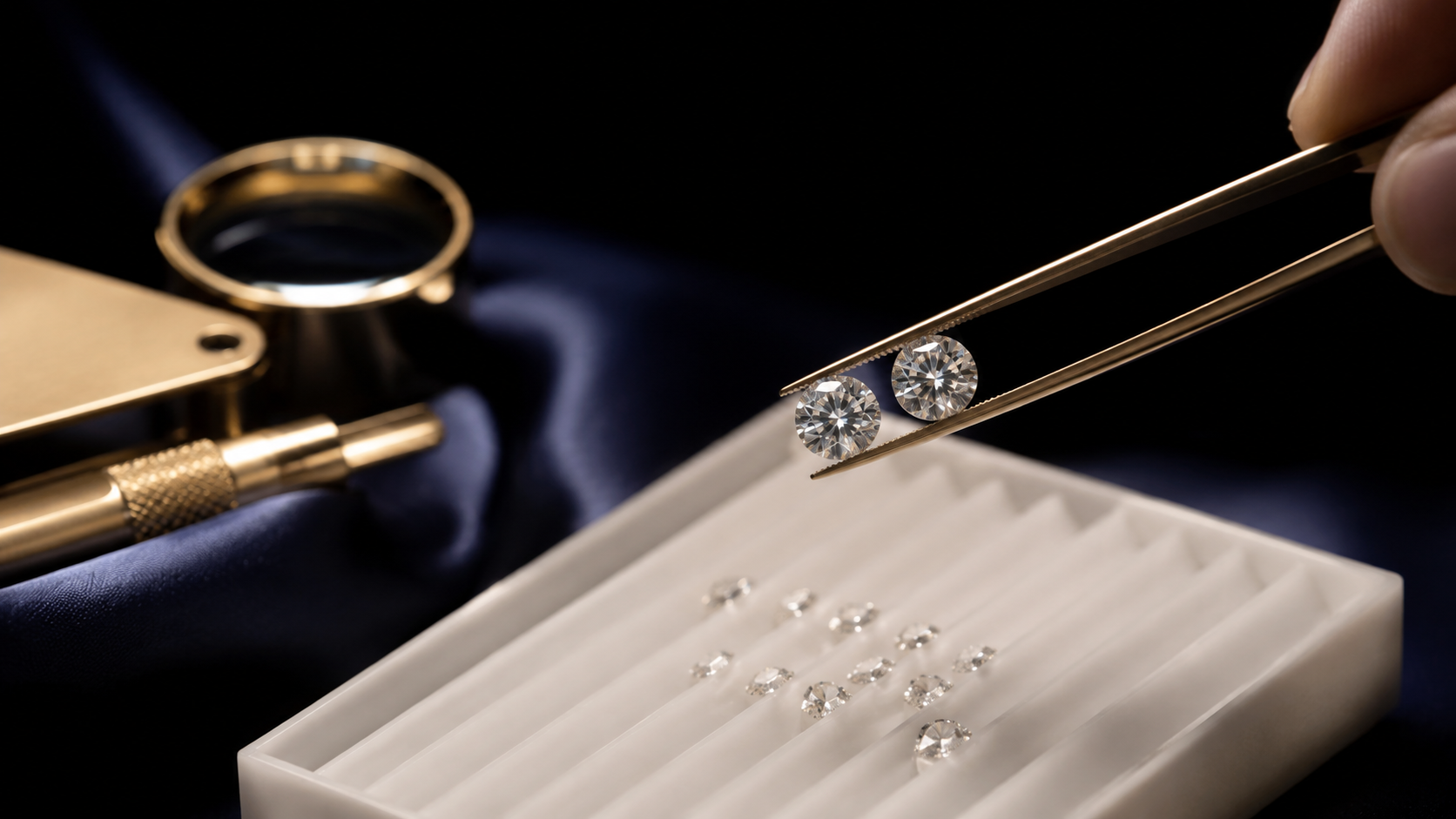
Two diamonds of the same grade on paper can look quite different on the ear. That is why a matched diamond pair carries a premium over two stones bought separately, and why the side stones in a three-stone ring can take longer to source than the centre. Matching is a job of its own, done by eye against a set of tolerances, and it is worth understanding what is being paid for.
What matching means
A report gives colour, clarity, weight and measurements. Matching goes further. Two stones are matched when they look the same to a trained eye, face up, side by side, in the same light. That involves:
Dimensions. For round stones in earrings, diameters typically within a tenth of a millimetre. Weight matters less than spread; a 0.52 and a 0.48 can look identical if the diameters agree, and two 0.50s can look wrong if one is cut deep.
Colour. Same grade, or at most one grade apart, and in the same direction. A G with a faint yellow tone next to a G with a faint brown tone will not read as a pair.
Cut. Similar proportions, so that both stones return light the same way. A stone with a slightly larger table and a shallower crown will look flatter and brighter than its partner, and the difference shows once they are set.
Fluorescence. Same strength. A stone with medium blue fluorescence next to an inert one can look different outdoors, even if identical indoors.
Clarity character. Two VS2 stones, one with a small crystal under the table and one with a cloud near the girdle, can differ in how they face up. Matching looks at where the inclusions are, not only the grade.
Why a matched diamond pair costs more
Sorting is the cost. To find two stones that agree on every count, a dealer works through many more than two. The rejected stones are still saleable, but the time and the reduced choice are real, and the pair is priced accordingly. The premium is usually modest for small stones, where there is a large pool, and grows with size, because large stones are rarer and finding two that agree is harder.
Fancy shapes add a further dimension: the length-to-width ratio must match, and for pears and marquises so must the outline. Two pear shapes of the same weight with different shoulders will never look like a pair.
Side stones for a centre
Side stones are matched to each other and proportioned to the centre. The usual starting point for a three-stone ring is sides that together weigh between half and equal to the centre weight, though this depends heavily on shape. Tapered baguettes and half-moons flanking a centre are matched by length and by the angle of the taper.
The colour of side stones is normally chosen to sit at or just below the centre. A pair of F sides next to an H centre will make the centre look warmer than it is. A pair of H sides next to an F centre is invisible.
Small stones for halos and shoulders are sorted by sieve size rather than weight, in fractions of a millimetre, and bought in matched lots. A halo with stones of uneven size looks wrong immediately, even to someone who cannot say why.
Matching to an existing stone
Bringing in one diamond and asking for a partner is the hardest case. The existing stone must be measured and graded first, and then a match found for it, which means sorting against one fixed target instead of pairing from a pool. Older stones cut to earlier proportions are particularly difficult, and sometimes the honest answer is that a modern stone will never look quite the same beside an old one.
What to ask
Have the stones been matched by eye as well as by report? Can you see them side by side in daylight before setting? What are the diameters? And for a ring, has the colour of the sides been chosen to flatter the centre rather than to compete with it. A jeweller who sorts stones regularly will answer without needing to look anything up.
Book a complimentary design consultation at the C'Garden atelier, The MET Corporate Towers, Kuala Lumpur: 010-766 7448 · hq@cgarden.com.my
C'Garden is an independent bespoke jeweller in Kuala Lumpur. We are not affiliated with, endorsed by, sponsored by or certified by any organisation, laboratory or brand named in this article. Third-party names are used only to refer factually to those organisations and their published standards. All text and imagery in this article is original work created by C'Garden.
Reference
Gemological Institute of America. (n.d.). Diamond cut. GIA. https://www.gia.edu/diamond-cut
All journal entries