
The Laser Inscription on Your Diamond: What It Is and How to Check It
A diamond laser inscription is a microscopic report number on the girdle. How to find it with a loupe, match it to the report and what it cannot tell you.
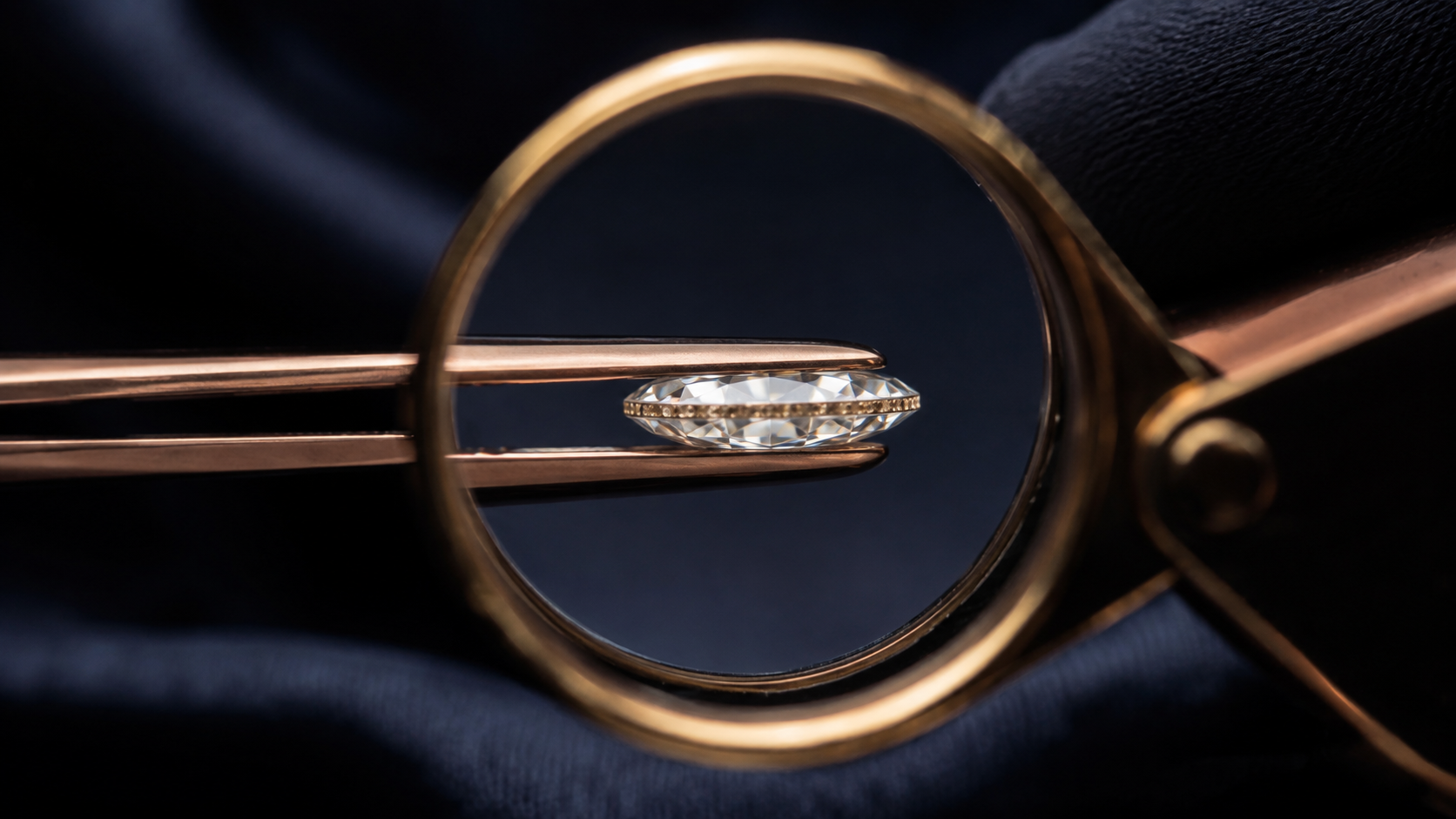
Most laboratory-graded diamonds now carry a diamond laser inscription: a string of characters, usually the laboratory's initials and the report number, etched into the girdle. It is far too small to see unaided, does nothing to the stone's appearance or value, and is the simplest available way to confirm that the diamond in a ring is the diamond described on its report.
What it is
The inscription is made with a laser that removes a microscopic layer of material from the girdle, the thin band around the stone's widest point. The characters are typically a fraction of a millimetre high. Under a ten times loupe, with the stone held edge on and the light at the right angle, they appear as a faint grey line of text.
The girdle is used because it is the one surface that has no optical function and is almost always hidden by the setting. An inscription there does not affect clarity grade, brightness or weight in any measurable way.
What it usually says
The laboratory's initials or logo, followed by the report number. On a report from a major laboratory, that number lets anyone look up the grading record online and compare it to the stone in front of them.
Some stones also carry a second inscription: a brand name, a serial number from a mine or cutting house, or a personal message requested by the buyer. Personal inscriptions are a service some laboratories and cutters offer and are recorded on the report when done at grading.
Laboratory-grown diamonds are normally inscribed with an indication of their origin alongside the report number, which is one of the reasons the inscription matters more now than it once did.
How to find it
Use a loupe of at least ten times. Most inscriptions are difficult with less; some very small ones benefit from twenty.
Hold the stone so you are looking directly at the girdle, with the table pointing away from you or to the side.
Rotate slowly. The inscription is at one point on the circumference, and the report usually notes its position relative to a landmark such as a specific facet or a plotted inclusion.
Adjust the light. The characters show best when light skims across the girdle surface rather than shining straight into it. Tilting the stone a few degrees back and forth usually brings them up.
On a set stone, this is harder. The prongs may cover it. A jeweller's microscope makes it straightforward, and any jeweller can check it for you in a minute or two.
Matching it to the report
Once read, compare the number character by character to the report. Then, if the report is from a laboratory with an online database, enter the number there and confirm that the weight, measurements, colour and clarity shown match the printed document.
If everything lines up, you have confirmed three things: the report is genuine, the stone is the one the report describes, and nobody has swapped it since grading.
What it cannot tell you
It does not prove the grades are right. It confirms which report belongs to the stone, not that the laboratory's opinion is correct. That depends on the laboratory.
It is not tamper-proof. An inscription can be polished off, though doing so removes a small amount of weight and would leave the stone without a matching report. It is also possible, in principle, to inscribe a false number. This is rare and easily detected by comparing the stone's measurements to the database record.
It says nothing about treatments or origin unless the laboratory chose to record them. That information is on the report itself.
When to check it
At purchase, before the stone is set. After any repair or resetting where the stone has left your sight. Whenever a ring comes back from an insurer, a cleaner or a jeweller you do not know well. It takes two minutes and it is the only easy proof of identity a diamond has.
Book a complimentary design consultation at the C'Garden atelier, The MET Corporate Towers, Kuala Lumpur: 010-766 7448 · hq@cgarden.com.my
C'Garden is an independent bespoke jeweller in Kuala Lumpur. We are not affiliated with, endorsed by, sponsored by or certified by any organisation, laboratory or brand named in this article. Third-party names are used only to refer factually to those organisations and their published standards. All text and imagery in this article is original work created by C'Garden.
Reference
Gemological Institute of America. (n.d.). Laser inscription. GIA. https://www.gia.edu/gem-lab-service/laser-inscription
All journal entries