
Jewellery and Sport: What Survives the Gym, the Pool and the Court
Jewellery at the gym, in the pool and on the court: what bends, what corrodes, what snags and what can be worn safely, with practical rules by activity.
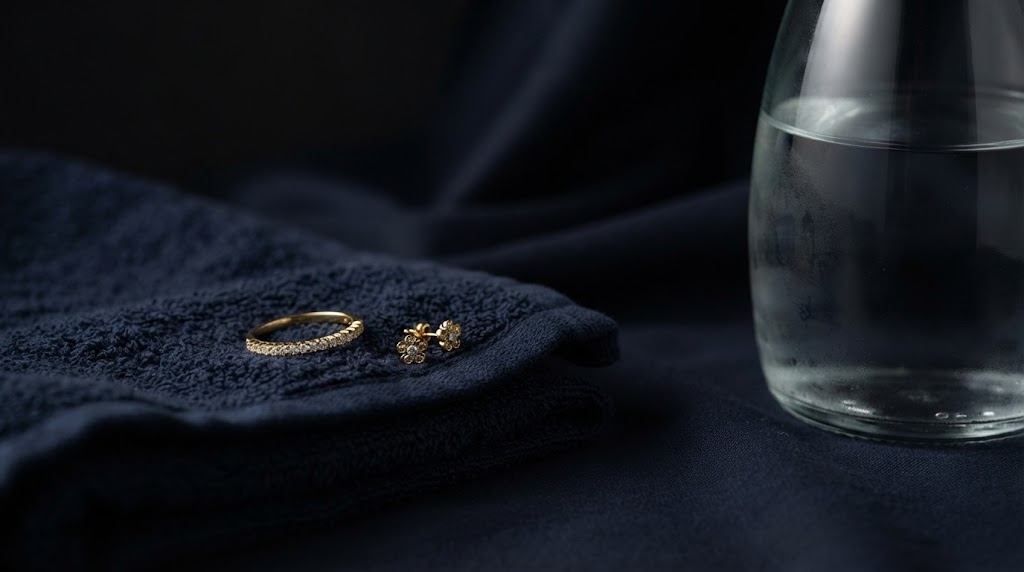
Most questions about jewellery and the gym come down to one of three risks: deformation, corrosion or snagging. Each sport has its own mix. Knowing which risk applies lets you decide what to leave in the locker rather than following a blanket rule.
Jewellery, gym and weights
The risk is deformation. A barbell, dumbbell or pull-up bar concentrates body weight through a ring. Gold and platinum are soft; a shank pressed between a bar and a finger bone bends into an oval, and the stone above it is levered against its prongs. This is the single most common cause of a misshapen ring seen at any bench.
Rings come off for anything involving a bar, kettlebell or rowing handle. A silicone band is the accepted substitute.
Chains and bracelets are less at risk but catch on cable machines and get soaked in sweat. Sweat is mildly corrosive and salty, and left on a chain overnight it dulls the metal and irritates skin.
Studs are fine. Small, secure earrings with good backs cause no trouble in the weights room.
The pool
The risk is corrosion. Chlorinated water attacks the copper and silver in gold alloys and, over repeated exposure, makes 14k and lower alloys brittle. Stress corrosion cracking at prong tips is a known result. 18k and 22k are more resistant but not immune. Platinum is unaffected. Sea water is less aggressive than pool water but still leaves salt in every recess.
Cold water shrinks fingers. Rings slip off in pools and are almost never found.
Pearls, opal, turquoise and emerald must not go near chlorine at all; the first three are porous and the last is usually oil-treated.
Everything comes off for swimming. Rinse in fresh water anything that got splashed.
Badminton, tennis, squash and basketball
The risk is snagging and impact. A racket handle twisted a thousand times an hour rubs a ring against the grip and against the neighbouring fingers. Basketball and netball involve hands in contact with other bodies, and a raised setting can cut someone. Hoop earrings can be pulled; dangling earrings can be torn.
Rings off for racket sports and any contact ball game. Small studs with screw backs stay in. Necklaces go inside the shirt or, better, off.
Running and cycling
The risk is minor. Sweat, sun and vibration. A ring worn running is unlikely to be damaged, though fingers swell in Malaysian heat and a ring that was tight at the door can be painful five kilometres later. Chains bounce and tangle; a short pendant sits better than a long one. Cycling gloves and handlebars make rings uncomfortable more than dangerous.
Golf
Rings on the gloved hand are usually fine. On the ungloved hand, a ring rubbing the grip wears the band and irritates the palm. Many golfers move the ring or remove it.
Martial arts, climbing and gymnastics
Everything off, without exception. Grip loads and grapples are the conditions under which rings cause serious finger injury, and climbing gyms in Kuala Lumpur generally say so at the door.
Pieces designed for the active
If you want something on while training, a low flush-set band in platinum, screw-back studs and a short fine chain with a small pendant are the three pieces that behave. Nothing with prongs, nothing that dangles, nothing soft.
After every session
Rinse, dry, and once a week wash pieces in warm water with a drop of mild soap. Sweat left to dry is the slow version of the pool.
Book a complimentary design consultation at the C'Garden atelier, The MET Corporate Towers, Kuala Lumpur: 010-766 7448 · hq@cgarden.com.my
C'Garden is an independent bespoke jeweller in Kuala Lumpur. We are not affiliated with, endorsed by, sponsored by or certified by any organisation, laboratory or brand named in this article. Third-party names are used only to refer factually to those organisations and their published standards. All text and imagery in this article is original work created by C'Garden.
Reference
Jewelers of America. (n.d.). Jewelry care. Jewelers of America. https://www.jewelers.org/buying-jewelry/jewelry-repair-and-care/jewelry-care
All journal entries