
How to Tell If a Diamond Is Real: Home Tests and Their Limits
How to tell if a diamond is real: what the popular home tests can and cannot show, why moissanite fools most of them, and when only a laboratory will do.
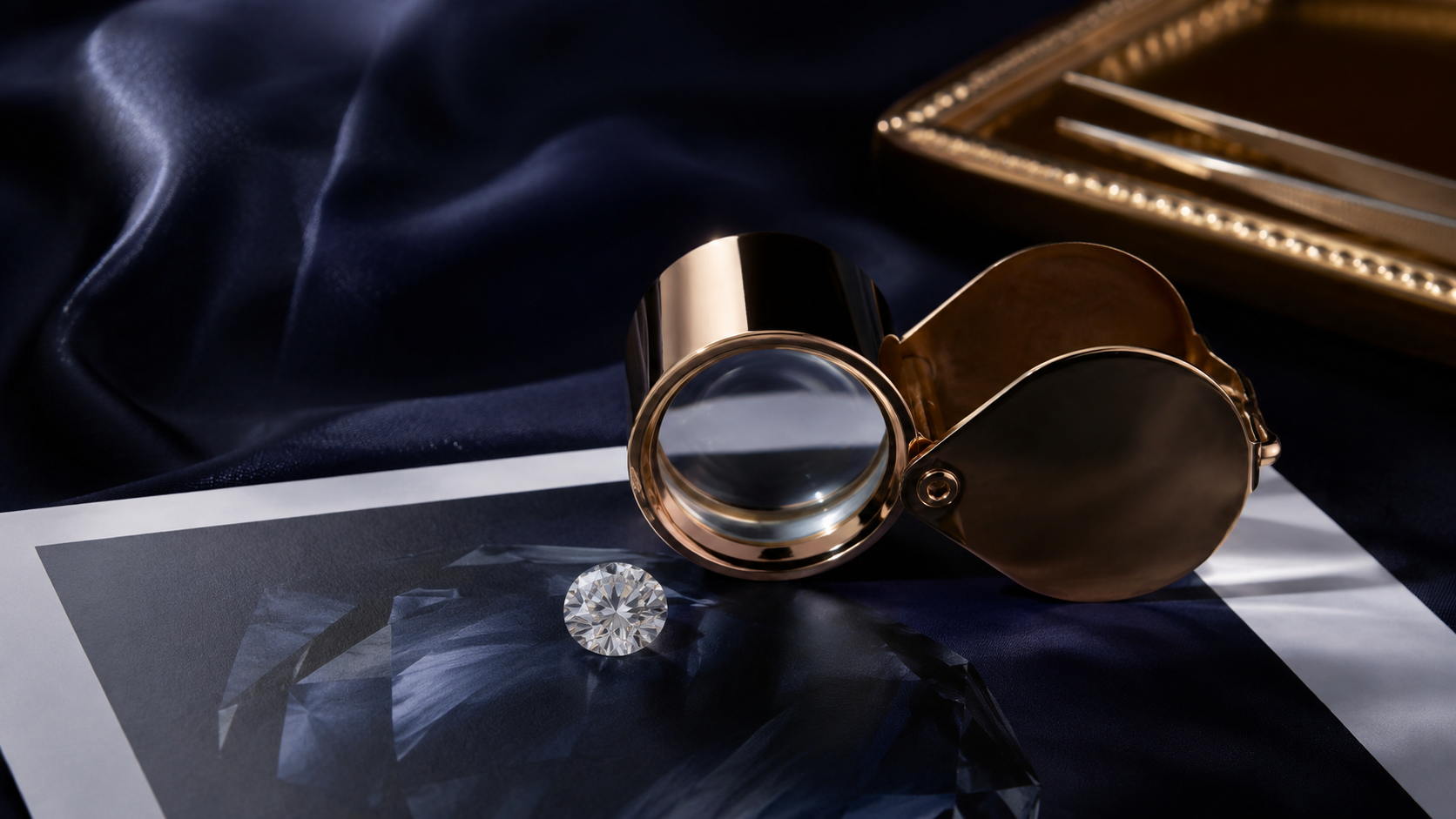
Searches for how to tell if a diamond is real usually turn up the same handful of kitchen-table tests. Some of them are useful for ruling out glass. None of them can rule out the simulants that actually get sold as diamond today, and none can separate a grown diamond from a mined one. It is worth knowing exactly what each test proves, so that you know when to stop trusting it.
Tests that rule out glass and little else
The fog test. Breathe on the stone. Diamond conducts heat so well that condensation clears almost instantly; glass stays fogged longer. This works against glass and cubic zirconia. It fails against moissanite, which conducts heat about as well as diamond.
The water test. Drop a loose stone in a glass of water; diamond sinks. So does every other stone of jewellery density, including glass. This test proves nothing.
The read-through test. Place a loose stone table-down on printed text. A well-cut round diamond bends light so strongly that you cannot read through it. A poorly cut diamond, a shallow stone or a fancy shape may let some text through, and a well-cut cubic zirconia will block it just as effectively. Unreliable in both directions.
The scratch test. Do not do this. Diamond scratches glass, but so do sapphire, moissanite and cubic zirconia, and a hard knock can chip a real stone.
Tests that tell you more
Doubling under a loupe. Tilt the stone and look through the crown with a ten power loupe at the back facet edges. Moissanite is doubly refractive, so the edges appear doubled, like a slightly blurred line. Diamond shows single crisp lines. This takes practice but is the most useful home test there is, because moissanite is the simulant most likely to be passed off as diamond.
The girdle inscription. Most graded diamonds sold in the past twenty years carry a laser inscribed report number on the girdle. Find it with a loupe and check it against the laboratory's online database. The presence of a number that matches a report for a stone of the same weight and measurements is strong evidence. It is not proof: inscriptions can be copied onto other stones, which is why the measurements must match too.
The setting itself. Real diamonds are rarely set in base metal or plated brass. Look for a fineness mark, such as 750 or 916 or PT950. A high-quality setting is not proof of a real stone, but a cheap one is a warning.
What a jeweller's tester does
The handheld pen testers in most shops measure thermal conductivity. They separate diamond from glass, cubic zirconia and coloured stones, and they say moissanite is diamond. Better testers add an electrical conductivity check, which catches most moissanite, though not every kind. A jeweller who tests your stone with a thermal pen and declares it real has not actually ruled out moissanite.
What no home test can do
Grown from mined. A lab-grown diamond is diamond. Every test above, including the pen tester and the loupe, will call it real, because it is. Separating grown from natural requires laboratory instruments that examine fluorescence patterns and absorption spectra. If origin matters to you, only a report from a recognised laboratory settles it.
Treated from untreated. Fracture filling, laser drilling and colour treatment are likewise a laboratory matter, though a good loupe and an experienced eye will catch some of them.
How to tell if a diamond is real: the sensible sequence
Check for an inscription and verify it. Look for doubling with a loupe. Ask for a report if there is none, and if the seller cannot produce one for a stone above about half a carat, treat that as an answer in itself. For anything of real value, an inherited stone with no paperwork or a purchase from an unfamiliar source, send it to a laboratory. In Kuala Lumpur that means a few days and a modest fee, and it replaces every home test with a document you can rely on.
Book a complimentary design consultation at the C'Garden atelier, The MET Corporate Towers, Kuala Lumpur: 010-766 7448 · hq@cgarden.com.my
C'Garden is an independent bespoke jeweller in Kuala Lumpur. We are not affiliated with, endorsed by, sponsored by or certified by any organisation, laboratory or brand named in this article. Third-party names are used only to refer factually to those organisations and their published standards. All text and imagery in this article is original work created by C'Garden.
Reference
Gemological Institute of America. (n.d.). Report check. GIA. https://www.gia.edu/report-check-landing
All journal entries