
How to Read a Coloured Gemstone Report
A gemstone certificate for a sapphire or ruby identifies and describes; it does not grade. What each line means, what it leaves out, where to look.
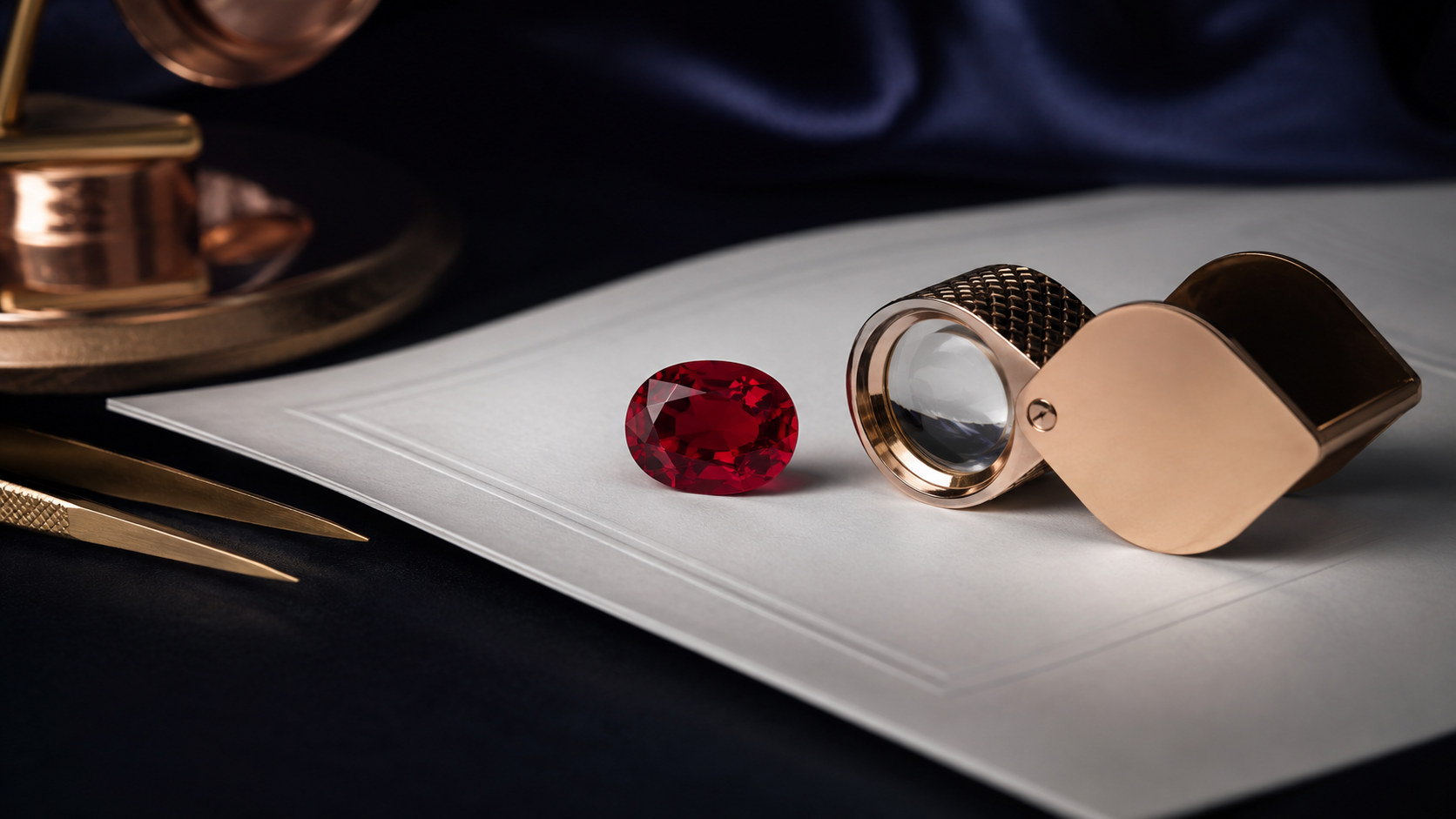
Clients who have bought a diamond arrive expecting a coloured stone to come with the same kind of document: a grade for colour, a grade for clarity, a cut score. A gemstone certificate for a sapphire, ruby, emerald or spinel does something different. It identifies and describes. It does not grade, and knowing that changes how you read it.
First, the word certificate
Laboratories call the document a report, not a certificate, and there is a reason. It records the laboratory's findings on a particular day using particular methods. It does not certify quality or value. We use the everyday word in this article because it is the word people search for, but the report itself will say report.
The lines you will see
Identification. The species and variety: natural corundum, variety sapphire. This is the most important line. It settles whether the stone is natural or synthetic and what mineral it is.
Weight, measurements and shape. Carat weight to two decimal places, dimensions in millimetres, and the cutting style. Check these against the stone in front of you. A report belongs to one specific stone and can be paired with another by mistake or by intent.
Colour. Described in words, not graded. "Blue", "pinkish red", "greenish blue". Some laboratories add trade terms such as "royal blue" or "pigeon's blood" for stones that meet their internal criteria. These terms are opinions with commercial weight, not measurements, and different laboratories apply them differently.
Transparency and clarity. Usually a single word: transparent, translucent. There is no clarity grade equivalent to VS or SI for coloured stones on most reports.
Treatment. The line that most affects value. Common phrasings: "no indications of heating", "indications of heating", "minor clarity enhancement", "evidence of glass filling", "indications of diffusion". Read every word. "No indications" is the laboratory's honest limit; it means they found no evidence, not that the stone is proven untouched.
Origin. Optional and often on a separate document. Stated as an opinion based on inclusions and trace element chemistry, for example "Sri Lanka" or "Myanmar (Burma)". Laboratories will say "origin undetermined" when the evidence is not clear enough. An origin opinion can differ between laboratories for the same stone.
Comments. Where anything unusual is recorded. Do not skip it.
What a report will not tell you
It will not tell you whether the stone is beautiful. Two sapphires with identical reports can differ enormously in tone, saturation, brightness and cut quality, and therefore in price. The report is a floor, not a description of merit.
It will not tell you the stone is undamaged. A chipped girdle or an abraded facet is rarely noted.
It will not give a value. Any figure quoted for insurance should come from a separate valuation, not the laboratory.
Which laboratory
For coloured stones, the names that carry weight internationally include GIA, SSEF, Gübelin, GRS, AGL and Lotus. Regional laboratories vary widely. A report from a laboratory nobody recognises is a piece of paper. For a stone of any real cost, we recommend one of the established names and are happy to arrange submission.
How to use the report at the counter
Match the stone to the paper. Weight and dimensions should agree. Ask to see the stone weighed.
Ask for the date. An old report on a stone that has since been recut, repolished or re-treated is out of date.
Ask what the treatment line means in plain words. A jeweller should be able to explain it without reaching for the brochure.
Ask what was not tested. If origin was not requested, it will not appear. That is not concealment, just scope.
Read this way, a gemstone certificate is a useful tool. It tells you what the stone is and what has been done to it. Deciding whether it is the right stone is still your job and ours.
Book a complimentary design consultation at the C'Garden atelier, The MET Corporate Towers, Kuala Lumpur: 010-766 7448 · hq@cgarden.com.my
C'Garden is an independent bespoke jeweller in Kuala Lumpur. We are not affiliated with, endorsed by, sponsored by or certified by any organisation, laboratory or brand named in this article. Third-party names are used only to refer factually to those organisations and their published standards. All text and imagery in this article is original work created by C'Garden.
Reference
Gemological Institute of America. (n.d.). GIA laboratory services. GIA. https://www.gia.edu/gem-lab
All journal entries