
How Gold Jewellery Is Priced in Malaysia: Weight, Workmanship and Margin
Gold jewellery price Malaysia explained: metal at the day's rate, workmanship and margin. How each is calculated and how to compare two quotes fairly.
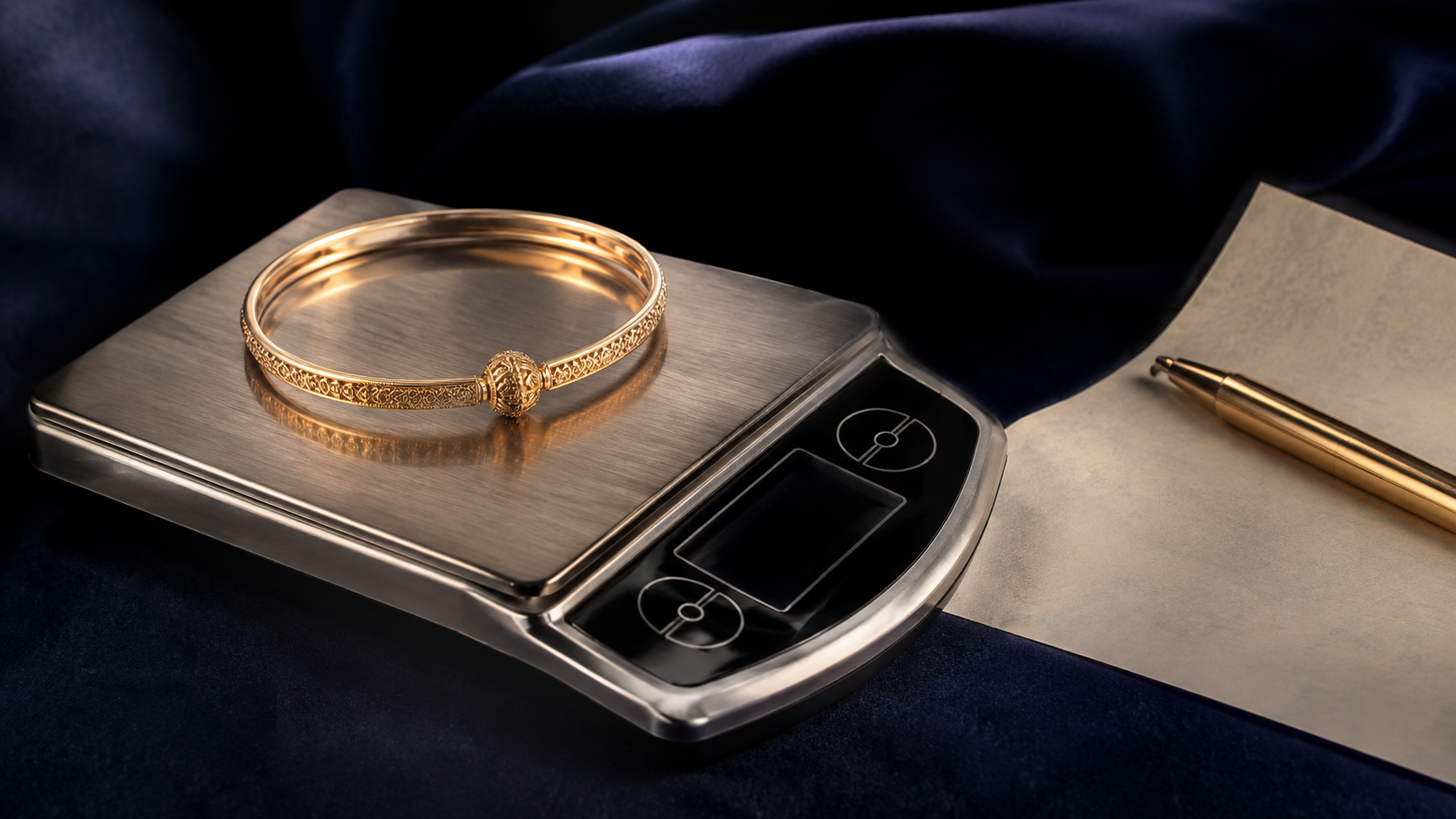
Ask what a piece costs in a Malaysian gold shop and the answer is usually a number arrived at on a calculator, on the spot, from a rate written on a board behind the counter. That habit is not carelessness. It reflects the fact that a gold jewellery price in Malaysia is built from three separate parts, and only one of them is fixed by the shop.
Understanding the three parts is the difference between comparing pieces properly and simply comparing totals.
Part one: the metal
Gold is traded internationally in US dollars per troy ounce. Malaysian retailers convert that into a ringgit rate per gram, adjust for purity, and post it daily. A 916 piece (22 karat, 91.6 percent gold) is priced from the 916 rate, an 18 karat piece (75 percent gold) from a lower one, and so on.
The metal cost of any piece is therefore simple arithmetic: weight in grams multiplied by the day's rate for that purity. Two shops on the same street will quote nearly identical metal costs for the same weight, because they are both working from the same underlying market.
What to check. That the piece is weighed in front of you, that the rate on the board matches the rate on the receipt, and that the purity stated on the receipt matches the hallmark on the piece.
Part two: workmanship
This is the part most buyers overlook and most sellers understate. Workmanship, often called upah locally, is the charge for turning metal into a finished object. It covers design, casting or hand fabrication, setting, finishing and the labour hours of whoever did the work.
Workmanship is usually expressed in one of two ways: a flat fee per piece, or a fee per gram added to the metal rate. Either method is legitimate. The problem is that the two are hard to compare directly, and a shop that quotes a low per-gram rate may be recovering the difference with a higher flat fee, or the other way round.
Where workmanship varies most. Plain bangles and chains carry low workmanship because machines do most of the work. Filigree, hand-set stones, intricate pendants and bespoke pieces carry high workmanship, because hours are hours. A light, intricate piece can reasonably cost more in workmanship than in metal.
Part three: margin
Every retailer adds margin to stay in business: rent, staff, security, insurance and stock financing. In Malaysia this is rarely stated as a separate line. It is folded into the workmanship figure, into a slightly higher posted rate, or both.
Margin is not something to resent. It is something to be aware of when a piece is described as being priced "at the gold rate", which typically means the metal is at the gold rate and everything else is elsewhere.
Why the buy-back rate matters at purchase
Most Malaysian gold shops will buy back gold they sold, at a posted buy-back rate below the selling rate. The gap between the two is, in effect, the workmanship and margin you paid on the way in. A wide gap on a plain piece is a signal that the price was heavier on margin than it looked.
Comparing two quotes fairly
Separate the numbers. Ask for weight, purity, rate per gram and workmanship as four figures, not one total.
Compare like with like. A hand-fabricated piece against a cast piece is not a price comparison, it is a quality comparison.
Ask what is included. Sizing, engraving, a certificate and a box are sometimes bundled, sometimes charged.
Ask how bespoke is priced. A bespoke jeweller will typically quote metal at the day's rate and workmanship as a separate design and making fee, which is the most transparent structure of all.
Book a complimentary design consultation at the C'Garden atelier, The MET Corporate Towers, Kuala Lumpur: 010-766 7448 · hq@cgarden.com.my
C'Garden is an independent bespoke jeweller in Kuala Lumpur. We are not affiliated with, endorsed by, sponsored by or certified by any organisation, laboratory or brand named in this article. Third-party names are used only to refer factually to those organisations and their published standards. All text and imagery in this article is original work created by C'Garden.
Reference
World Gold Council. (n.d.). Gold price. World Gold Council. https://www.gold.org/goldhub/data/gold-prices
All journal entries