
Hearts and Arrows: What 'Ideal Cut' Really Means
A hearts and arrows diamond shows a symmetrical pattern under a viewer. What the pattern proves, what it does not and how it relates to the cut grade.
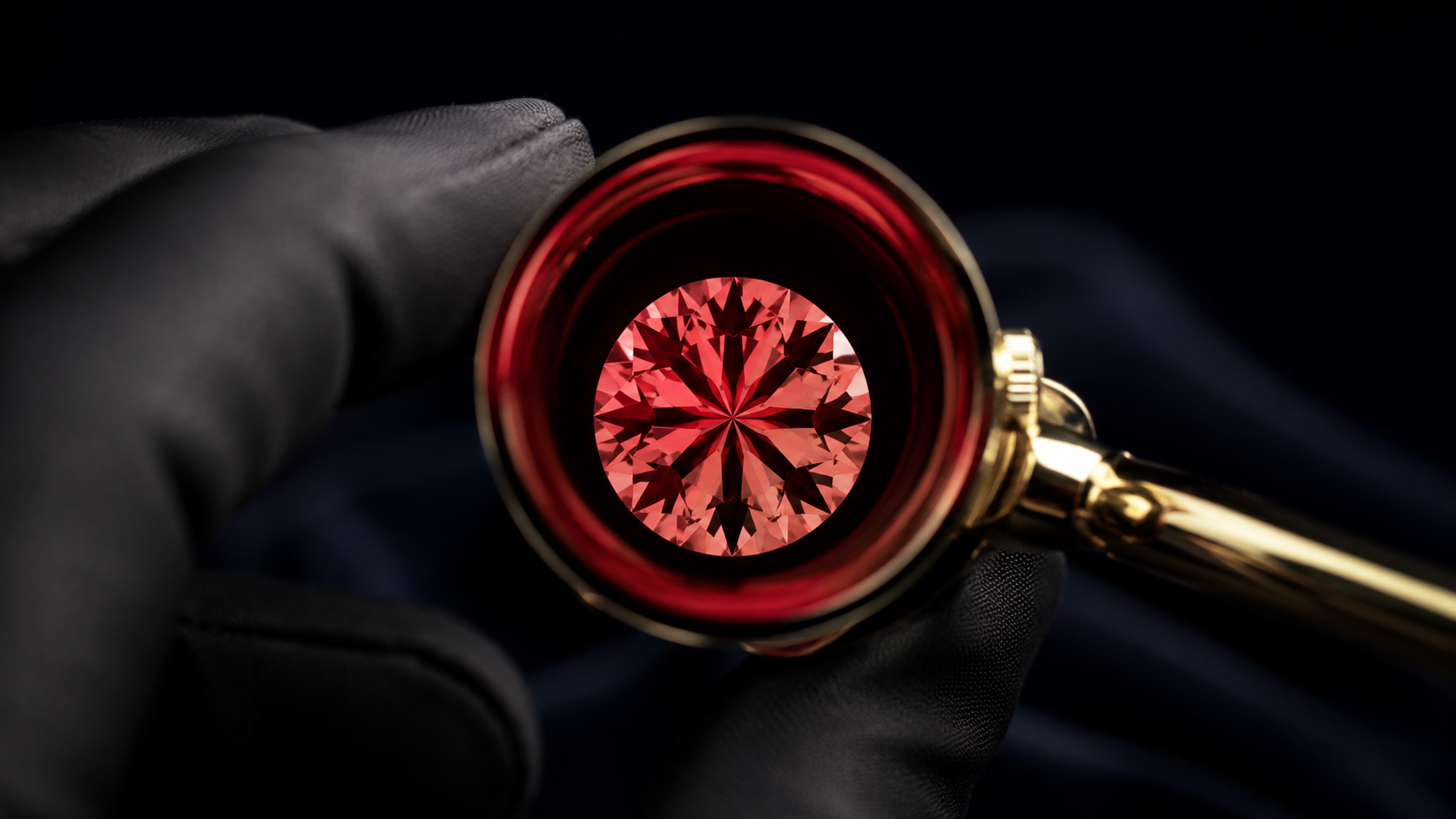
A hearts and arrows diamond is a round brilliant whose facets are aligned so precisely that, viewed through a simple filtered scope, it shows eight arrows from the top and eight hearts from the bottom. The pattern is real, it is a genuine mark of cutting precision, and it is also one of the most oversold ideas in diamond retail. Both things are true.
What the pattern is
Every round brilliant has eight pavilion main facets meeting at the culet. When light enters the stone and reflects off them, the crown facets above show that reflection as a pattern. In a stone with average alignment, the pattern is muddled. In a stone where every facet is placed at exactly the same angle as its neighbours and every facet junction meets cleanly, the reflections line up.
Viewed through a scope that colours the light from one direction, the face-up pattern becomes eight dark arrows radiating from the centre. Turned over and viewed through the pavilion, the same alignment produces eight hearts around a ring.
The pattern is a test of optical symmetry: whether the facets are all doing the same thing in the same place. That is a different quality from the physical symmetry graded on a report, which measures whether the outline is round, the table is centred and the culet is not off to one side. A stone can have excellent physical symmetry and a mediocre arrows pattern.
What it proves
Crisp, complete, evenly sized hearts and arrows prove that the stone was cut with unusual care. Facet angles are consistent to a fraction of a degree. That consistency tends to produce a stone with even, orderly light return: bright across the whole face, with well-defined flashes rather than a scatter of small sparkles.
For someone who values that particular look, clean and structured and slightly formal, the pattern is a reliable way to find it.
What it does not prove
It does not prove the stone is bright. Symmetry is one input. Proportions are another. A stone can be perfectly symmetrical and still cut with angles that leak light. The hearts and arrows pattern says the facets agree with each other; it does not say they are pointed in the right direction.
It does not replace the cut grade. The report's cut grade considers proportions, polish, symmetry and the resulting brightness, fire and scintillation. Hearts and arrows is a supplement, not a substitute.
It does not mean "ideal cut" in any regulated sense. There is no single agreed definition of ideal. Some laboratories use the term as their top cut grade; others use excellent. Retailers use it freely. A stone described as ideal should always be checked against what the actual report says.
It is not all or nothing. Many well-cut stones show a good but imperfect pattern, with one arrow slightly off or hearts of slightly different sizes. The difference between that and a perfect pattern is invisible to the naked eye.
Triple excellent and super ideal
A stone graded excellent for cut, polish and symmetry is often called triple excellent. Most triple excellent rounds show a reasonable arrows pattern; a smaller number show a perfect one.
Some cutters go further, holding tighter tolerances than the top grade requires and marketing the result as super ideal. These stones are beautiful. They also carry a premium for precision that the eye cannot detect beyond a certain point. Whether that premium is worth paying is a matter of taste and, frankly, of temperament.
A sensible way to use it
Start with the cut grade. Excellent or its equivalent from a respected laboratory.
Check the proportions on the report against the ranges the laboratory recommends.
Then look at the arrows, if a viewer is available, as a tie-breaker between stones that already pass the first two tests.
Then look at the stone in daylight, without a scope, which is the only test that matters.
A hearts and arrows diamond is a well-made thing. Just remember that the pattern is evidence of care, not a guarantee of beauty, and that the report and your own eyes come first.
Book a complimentary design consultation at the C'Garden atelier, The MET Corporate Towers, Kuala Lumpur: 010-766 7448 · hq@cgarden.com.my
C'Garden is an independent bespoke jeweller in Kuala Lumpur. We are not affiliated with, endorsed by, sponsored by or certified by any organisation, laboratory or brand named in this article. Third-party names are used only to refer factually to those organisations and their published standards. All text and imagery in this article is original work created by C'Garden.
Reference
Gemological Institute of America. (n.d.). Diamond cut. GIA. https://www.gia.edu/diamond-cut
All journal entries