
Hand-Fabricated vs Cast: How Fine Jewellery Is Actually Built
Handmade vs cast jewellery is a choice of method, not a contest. How lost-wax casting and hand fabrication work, and how bespoke pieces use both.
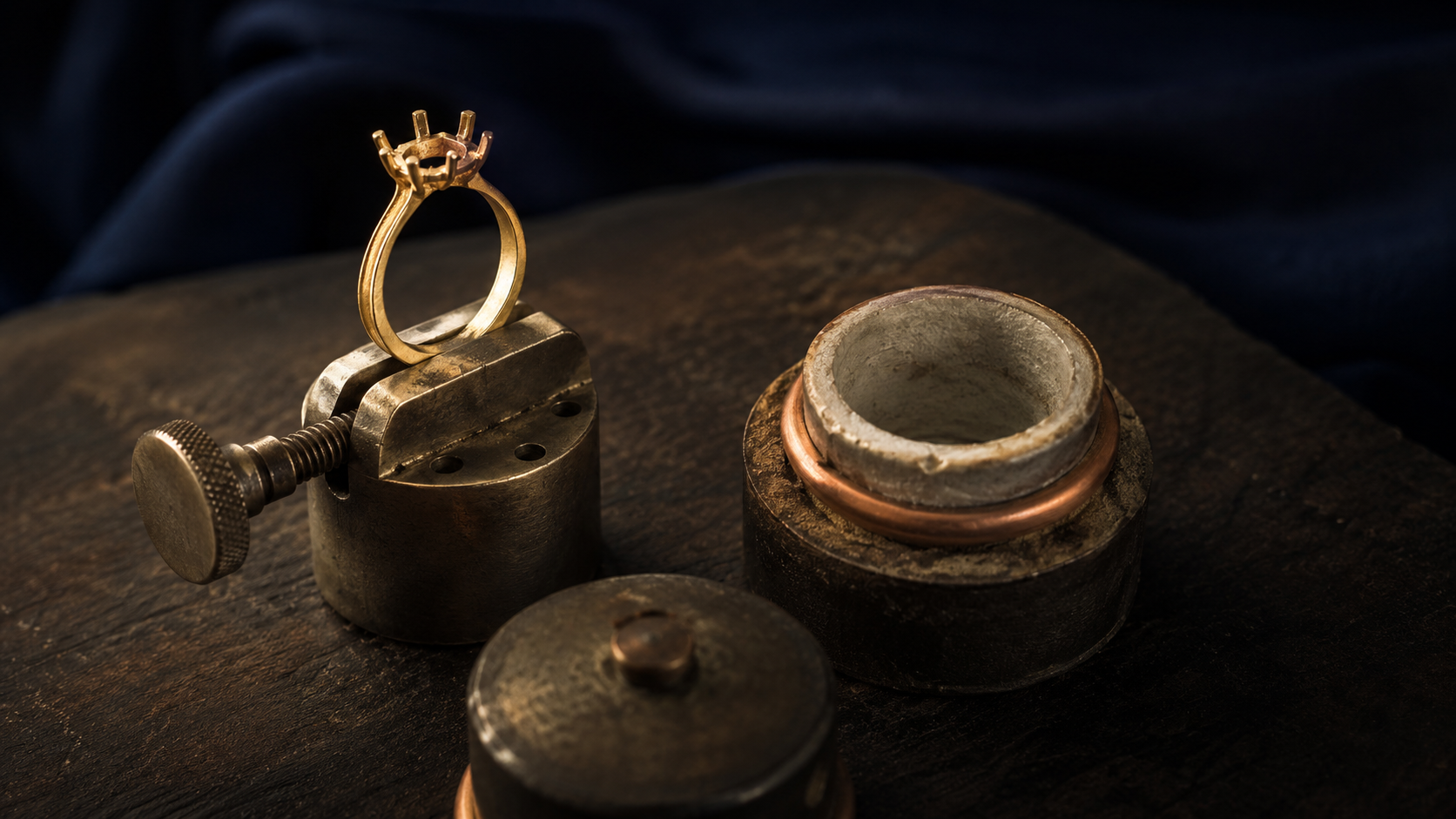
Almost every piece of fine jewellery arrives at its final form by one of two routes. Either molten metal is poured into a mould, or solid metal is cut, bent, forged and soldered into shape. The handmade vs cast jewellery debate treats these as rivals. In a working atelier they are tools, and a good jeweller chooses between them piece by piece.
Casting
Modern casting is lost-wax casting. A model of the piece is made in wax, either carved by hand or printed from a CAD file. The wax is embedded in a plaster-like investment, the investment is heated until the wax burns out, and molten gold or platinum is forced into the cavity by centrifugal force or vacuum. When it cools, the investment is broken away and a rough metal casting remains, which is then cleaned, filed, polished and set.
What casting does well. Complex shapes, repeated designs, organic forms and anything with fine relief that would take days to cut by hand. A ring with a sculpted gallery, a signet with a raised motif, a pendant with a flowing outline. Casting also allows a client to approve a wax or a resin print before any gold is committed.
Its weaknesses. Cast metal cools with a slightly open grain, and can contain porosity: tiny voids where gas was trapped. Good casting practice keeps this to a minimum, but a cast shank is generally a little less dense and less strong than the same shank forged from bar. Thin cast prongs are more prone to breaking than drawn wire prongs.
Hand fabrication
Fabrication starts with metal already in solid form: sheet, wire, tube and bar rolled or drawn from an ingot. The jeweller cuts, bends, files and solders these into the piece. A shank is formed from bar, a bezel from strip, prongs from wire.
What fabrication does well. Strength and precision. Working metal by rolling and hammering compresses its grain and work-hardens it, so a fabricated shank of the same dimensions is tougher than a cast one. Clean geometric forms, knife-edge bands, tapered wires and settings for unusual stones all come naturally to fabrication. Adjustments during the build are easy because nothing is committed until it is soldered.
Its weaknesses. Time. Every step is done once, by a person, and a complex piece can take many days. Elaborate relief and sculptural surfaces are slow or impractical. Cost follows time.
How most bespoke pieces are actually made
The honest answer is: both. A common approach for an engagement ring is a cast shank and gallery from a CAD model, with the prongs or collet for the centre stone fabricated from wire and soldered on, because that is where strength matters most. A signet might be cast for the body and hand-engraved on top. A plain wedding band is often fabricated entirely, because forging a band is quick and produces a better ring.
In our atelier the question we ask of each component is which method makes it stronger, cleaner or more affordable without compromising the other two.
What to ask a jeweller
Which parts are cast and which are fabricated? A confident answer is a good sign.
How is porosity controlled? Vacuum casting, correct metal temperature and clean metal are the usual answers. A pitted surface after polishing is the visible symptom of poor practice.
Are the prongs cast or wire? For a centre stone of any value, wire or a fabricated collet is the safer choice.
Can I see a wax or print before casting? For any cast piece, this is a normal step.
What it means for the client
Neither method is better in the abstract. A well-cast ring from a careful workshop will outlast a badly fabricated one, and vice versa. What matters is that the method fits the piece, the metal is handled well, and the jeweller can explain what they did and why. If the explanation is clear, the ring is usually sound.
Book a complimentary design consultation at the C'Garden atelier, The MET Corporate Towers, Kuala Lumpur: 010-766 7448 · hq@cgarden.com.my
C'Garden is an independent bespoke jeweller in Kuala Lumpur. We are not affiliated with, endorsed by, sponsored by or certified by any organisation, laboratory or brand named in this article. Third-party names are used only to refer factually to those organisations and their published standards. All text and imagery in this article is original work created by C'Garden.
Reference
Jewelers of America. (n.d.). Buying jewelry. Jewelers of America. https://www.jewelers.org/buying-jewelry
All journal entries