
Gold in Indian Weddings in Malaysia
Why gold carries such weight in Indian wedding tradition, which pieces are customary, and how Malaysian Indian families balance heritage against everyday wear.
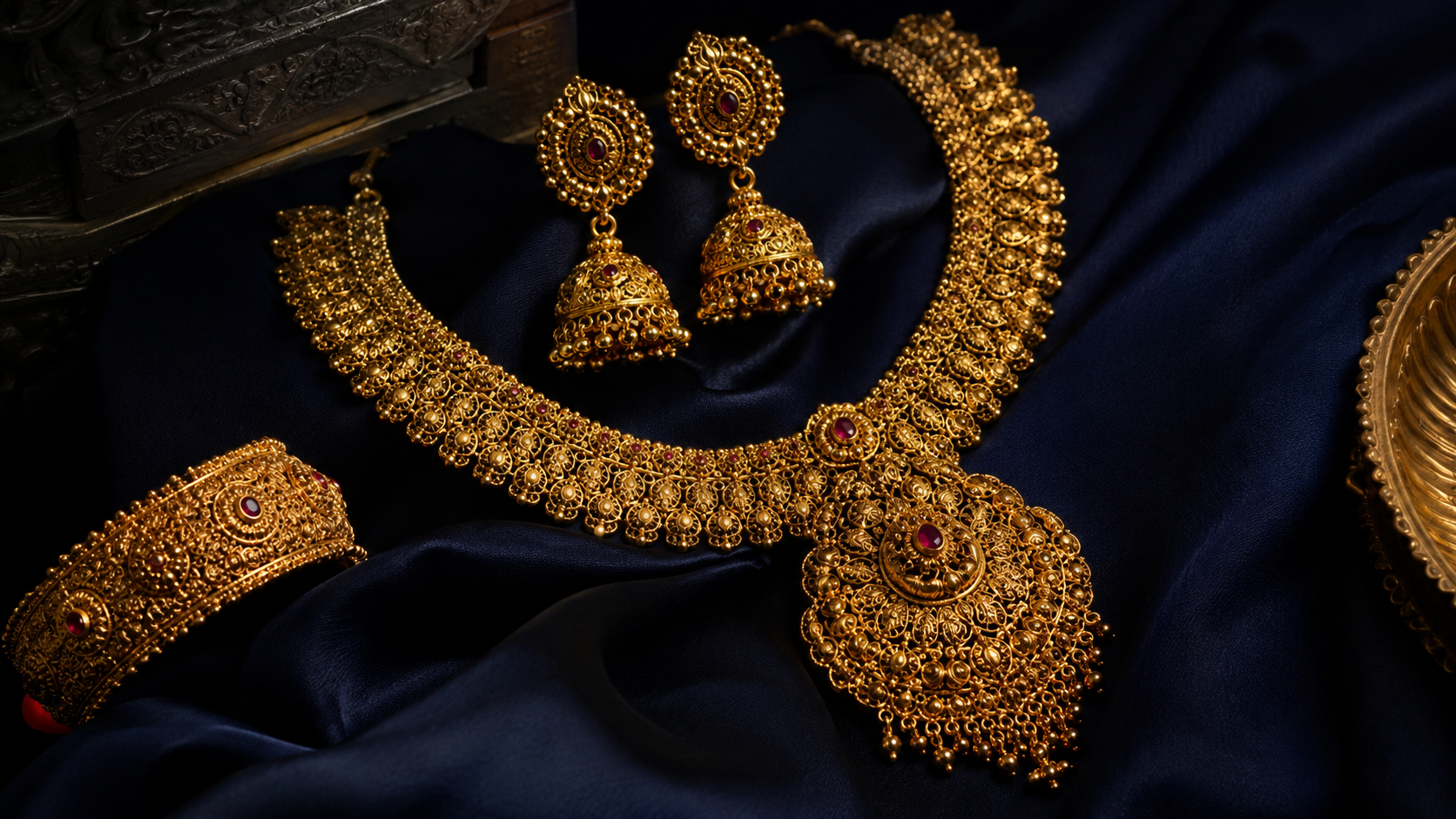
In Indian tradition gold is not decoration at the margins of a wedding. It is central, to the ceremony, to the family's standing, and to the bride's own security.
Why gold specifically
Three ideas overlap, and they still hold in Malaysia today.
Auspiciousness. Gold is associated with Lakshmi and with prosperity. Its presence at a wedding is a blessing, not merely a display.
The bride's own property. Gold given to a bride is stridhan, hers, not her husband's and not his family's. Historically this was a woman's only independent asset. That principle is still meaningful.
Portability of value. Gold holds worth across borders and generations in a way few assets do.
The pieces
Customs vary considerably between communities, Tamil, Telugu, Malayali, Punjabi and Gujarati families do this differently, but some pieces recur.
The thali or mangalsutra. The central marriage symbol, tied by the groom during the ceremony. Among Tamil families the thali is strung on a turmeric-dyed thread or a gold chain; its design is often specific to family or community.
Necklaces, frequently several, layered, from a short close-fitting piece to a long haaram.
Bangles, usually in multiples and often worn in a stack up the forearm.
Jhumkas and other earrings, often substantial.
Waist chain, nose ring, hair ornaments in fuller traditional styling.
Why 916 and 22k
Indian tradition favours high-purity yellow gold, and Malaysia's widely traded 916 corresponds to 22k. The deep yellow colour is part of the aesthetic, paler alloys read as a different metal entirely.
The trade-off is softness. 22k dents and scratches more readily than 18k. For ceremonial pieces worn a handful of times this hardly matters. For a chain worn daily for thirty years it does.
How Malaysian families are adapting
Splitting the budget. One or two substantial ceremonial pieces, plus lighter modern pieces the bride will actually wear afterwards.
Lighter construction. Hollow and machine-worked pieces give visual scale at lower weight. Ask about durability, hollow pieces dent and are harder to repair.
Rental for the heaviest items. Increasingly common for pieces worn only on the day.
Keeping the thali, remaking the rest. Inherited necklaces are often remodelled into wearable modern pieces while the thali stays untouched.
Practical advice
Buy the ceremonial pieces early. Traditional work takes time, and the weeks before a wedding are the wrong time to discover a delay.
Get bangle sizes measured, not guessed. A bangle must clear the widest part of the hand.
Keep documentation. Weight, fineness and receipts, for insurance and for the future.
Ask about buy-back before buying, so the structure of the price is clear from the start.
Book a complimentary design consultation at the C'Garden atelier, The MET Corporate Towers, Kuala Lumpur: 010-766 7448 · hq@cgarden.com.my
C'Garden is an independent bespoke jeweller in Kuala Lumpur. We are not affiliated with, endorsed by, sponsored by or certified by any organisation, laboratory or brand named in this article. Third-party names are used only to refer factually to those organisations and their published standards. All text and imagery in this article is original work created by C'Garden.
Reference
World Gold Council. (n.d.). Gold demand by country. World Gold Council. https://www.gold.org/goldhub/data/gold-demand-by-country
All journal entries