
Gold Bars or Gold Jewellery: Which Is Better for Saving?
Gold bar vs gold jewellery for saving: what each costs to buy, what each returns when sold, and why the answer depends on what you want the gold to do.
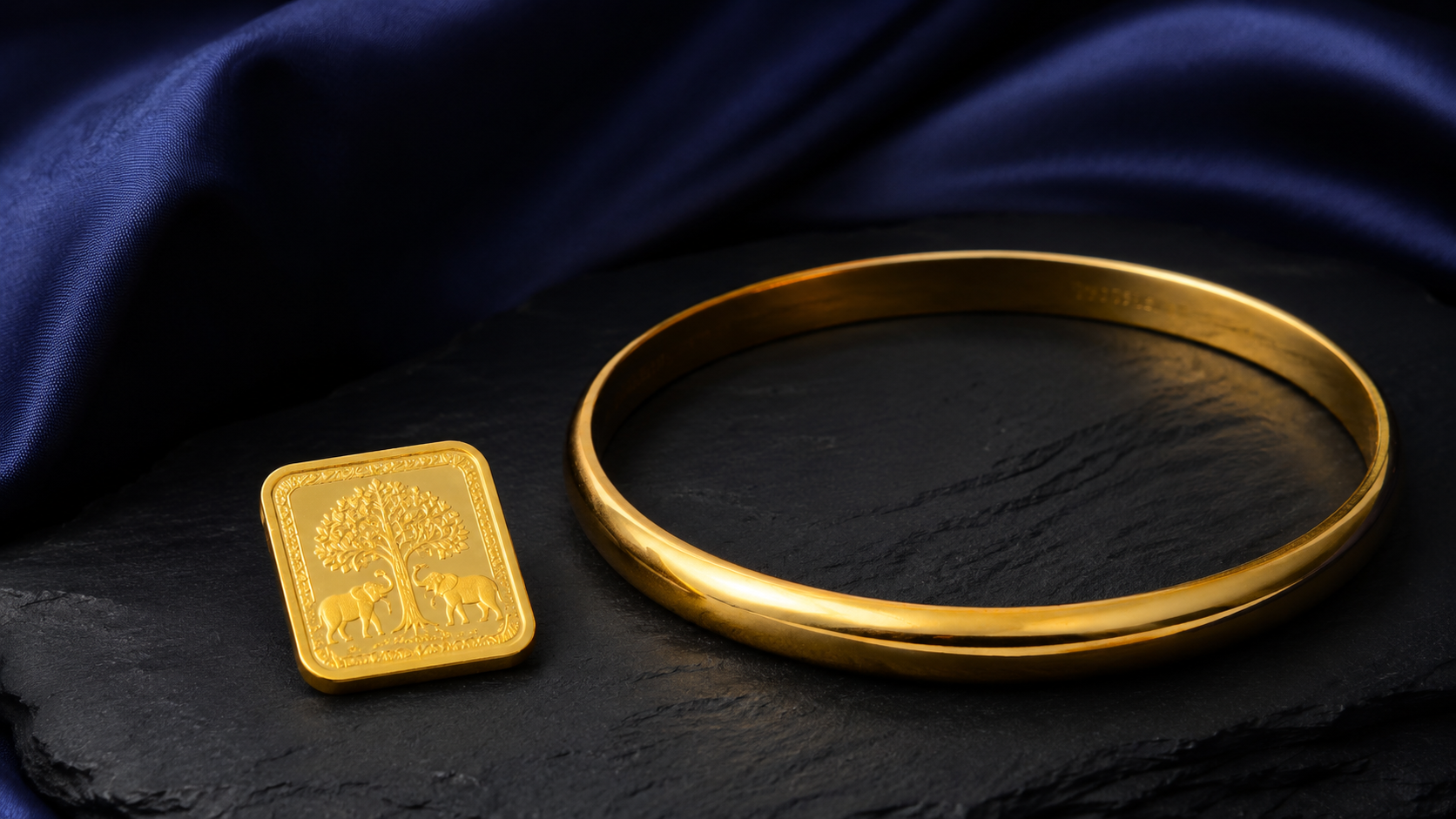
In Malaysia, gold has always done two jobs at once. It is worn, and it is kept. Many families would struggle to say which purpose came first when a bangle was bought. So the gold bar vs gold jewellery question is a fair one, and it deserves a straighter answer than either a bullion dealer or a jeweller usually gives.
The short version: a bar is more efficient as a store of value. Jewellery is a store of value that you also get to use. Whether that use is worth its cost is a personal decision, not a financial law.
What you pay on the way in
Bars. A minted bar is priced at the gold rate plus a small premium for fabrication, assay and packaging. The premium is proportionally smaller on larger bars. Purity is typically 999 or 999.9, and the bar comes sealed with its own certificate.
Jewellery. A 916 piece is priced at the 916 rate plus workmanship and margin. On a plain chain or bangle the extra is modest. On an intricate piece it can be substantial. You are paying for craft, and craft is not recoverable at the scale.
What you get on the way out
Bars. Sold back to a dealer at a posted buy-back rate, usually close to the selling rate. Sealed, recognised bars change hands easily.
Jewellery. Sold back to a gold shop at its buy-back rate for the purity, by weight. Workmanship is not refunded. A piece that cost significantly more than its metal value will return only its metal value, minus the shop's spread.
That spread is the whole argument. Gold in either form rises and falls together. The difference is how much of your money is in the gold and how much is in the making.
Where jewellery holds its own
It is used. A bar in a safe deposit box provides nothing between purchase and sale. A bangle is worn for decades. If you would have bought jewellery anyway, the gold inside it is savings you were going to hold regardless.
It is culturally liquid. In Malaysia, 916 jewellery is understood, valued and easily sold almost anywhere. A bar requires a dealer.
Plain pieces close the gap. A heavy plain bangle or a simple rope chain carries low workmanship relative to its weight. These are the pieces that families have traditionally treated as savings, and the tradition is sound.
Where bars are clearly better
Larger sums. Once the amount is significant, the premium on a bar becomes almost negligible while the workmanship on jewellery does not.
No wear. Bars do not scratch, thin, lose stones or need repair.
Cleaner records. A sealed bar with its certificate is straightforward to document for family or estate purposes.
A practical way to decide
Ask what the gold is for.
If it is purely to hold value, buy bars, and buy the largest single bar the budget comfortably allows.
If it will be worn and also kept, buy plain, heavy, high-purity jewellery, and treat the workmanship as the cost of wearing it.
If it is a gift or an heirloom, the emotional value is the point, and worrying about the spread misses it.
Many Malaysian households sensibly do both. A bar for the sum they never intend to touch. A bangle for the sum they want to see on a wrist. Neither is the wrong answer.
Book a complimentary design consultation at the C'Garden atelier, The MET Corporate Towers, Kuala Lumpur: 010-766 7448 · hq@cgarden.com.my
C'Garden is an independent bespoke jeweller in Kuala Lumpur. We are not affiliated with, endorsed by, sponsored by or certified by any organisation, laboratory or brand named in this article. Third-party names are used only to refer factually to those organisations and their published standards. All text and imagery in this article is original work created by C'Garden.
Reference
World Gold Council. (n.d.). Why invest in gold. World Gold Council. https://www.gold.org/goldhub/research
All journal entries