
From Drawing to Wax to Gold: How a Bespoke Piece Is Made
Six stages between a sketch and a finished ring, what happens at each, and which ones you get to approve before anything becomes irreversible.
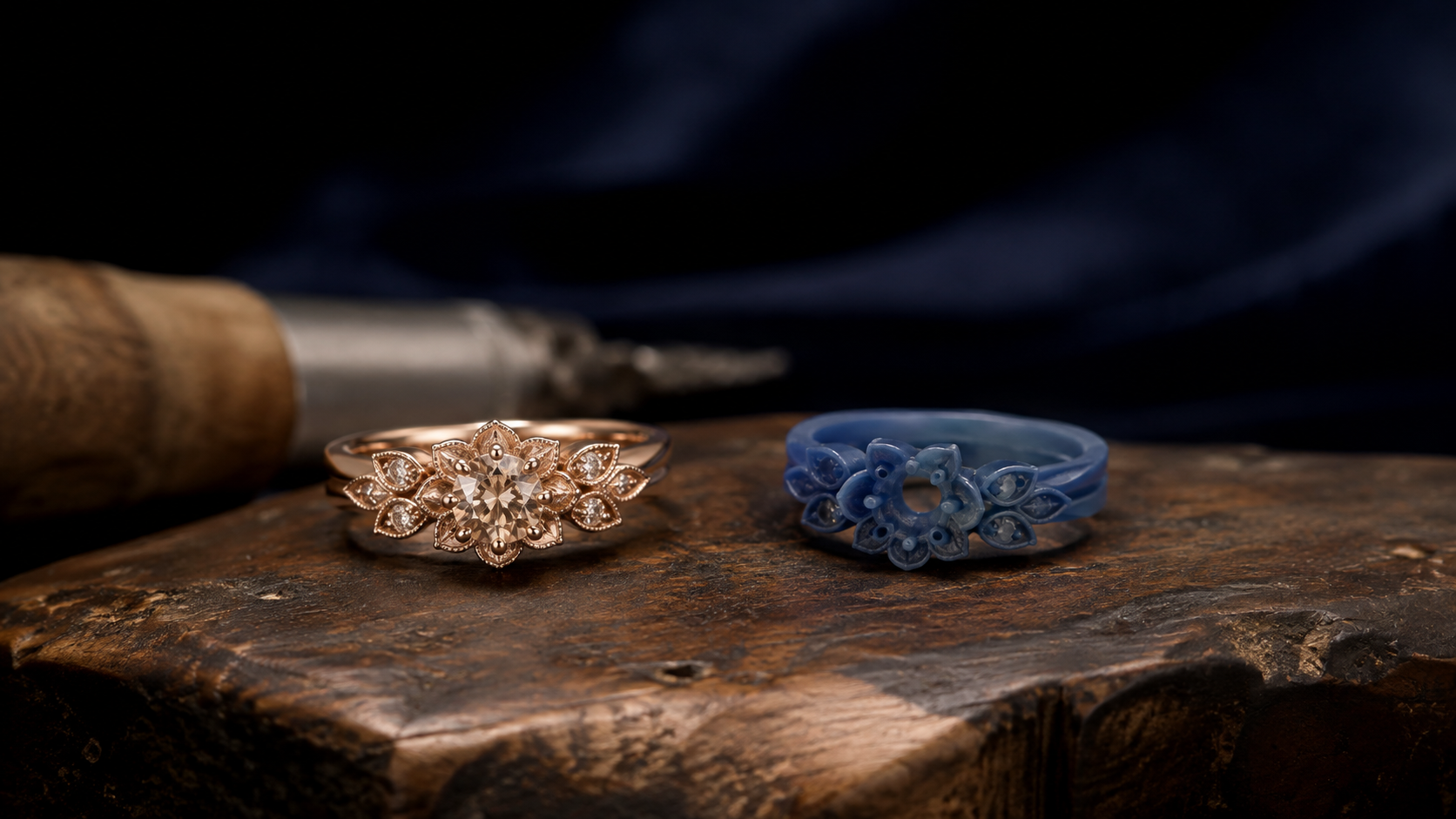
Clients often assume a bespoke ring is carved out of a lump of gold. It is not. Understanding the actual sequence tells you where you still have a say, and where you no longer do.
1. The drawing
Hand-drawn, in the consultation, changed while you watch. Cheap to alter. This is the stage where changing your mind costs nothing, so it is the stage to be difficult in.
2. The CAD model
The approved drawing is built as a three-dimensional model. You see it rendered from several angles, at the real proportions.
Two things get caught here that a drawing hides: how thick the band actually is where it meets the setting, and how high the stone really sits. Flat drawings flatter both.
3. The wax or resin pattern
The model is 3D-printed in a castable resin. This is a physical object, you can hold it, put it on the finger, and see the size and mass in a way no screen conveys.
This is the last cheap moment. A change here costs a reprint. A change after this costs a recast.
4. Casting
The pattern is invested in plaster, the plaster is heated until the pattern burns out completely, and molten gold is drawn into the cavity left behind. This is lost-wax casting, and it is essentially the same process used four thousand years ago, with better temperature control.
What comes out is rough, dull, and attached to sprues. It looks nothing like jewellery yet, which alarms people who see it at this stage.
5. Finishing
The longest skilled stage and the one nobody photographs. Sprues cut away, surfaces filed, then a progression of abrasives from coarse to fine, then polishing. Setting the stones happens here too, the metal of each prong is pushed over the girdle and burnished down.
Most of what makes a piece look expensive is decided in finishing, not in design.
6. Final check and hallmarking
Stones checked for security, dimensions confirmed, piece cleaned and inspected under magnification, then stamped for fineness.
Where the time goes
The making is rarely the bottleneck. Waiting on a particular stone is. If a specific size and colour has to be sourced, that can add weeks on its own, which is why we ask about deadlines in the first conversation rather than the last.
What this means for you
Be demanding at stages one to three. They are reversible and cheap. By stage four your ring exists in metal, and enthusiasm has become expensive.
Book a complimentary design consultation at the C'Garden atelier, The MET Corporate Towers, Kuala Lumpur: 010-766 7448 · hq@cgarden.com.my
C'Garden is an independent bespoke jeweller in Kuala Lumpur. We are not affiliated with, endorsed by, sponsored by or certified by any organisation, laboratory or brand named in this article. Third-party names are used only to refer factually to those organisations and their published standards. All text and imagery in this article is original work created by C'Garden.
Reference
Jewelers of America. (n.d.). Jewelry buying guides. Jewelers of America. https://www.jewelers.org/buying-jewelry/jewelry-buying-guides
All journal entries